

ALMATY – The Astana Times has selected key articles from international media outlets covering Kazakhstan. This week’s foreign media digest highlights Nazarbayev University’s growing global profile, reforms at the National Bank of Kazakhstan, the rapid expansion of the Middle Corridor, regional diplomacy in the South Caucasus, cultural exchanges with China, and efforts to boost domestic food production.
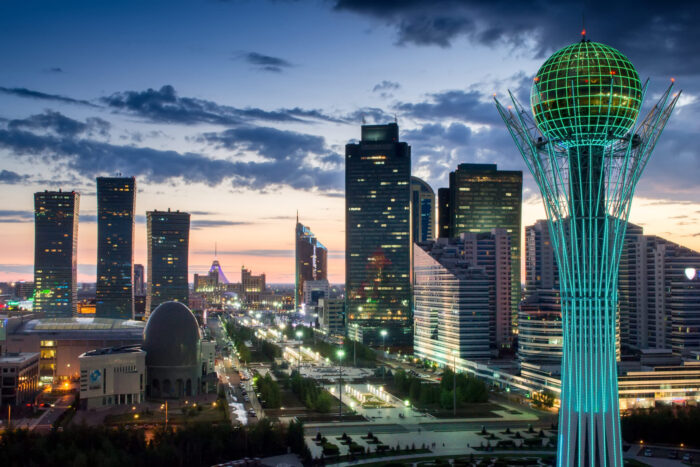
Photo credit: Pavel L Photo and Vide/Shutterstock.
Nazarbayev University emerges as Central Asia’s launchpad for global leaders
Gulf News published a feature on Dec. 25 describing Nazarbayev University (NU) as Central Asia’s leading English-medium university and a launchpad for globally competitive graduates.
The article highlights NU’s autonomous governance model, international accreditations, and strong graduate outcomes, with more than 98% of alumni employed or pursuing further studies within a year. NU ranks first in Central Asia and the Caucasus in the Times Higher Education World University Rankings 2026 and places in the top 23% globally.
University President Waqar Ahmad told Gulf News that NU focuses on developing globally minded leaders rather than replicating Western institutions, emphasizing international faculty, joint degrees, and global research partnerships spanning Asia, Europe, and North America.
IMF supports Kazakhstan’s efforts to strengthen monetary forecasting
The International Monetary Fund (IMF) published a technical summary on Dec. 24 detailing its cooperation with the National Bank of Kazakhstan to enhance monetary analysis and forecasting capacity.
According to the report, an IMF mission assessed existing tools and data systems and recommended developing a robust near-term forecasting framework to support monetary policy decisions. The project, scheduled for implementation in fiscal year 2026, aims to integrate forecasting into the central bank’s broader policy analysis while addressing risks related to staff turnover and training needs.
Middle Corridor growth highlights Kazakhstan’s rising transit role
RailFreight online platform analyzed Kazakhstan’s expanding role in Asia–Europe logistics on Dec. 24, noting strong growth along both the northern route to Poland and the Trans-Caspian Middle Corridor.
Since 2017, container traffic through Kazakhstan has increased sharply, with Middle Corridor volumes growing more than sixfold. The article identifies Kazakhstan as a key driver of this expansion, particularly through the co-managed Xi’an Dry Port in China.
However, rising congestion at border crossings such as Dostyk and Altynkol has created delays, prompting infrastructure upgrades and capacity expansion. Analysts note that while Kazakhstan is cementing its role as a transit hub, efficiency and cost competitiveness remain critical challenges.
Kazakhstan, Azerbaijan reaffirm strategic alliance
The Azerbaijan state news agency reported on Dec. 24 that President Kassym-Jomart Tokayev and Azerbaijani President Ilham Aliyev discussed strengthening their strategic allied relations during a phone conversation.
The leaders highlighted the positive trajectory of bilateral ties and emphasized the importance of reciprocal high-level visits, recalling recent state visits in both directions. They also exchanged views on future cooperation and regional engagement.
Chinese Food Festival showcases cultural diplomacy in Astana
People’s Daily online news agency reported on Dec. 25 that a Chinese Food Festival was held in Astana, drawing residents eager to experience traditional Chinese cuisine, including hand-pulled noodles, Peking duck, and regional desserts.
The event underscored growing cultural exchanges between Kazakhstan and China, complementing broader cooperation in education and trade.
Mangystau plans to cut salmon imports through domestic aquaculture
The Times of Central Asia reported that Kazakhstan’s Mangystau Region aims to replace up to 60% of the country’s salmon imports within five years by expanding marine aquaculture in the Caspian Sea.
Governor Nurdaulet Kilybay said four major projects are planned between 2025 and 2027, with production expected to reach 5,000 tons by 2029. The initiative aligns with Kazakhstan’s broader strategy to diversify its economy and strengthen food security, as domestic fish farming continues to expand nationwide.