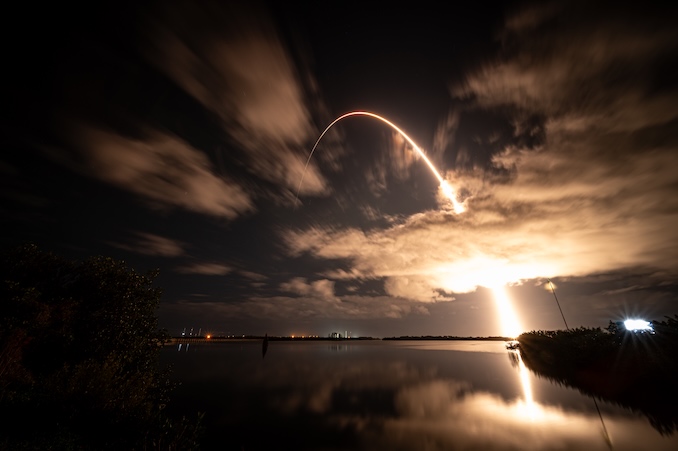
Update Dec. 16, 3:52 p.m. EST (0852 UTC): Successful liftoff of the Atlas 5 rocket and subsequent shutdown of the RL10C-1-1 engine.
United Launch Alliance aced its final launch of 2025, a predawn flight of an Atlas 5 rocket carrying 27 satellites for Amazon’s recently re-branded Leo broadband internet service.
The on time liftoff from Space Launch Complex 41 at Cape Canaveral Space Force Station happened at 3:28 a.m. EST (0828 UTC), as the RD-180 engine on the booster roared to lift alongside five solid rocket boosters. The rocket flew on a north-easterly trajectory upon leaving the launch pad.
The mission, referred to by ULA as Amazon Leo 4 and dubbed Leo Atlas 4 (LA-04) by Amazon, was ULA’s fourth launch for the venture, previously known as Project Kuiper.
ULA opted to forego a launch opportunity Monday morning because of a high winds that caused forecasters to offer little hope for acceptable weather. The 45th Weather Squadron painted a much better picture for Tuesday morning, predicting a 95 percent chance for favorable conditions during the launch window.
On Saturday morning, ULA rolled its 205-foot-tall (62.5 m) rocket, designation AV-111, out of the Vertical Integration Facility to begin the journey of a third of a mile to the pad. It was lowered onto the launch pad piers and completed “hard down” at 11:51 a.m. EST (1651 UTC). Later that day 25,000 gallons of rocket-grade kerosene were loaded onto the first-stage booster.
ULA finished fueling its rocket with liquid oxygen and liquid hydrogen in the hours leading up to liftoff on Tuesday.
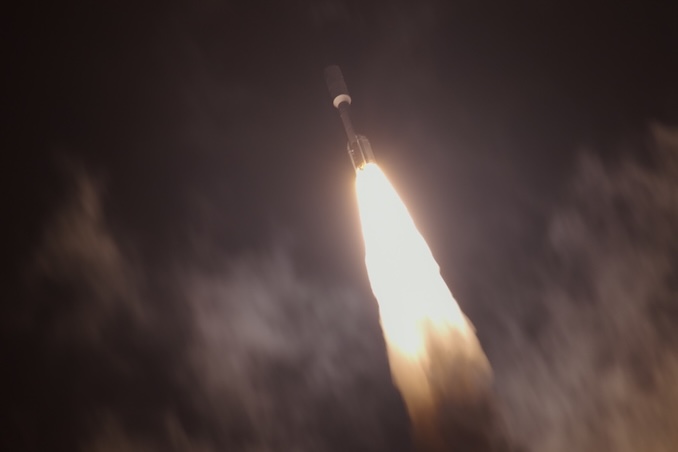
The Atlas 5 rocket flew in the 551 configuration, meaning the main RD-180 engine was supported by five solid rocket boosters around the base of the Atlas booster. Those SRBs jettisoned less than two minutes into the flight.
Roughly 4.5 minutes after leaving the pad, the Atlas booster separated and the RL10C-1-1 engine on the Centaur 3 upper stage began a burn lasting a little less than 13 minutes. A 15-minute-long deployment sequence for the Amazon Leo satellites will begin at about T+20 minutes.
Launch controllers will oversee a final burn of the Centaur’s engine to deorbit it.
Closing out Year 1
This year marked the start of the deployment of Amazon’s operational satellites. Following a successful launch on Tuesday, there will be 180 Amazon Leo satellites in orbit, launched on four Atlas 5 and three SpaceX Falcon 9 rockets. The company is required to deploy half of the 3,200 satellites by July 31, 2026, although it might apply to an extension or waiver for that requirement. The launch of the LA-04 mission will be the final flight of Amazon Leo satellites in 2025.
In early December, Amazon announced that components of the first Ariane 64 rocket sailed from Bordeaux, France, heading to French Guiana for a launch in early 2026. The company purchased 18 dedicated Ariane 6 missions, each carrying 32 satellites.
The satellites, which are manufactured in Kirkland, Washington, were flown to Amazon’s satellite processing facility at NASA’s Kennedy Space Center in Florida before heading onto French Guiana.

The year included other notable milestones, including the rebranding of the constellation from Project Kuiper to Amazon Leo in early November.
The company said it made the change as “a simple nod to the low Earth orbit satellite constellation that powers our network.”
Later in the month, Amazon unveiled its gigabit-speed user antenna called ‘Ultra,’ which it made available to a select group through a preview program. It described the product as “an advanced, enterprise-grade terminal that delivers best-in-class performance for demanding private and public sector applications.”