

Refresh
Gigantic sinkholes in Turkey
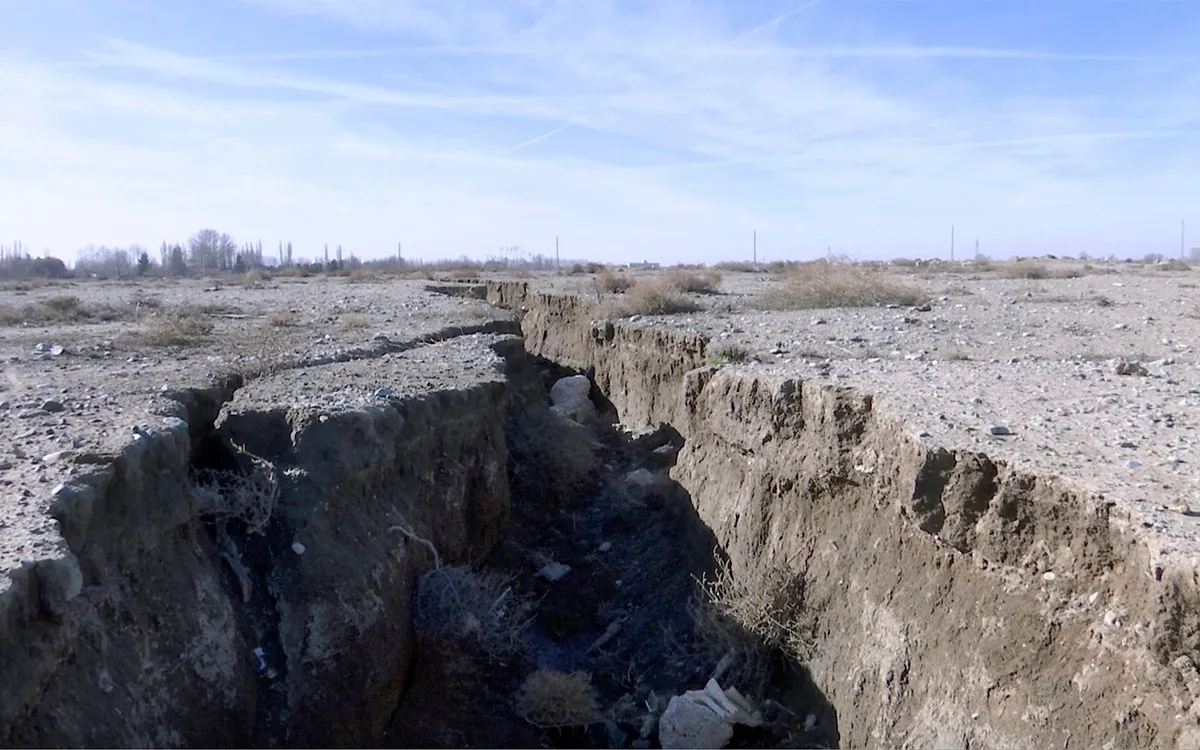
Almost 700 sinkholes have opened up in Turkey due to extreme drought and groundwater extraction.
Turkey’s Disaster and Emergency Management Authority found 684 sinkholes in the country’s wheat-growing region of Konya Plain as part of a recent sinkhole assessment, AccuWeather reports.
The sinkholes began appearing in the 2000s, but this year has seen the emergence of more than 20 new, large sinkholes. Some of the holes are hundreds of feet wide and more than 100 feet (30 meters) deep.
Bury Rex with his favorite dagger
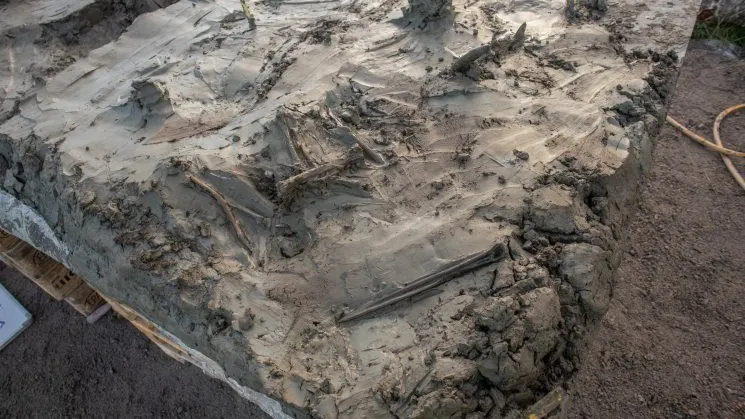
Stone Age fishers buried a dog next to a dagger in a Swedish lake bed, staff writer Kristina reports.
Archaeologists are investigating the mysterious 5,000-year-old burial, which may represent a previously unknown ritual.
The burial was uncovered during a high-speed railway construction project about 22 miles (35 kilometers) southwest of Stockholm. Today, the lake is a swampy bog, but during the Stone Age, it was clear and filled with fish.
You can read the full story here.
Wake up, new 3I/ATLAS preprint just dropped

Good morning, science fans! Patrick here to kick off the day’s science news blog coverage. I want to start with new comet 3I/ATLAS research.
Astronomers have detected a “wobbling high-latitude jet” in everyone’s favorite interstellar object, according to a preprint paper, which appeared on arXiv today.
This is the first time scientists have detected a spinning jet on an interstellar comet, and it may indicate that the comet’s nucleus is rotating rapidly as it moves through space.
Researchers observed the comet from the Teide Observatory on the island of Tenerife in the Canary Islands. Their letter, and findings, have been accepted for publication in the journal Astronomy & Astrophysics.
Comet 3I/ATLAS will make its closest approach to Earth on Friday, so stay tuned.

Patrick Pester
30 models of the universe are wrong

Thirty different cosmological models have been ruled out thanks to years of data from Chile’s Atacama Cosmology Telescope, which winked on in 2007 and shut down in 2022. The telescope’s final data release hints that theoretical physicists may need to go back to the drawing board to explain the Hubble tension, or the fact that the universe seems to be expanding at different rates depending on how you measure it, Live Science contributor and astrophysicist Paul Sutter reports.
To learn more about why the data is so powerful, and why so many models of the universe keep failing, read the full story here.
Thirty different cosmological models have been ruled out thanks to years of data from Chile’s Atacama Cosmology Telescope, which winked on in 2007 and shut down in 2022. The telescope’s final data release hints that theoretical physicists may need to go back to the drawing board to explain the Hubble tension, or the fact that the universe seems to be expanding at different rates depending on how you measure it, Live Science contributor and astrophysicist Paul Sutter reports.
To learn more about why the data is so powerful, and why so many models of the universe keep failing, read the full story here.
Tia Ghose
3I/ATLAS glows red in new X-ray image

The interstellar comet 3I/ATLAS is cruising toward its closest approach to Earth this week (Dec. 19), and the planet’s science agencies are observing it with everything they’ve got.
Images released last week by the Gemini North observatory in Hawaii show the comet taking on a brighter, greener hue after being warmed up by the sun, causing it to leak clouds of green-glowing diatomic carbon gas. Now, the latest 3I/ATLAS image from the European Space Agency (ESA) shows the familiar comet in a new light: red X-rays.
Taken with the XMM-Newton satellite, the images show high-energy X-ray emissions surrounding the comet, with darker blue regions of space behind it. These emissions are the result of charged solar radiation slamming into the comet’s coma — the thin atmosphere of gas that surrounds the comet’s main body and feeds its tail.
Studying these emissions should help scientists better understand what the comet is made of, with gases like hydrogen and nitrogen being especially easy to detect with X-ray telescopes, according to ESA.
The images were taken when the comet was roughly 175 million miles (282 million km) from the spacecraft, which is about as close as 3I/ATLAS will get to Earth this week. In addition to ESA and NASA, dozens of observatories around the world are watching the comet in cooperation with the U.N.’s International Asteroid Warning Network, which tracks transient near-Earth objects.
Stay tuned for more images this week.

Brandon Specktor
Levee fails near Seattle-Tacoma International Airport

A levee has been breached near Seattle-Tacoma International Airport, prompting the National Weather Service in Seattle to issue a flash flood warning for the populated area of about 46,000 people.
The Green River breach happened in the city of Tukwila, which is around 11 miles (17 kilometers) south of Seattle. The area also has one hospital and two schools.
“Leave immediately if you are in this area,” Washington Governor Bob Ferguson stated, according to mynorthwest.com. “Conditions are dangerous and access routes may be lost at any time … Do not drive or walk through standing or moving water. Turn around, don’t drown. Do not drive around barricades or road closures.”
Atmospheric rivers have pummeled the areas around Seattle for the past week and into this one, stranding people on the roofs of their cars and houses. In the Pacific Northwest, atmospheric rivers “are long, narrow storm systems that cross the Pacific Ocean,” KUOW environment reporter John Ryan reported. “They funnel moisture up from the subtropics, hence their local nickname the Pineapple Express, and they’re perfectly normal this time of year and how the Northwest gets a lot of its winter precipitation. But the bigger atmospheric rivers, they do cause flooding.”

While it’s unclear if climate change is driving the current atmospheric rivers, studies have found that a “hotter climate will mean more frequent atmospheric rivers and rivers that last longer and deliver more rain,” Ryan said. “And that’s because, really simply, that warmer air can hold more water, and then it can unleash more of that water when it’s time to rain, and that’s expected to drive more flooding. And as the climate warms, we’ll also be expecting more precipitation in our winters coming as rain instead of snow. And snow, of course, melts slowly over months, but rain can run off instantly and cause big flooding.”
I’m from Seattle, so I’ve been keeping an eye on the horrific flooding that’s been happening in the region. I’ve seen videos of a house being swept away in fast currents, the famous Snoqualmie Falls bursting at its seams, elk swimming across a flooded field by a middle school, and people kayaking along waterways that were once streets. It’s heart wrenching to see, and I’m hoping everyone in the region is staying as safe as they can.

Laura Geggel
Tanning beds uniquely harmful to skin

Tanning beds are especially harmful to skin, a new study in the journal Science Advances suggests.
The study analyzed the medical records of around 32,000 patients who had visited a dermatology clinic at Northwestern University. Of these, more than 7,000 reported using tanning beds.
The team looked at a subset of the tanners and compared them with folks who did not use tanning beds. After controlling for various factors, such as risk factors for the deadly skin cancer melanoma, the team found that using tanning beds multiplied the odds of developing melanoma by a factor of 2.85. There was also a subtle-sign of causality — a “dose-response” relationship whereby more tanning led to higher risk.
They also took biopsies from 11 of the tanning bed users in the study, who went to a “high risk” skin cancer clinic, as well as from six cadavers, who presumably had normal risk of skin cancer. They then looked for molecular signs of DNA damage in the skin. They compared those against data from a vast database of people, known as the U.K. biobank.
Tanning seemed to induce unique signatures of DNA damage that were somewhat different from those due to general sunlight exposure. And tanning beds exposed more of the skin to UV light, as well as exposing skin not typically exposed to high levels (presumably because people tan their whole body in such beds, versus wearing coverups or swimsuits outdoors).
Young people who tanned frequently also had more mutations in their skin than people who were twice their age, the study found.
“We found that tanning bed users in their 30s and 40s had even more mutations than people in the general population who were in their 70s and 80s,” study co-author Bishal Tandukar, a postdoc of dermatology at the University of California, San Francisco, said in a statement. “In other words, the skin of tanning bed users appeared decades older at the genetic level.”
Tia Ghose
Enormous genetic study groups psychiatric disorders

Live Science contributor Clarissa Brincat just covered the largest genetic analysis of psychiatric disorders to date. The study, which included data from more than 1 million people, found shared genetic profiles that unite different psychiatric disorders. Across 14 disorders — including anorexia, OCD, schizophrenia and ADHD — the analysis revealed five distinct groups that share similar genetics.
Some of these shared genetics point to shared biological mechanisms that may underpin the disorders. For instance, depression, PTSD and anxiety fell into one group that included genes associated with glia, the brain’s nonneuronal support cells. That may hint that glia play a key role in the manifestations of each of these disorders.
However, an expert told Live Science that it’s important to remember that correlation does not equal causation; a gene variant being linked to a given disorder doesn’t mean it’s a cause of that disorder. The genetics of psychiatric conditions are very complex, in that they interact with a person’s environment and their experiences. Additionally, the genes tied to disorders can also be tied to traits like creativity or intelligence — it’s not as if there’s a “depression gene” or “PTSD gene” that does only one thing.

Nicoletta Lanese
New pumpkin toadlet is so smol!

A newfound species of pumpkin toadlet has caught our eye. Researchers announced the discovery in the journal PLOS One mid-last week, but we think it deserves a shout-out today.
The frog lives in the mountains of southern Brazil and belongs to a group of miniaturized diurnal (awake during the day) frogs called Brachycephalus, some of which are pumpkin colored — hence the name, “pumpkin toadlet.”
The Brachycephalus genus boasts the smallest known vertebrate in the world: A species known as B. pulex, whose females average just 0.32 inch (8.15 millimeters) in length and whose males are even shorter, at 0.28 inch (7.1 mm), which is smaller than a human fingernail.

This latest addition to the pumpkin froglet clan is a bit bigger, with a body length of up to 0.53 inch (13.4 mm). The frog is bright orange, as you’d expect, but distinguishes itself from other pumpkin froglets with small amounts of green and brown at irregular points on its body.
The researchers who made the discovery want the frog’s territory in the Serra do Quiriri area of Brazil to be protected to safeguard its future, as well as other unique species that live there.
You’ve got to imagine that the researchers wanted this pumpkin toadlet study out closer to Halloween. Ah, well, it’s a winter treat.
3I/ATLAS Hulks out

Speaking of 3I/ATLAS, Brandon reported on Friday (while the blog was down) that the interstellar comet is changing hues as it approaches Earth.
Atop Hawaii’s dormant Mauna Kea volcano, the Gemini North telescope confirmed that comet 3I/ATLAS has become greener and brighter since flying past the sun in late October.
Our home star heated up the interstellar object and, in doing so, made it much more active.
Find out what’s driving the comet’s greenish hue by reading the full story here.
All eyes on 3I/ATLAS
The interstellar comet 3I/ATLAS makes its closest approach to Earth this week, coming within around 167 million miles (270 million kilometers) of our planet on Friday (Dec. 19).
Astronomers worldwide are studying the comet, which is only the third interstellar object ever recorded in our solar system and potentially the oldest comet ever seen.
But it’s not just space agencies getting in on the action. The United Nations’ International Asteroid Warning Network (IAWN) is about halfway through its 3I/ATLAS observing campaign, Live Science contributor Elizabeth Howell reports.
This is the first time that the IAWN network’s observing campaigns have tracked an interstellar object.
To learn why, read the full story here.
Geminid meteor shower gallery

The Geminids above Yosemite National Park in California.

A meteor zooms across the night sky above Ulanqab, Inner Mongolia, in China.

Back to Yosemite National Park for another striking meteor snap.

The Geminids above Yamdrok Lake in Tibet, China.

Here, a meteor appears as a horizontal dash across the night sky. This is the third photo taken by Tayfun Coskun at Yosemite National Park.
Geminids peak

Did you catch any meteors this weekend? The Geminid meteor shower peaked on Saturday night and Sunday morning in a near-moonless sky, making it perfect conditions for capturing the spectacle on camera.
The Geminids represent the most prolific meteor shower of the year. While the shower has been ongoing since Dec. 4, the best time to see its meteors was supposed to be overnight on Saturday through Sunday.
I didn’t see any because I was busy and unwilling to brave the cold. If like me you missed them too, we’ve still got a few more days to brave the elements — the Geminids will remain active until Dec. 20. I’ll also pull together a little gallery of some of the best images from the Geminids’ peak to mark the event.
If you want to learn more about the Geminids, check out our 2025 Geminids meteor shower guide by skywatching expert Jamie Carter.
Little Foot is a near-complete Australopithecus skeleton — the most complete ever discovered — from South Africa. Researchers first unveiled the small ancient human in 2017, but precisely where it sits on our family tree has been the subject of scientific debate.

Some have proposed that Little Foot is a previously unknown species and should be given the name Australopithecus prometheus. However, A. prometheus is a recycled name that was initially meant for another South African fossil discovered in 1948, but fell out of favour after researchers decided that the fossil was likely from the known species Australopithecus africanus. Another possibility was that Little Foot was also A. africanus.
The new claims derive from a study published last month in the American Journal of Biological Anthropology. Here, the research team argues that neither A. prometheus nor A. africanus is an appropriate classification for Little Foot.
The classification of human fossils is often contested, so I’m keen to see how other anthropologists react to the new study and will follow up with more information as it emerges.

Patrick Pester
You must confirm your public display name before commenting
Please logout and then login again, you will then be prompted to enter your display name.