


Update Dec. 27, 5:56 p.m. EST (2256 UTC): SpaceX scrubbed the launch due to a ground issue, targeting Sunday, Dec. 28.
SpaceX was preparing for its final Falcon 9 flight of the year, but had to scrub the mission due to a ground systems issue at its launch pad at Vandenberg Space Force Base in California.
When it launches, the 70-meter-tall rocket will carry an Earth observation satellite for Italy to low Earth orbit.
The Cosmo-SkyMed Second Generation Flight Model 3 (CSG-FM3) satellite nestled in the rocket’s payload fairing is an Earth observation satellite that serves dual purposes for the civilian and military sectors of the Italian government.
Liftoff is scheduled from Space Launch Complex 4 East (SLC-4E) at 6:08 p.m. PST (9:08 p.m. EST / 0208 UTC). A new launch date and time haven’t been announced yet by SpaceX.
Spaceflight Now will have live coverage beginning about 30 minutes prior to liftoff.
SpaceX will launch the mission on Falcon 9 booster tail number, 1081. This will be its 21st flight after launching missions including Crew-7, PACE and TRACERS, all for NASA.
Nearly 8.5 minutes after liftoff, B1081 will target a touchdown at Landing Zone 4. If successful, this will be the 31st landing at that site in total and the 554th Falcon booster landing to date.
The CSG-FM3 satellite will be deployed roughly 17 minutes after leaving the launch pad.
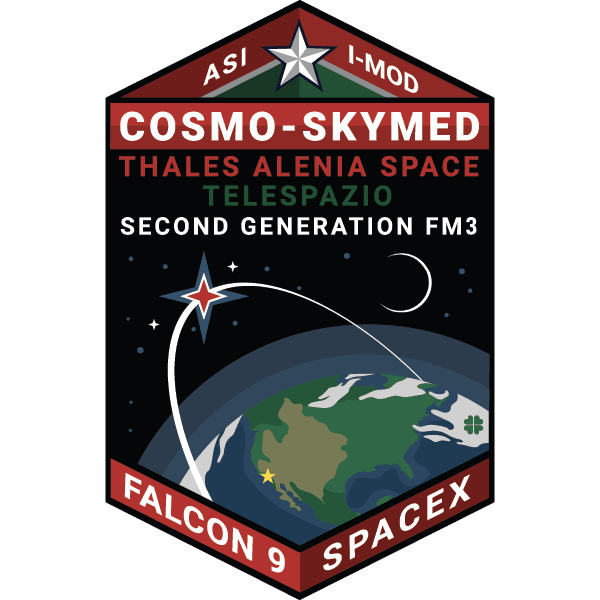
CSG-FM3 is the third in this series of Earth observation satellites managed both by the Italian Space Agency and the Ministry of Defense.
The first of these satellites launched in January 2021 on a Soyuz rocket from French Guiana and the second a year later on a Falcon 9 rocket from Cape Canaveral Space Force Station.
A total of four satellites, manufactured by Thales Alenia Space, are planned for constellation.
Designed to meet the requirements of both commercial & institutional customers, COSMO-SkyMed Second Generation dual-use system is a crown jewel in @Thales_Alenia_S ‘s fleet of #radar observation satellites. Check-out this stunning 📹 for more info. @ASI_spazio @MinisteroDifesa pic.twitter.com/rZ9zAymSBl
— Thales Alenia Space (@Thales_Alenia_S) December 15, 2020
The spacecraft are equipped with synthetic aperture radar (SAR) that operates in the X-band, which can penetrate clouds and capture imagery in darkness. They operate in a Sun-synchronous polar orbit inclined at 97.87 degrees to the equator. The satellite’s data is made publicly available through the European Space Agency’s (ESA) Third Party Missions Programme.
“Cosmo-SkyMed Second Generation’s purpose is to monitor the Earth for the sake of emergency prevention, strategy, scientific and commercial purposes, providing data on a global scale to support a variety of applications among which risk management, cartography, forest & environment protection, natural resources exploration, land management, defense and security, maritime surveillance, food & agriculture management,” ESA said in a statement.