

Update 2:40 p.m. EST (1940 UTC): SpaceX confirmed deployment of the 29 Starlink satellites.
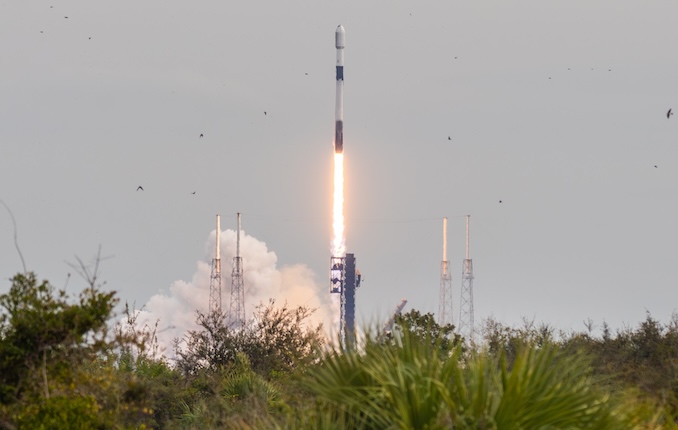
SpaceX’s launch of its Falcon 9 rocket Wednesday afternoon broke the turnaround record at its launchpad at Cape Canaveral Space Force Station by more than five hours.
The Starlink 6-98 mission lifted off at 1:08 p.m. EST (1808 UTC), just 45 hours after the launch of the Starlink 6-97 mission at 4:08 p.m. EST (2108 UTC) on Monday.
The previous record, set in December 2025, was 50 hours and 44 between the launches of NROL-77 and Starlink 6-90.
“The rocket was actually ready to fly at roughly 40 hours, but we needed to wait for the optimal deployment t-zero. Love seeing us continue to improve on our speed, efficiency, safety and reliability!” said Kiko Dontchev, SpaceX Vice President of Launch, wrote on social media after the Starlink 6-90 launch. “We once thought it was crazy town to launch from the same pad in two days. Now it feels crazy not to be launching from the same pad multiple times a day. Physics is the only constraint. Everything else is just an engineering challenge waiting to be solved.”
The Starlink 6-98 mission added another 29 Starlink V2 Mini Optimized satellites to the low Earth orbit constellation. This was SpaceX’s fourth Starlink mission of 2026 and its sixth Falcon 9 rocket launch of the year.
SpaceX launched the Starlink 6-98 mission using the Falcon 9 first stage booster with the tail number 1085. This was its 13th flight after flying missions, like Crew-9, Blue Ghost Mission 1 and Fram 2.
Nearly 8.5 minutes after liftoff, B1085 landed on the SpaceX drone ship, ‘A Shortfall of Gravitas.’ This was the 139th landing on this vessel and the 559th booster landing for SpaceX to date.