
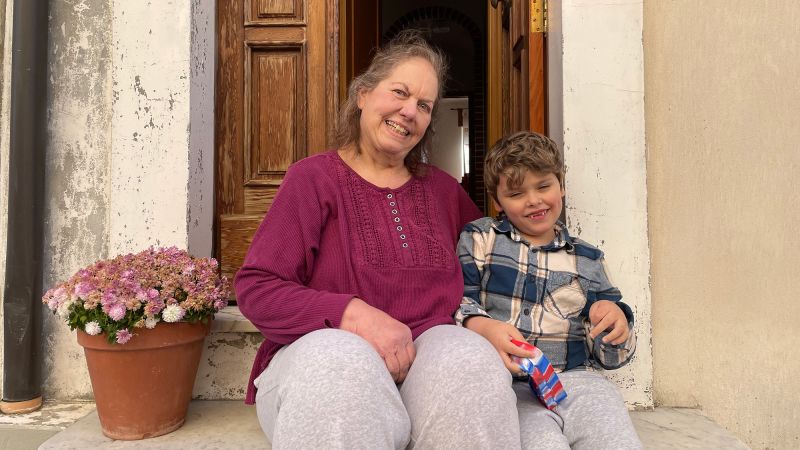
When Lynnette Elser, from Crossville, Tennessee, first arrived in the Italian village of Latronico with her 5-year-old adopted autistic son Kenny, she wasn’t planning on making it her new home.
Then, on their first night, Kenny, who has serious respiratory issues, seemed able to breathe without difficulty for what Elser, a retired federal government scientist, says was the first time ever.
Normally, she would check his blood oxygen level with a fingertip pulse monitor during the night when she heard him struggle to breathe, but in Latronico something was different.
“Truthfully, I thought his blood oxygen meter was broken and not reading the oxygen level correctly,” Elser says. “I switched monitors and it was still a good reading. Then that night as his breathing was steady I was just amazed watching him breathe and not trying to put his head higher on the pillows.”
As Elser kept vigil, Kenny’s blood oxygen level stayed steadily above 95%. His heart rate was normal.
“It is horrible watching a child not able to breathe, struggling with each breath, the oxygen level in his blood not going up, and with his heart beating at over 250 beats a minute,” she says. “When we were in Latronico he did not struggle to breathe, sucking in air.”
Seeing her son’s health improve, it struck Elser that Latronico, a small hill town of about 4,500 people in Italy’s southern Basilicata region, must become their new permanent home.
Elser was originally drawn to the town after reading a CNN article about the town’s affordable housing program aimed at luring new buyers and reversing a depopulation trend caused by decades of people leaving the area in search of employment. It’s one of numerous rural places across Italy that have offered homes for sale at cheap rates.

In September 2024, Elser bought an old 100-square-meter refurbished house in Latronico, sight-unseen, on the town’s online platform for 50,000 euros — about $59,000.
She was planning to use the upper-story property simply as a vacation home and enjoy a non-touristy, peaceful place close to the sea and mountains, surrounded by nature.
But when she and Kenny visited to finally see what they had actually bought in the historic district, everything changed.
On that same first visit, she ended up buying the vacant property below to enlarge the house into a four-story dwelling. She’s currently finalizing the renovations.
Kenny had been hospitalized multiple times in the US for respiratory issues and has multiple special needs. He is autistic and nonverbal, with severe developmental delays and allergies, and a history of low blood oxygen levels that frequently drop below 90% — a situation that typically requires medical intervention.
Elser believes it’s the “healing” location of Latronico that now helps Kenny breathe at night. The town is high enough up on the hills to be above forests and tree pollen, with fresh air, few cars and no smog — conditions that would typically present a lower-risk environment for those with respiratory ailments.
Rosalia Loresco, a doctor and pediatrician based in Latronico, says she’s seen other people with respiratory conditions benefit from the region’s clean air.
“Many patients with asthma and respiratory conditions report improved breathing comfort and overall well-being during their stay in this area,” she says.

As the property sale was going through, Elser kept thinking about how easily Kenny could breathe in Latronico and filed the paperwork to make it their main place of residence, which also allows her to avoid taxes normally levied against second homeowners.
She and Kenny are currently living in their original property in the town, which consists of two upper floors with two large bedrooms. It was already habitable at the time of purchase, requiring only minor fixes like upgraded heating and electrics, air conditioning, an external water-resistant coating, and energy-efficient windows and doors.
The other 83-square-meter property on the two lower floors, one almost below street level, requires more work. It cost 18,000 euros and was previously used to house pigs. Elser is spending 63,000 euros to convert it into a livable space with two bedrooms, bathrooms, a kitchen, plumbing and electricity. The restyle, 95% done, is scheduled for completion in summer 2026, when the outside walls will be repainted.
Once the two properties are united, they’ll cover 183 square meters, with a front porch and multiple balconies offering mountain and valley views. Elser also plans to buy a nearby garage. The space will mean Kenny can have his own indoor playroom.
“Money was never an issue,” she says. “I have always worked to be able to buy what I wanted. If I could not afford something I just worked more and waited. So, I definitely looked at the price of the house and the costs to improve the house, but I was more focused on the quality of life.”

In March 2025, Elser applied for an elective residency visa — which requires a passive income of 31,000 euros per person — and made the move to Latronico, with Kenny, in July. In the spring, she plans to enroll Kenny at the village school and is completing paperwork to ensure he will get full support.
Elser believes he will cope better in Latronico’s classrooms, with far fewer pupils with special educational needs than those in Tennessee, a situation that meant he made little progress there.
She says she and her son have already integrated into Latronico’s tight-knit community in just a few months, interacting with locals as they spend their days walking in parks and shopping at stores.
People call Kenny “bellissimo angelo” — “most beautiful angel” — she says. At the grocery store, they give him candy bars and holiday treats. Most of the shopkeepers know some English or use a translator app to communicate when necessary.
“So many times shopkeepers went out of their way to help me find the correct thing,” Elser says. “Neighbors walking down the street will say ‘buono’ and do a thumbs up as they see the new tiles on the walkway or the new window.”
The welcoming village is a sharp contrast to Crossville, where, she says, her neighbors were more likely to offer complaints than compliments and any visit to the store involved a 20-minute drive.
“People seem more satisfied with their life,” she adds. “I understand that a lot of the youth have moved away to places where the economics can help them get more but the people remaining seem happy and not in that constant competition mindset.”

At home, they practice occupational therapy exercises, with special grip crayons, puzzles and special toys. Once a week, they drive to a larger nearby town to buy items like printer ink or furniture. The tranquil pace of life in the town also helps Kenny avoid getting overstimulated, a common source of stress for autistic people.
“We are happy with our calm and routine life. When he starts going to school, I will focus on learning Italian because I eventually will need to pass a driver’s license test, and I will start doing some of my hobby crafts like quilting,” she says.
Kenny’s diet has also improved. He loves having carbs for breakfast like a croissant or pastry rather than a protein-heavy US-style meal with eggs, ham or bacon. The cost of living is significantly lower than in Tennessee, especially when it comes to food prices. Many prescription medications can be obtained free of charge under Italy’s public healthcare program.
Elser says that she enjoys a simpler way of life in Latronico, with fewer visible signs of consumerism. She doesn’t currently have a TV and says Kenny is fine with that.
“There is a lot less impulse buying. Everything we need is in town,” she says.