

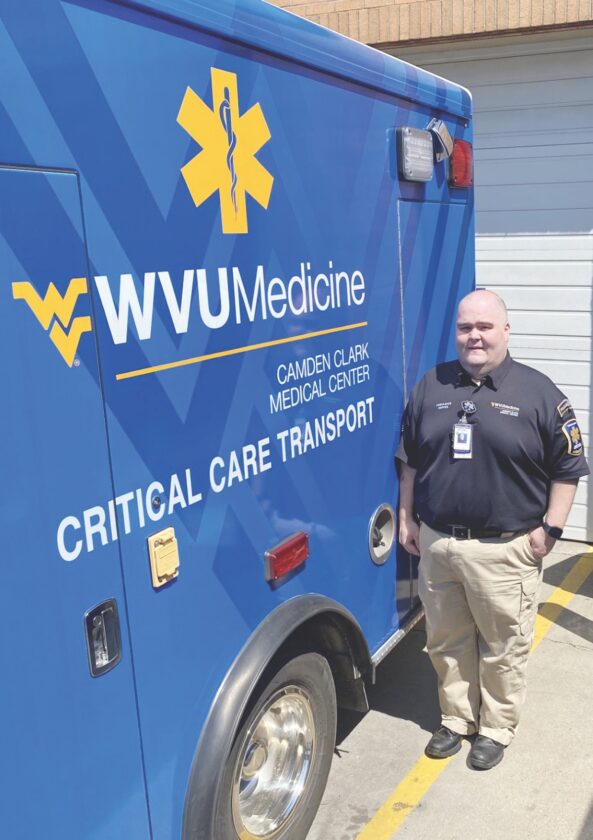
Michael Leggett of the Camden Clark Ambulance Service recently completed a 12-week training course (through HealthNet) as a critical care transport nurse. He is the first critical care transport nurse for the Camden Clark Ambulance Service. (Photo by Brett Dunlap)
PARKERSBURG — A desire to help others has driven Michael Leggett to continue his education so he can do as much as he can when responding to an emergency as part of the Camden Clark Ambulance Service.
Leggett, 39, started as an emergency medical responder around 2008 after he went to a local football game in his native Ritchie County and saw the ambulance crew there covering the game. He started asking them questions about what working in the emergency medical service was like. They told him to volunteer and work with a crew and build up his experience.
“I did and I am still doing it,” he said. “I just liked being able to help people.
“It is rewarding. You never know what kind of call you are going to get.”
During his career, he received training to be an emergency medical technician (which he worked for six years), then he was an EMTI (for one year) and became a paramedic in 2015. He recently completed a 12-week training course (through HealthNet) as a critical care transport nurse and took the test last October. He also worked as an emergency nurse for three years in the Camden Clark emergency room having an associate degree in nursing from Washington State College of Ohio.
“I love learning,” he said. “Anything I can do to help I like to do.
“This is just another stepping stone to help me further my education to help to provide better care to my patients. The more I train, the more I feel like I am able to help.”
He also serves as a volunteer firefighter and the chief of the Pennsboro Volunteer Fire Department.
All forms of emergency medical responders can do a variety of first aid assistance with injuries and so on.
Training and certifications deal with what someone is able to do more in depth out in the field. An EMT can administer some basic meds, like nitro, oxygen and be able to transport patients to the hospital. They have to have orders from the medical command to be able to administer those. Now, with recent changes, they can administer those under conditions that fall within their established protocols, guidelines on how patients can be treated under certain circumstances.
EMTIs can administer IVs and give a lot of medications with permission from the medical command. They could give certain medications if someone is in cardiac arrest. Paramedics are able to do EKGs and use defibrillators, if needed, as well as some medications that can “jump start” someone’s heart and other things to get the heart back in a normal rhythm.
Being a critical care nurse, he is able to transport “the sickest of the sickest.” They transport a lot of intubated patients from hospital to hospital. If the patient is on three or more meds (including sedation medication and others to help keep their blood pressure stable) and also on a ventilator they have to be accompanied by a critical care nurse on the ambulance. They also have access to arterial lines and balloon pumps on their critical care truck.
He can also RSI (rapid sequence intubation) patients on transfers. RSI is where there is a combination of medications to keep the patient calm and intubate them to control their airway. It is used when someone is under respiratory distress, tired and having trouble breathing on their own and the critical care nurse is helping them to breathe without having to bag them all the time.
Camden Clark Ambulance Service is one of the only ambulance services in the area who are qualified to RSI patients, said Shawn Marshall, director of Camden Clark Ambulance Service. Over the last six months they have done 10 RSI procedures, he added.
Leggett is the first critical care nurse with the Camden Clark Ambulance Service. They will be getting another one soon.
Every call an ambulance goes on is different.
They can go from someone just not feeling well to someone with a multi-system trauma and they are trying to keep someone alive, Leggett said.
In the last six months, he has had four saves in the field where someone went into cardiac arrest and their crew was able to get them back. Of those, he had three or four walk out of the hospital and were talking to him within a couple of hours of getting them to the hospital.
In many cases, Leggett can be dealing with the sickest of the sick patients and people who have been intubated.
He prefers to do his work in an ambulance that is sitting still. He doesn’t have to keep sending someone back and forth to the truck to get something and he has access to everything in his truck.
“I have what I need,” he said. “I have everything within reach. I don’t have to stop and delay care by having someone go and get something I need. Seconds matter.”
There are times when they have to work while the ambulance is in motion.
“Sometimes we have to make those hard decisions,” Leggett said.
His recent training got him to think critically at a higher skill level than what they were already performing at.
Many people who are part of a crew on an ambulance regularly see people at their lowest and in the worst times.
“Helping someone is a really good feeling in knowing that you are able to help someone,” Leggett said. “Just knowing that you were able to help them. It is a different type of joy. We see people at their worst. Knowing that we are there to help them, it is just rewarding.”
However, there are times when they have done everything they can do and it was not enough. He has had to go on calls involving someone he knows or the family of people he knows where someone ended up dying.
“That is rough,” Leggett said. “You have to learn to deal with the bad and the good. You hope for the best but not everything is going to work out the way you hope.
“You may get someone you know. You have to put it to the side and do the job.”
They do have to make sure they do deal with it. He credits Camden Clark with having counseling services available to help people through those times.
“That is a great asset to being here,” he said.
As far as the future, Leggett said he is as high as he can go with the emergency medical services. He has thought about getting his bachelor’s degree in nursing with the possibility of being a nurse practitioner.
“I thought about it, but I haven’t put a lot of thought into it right now,” he said. “I am content where I am at right now.
“Maybe down the road, it will be a possibility.”
Leggett admits he doesn’t like talking about himself as so many in the emergency medical service are out there every day helping others.
“I don’t do this for recognition,” he said. “I do it because I want to help people.”