
WENATCHEE — When Mary Big Bull-Lewis founded the Indigenous Roots and Reparation Foundation, or IRRF, she imagined a community space for all Indigenous peoples to gather together.
“I grew up here in Wenatchee with not a lot of acknowledgment or opportunities to learn cultural things,” she said.
Big Bull-Lewis is an enrolled member of the Colville Confederated Tribes and a descendant of the Blackfoot Tribe. The Wenatchi (p’squosa) Tribe is not federally recognized and is under the governance of the Colville tribes. When IRRF was founded, the mission was to bring people back to their homelands.
“A lot of our relatives were pushed out from this area either to the Colville Reservation or the Yakama Reservation or even further, and so we’re kind of displaced,” Big Bull-Lewis said. “This vision for starting like this cool outdoor kind of culture camp kind of came about our first year.”
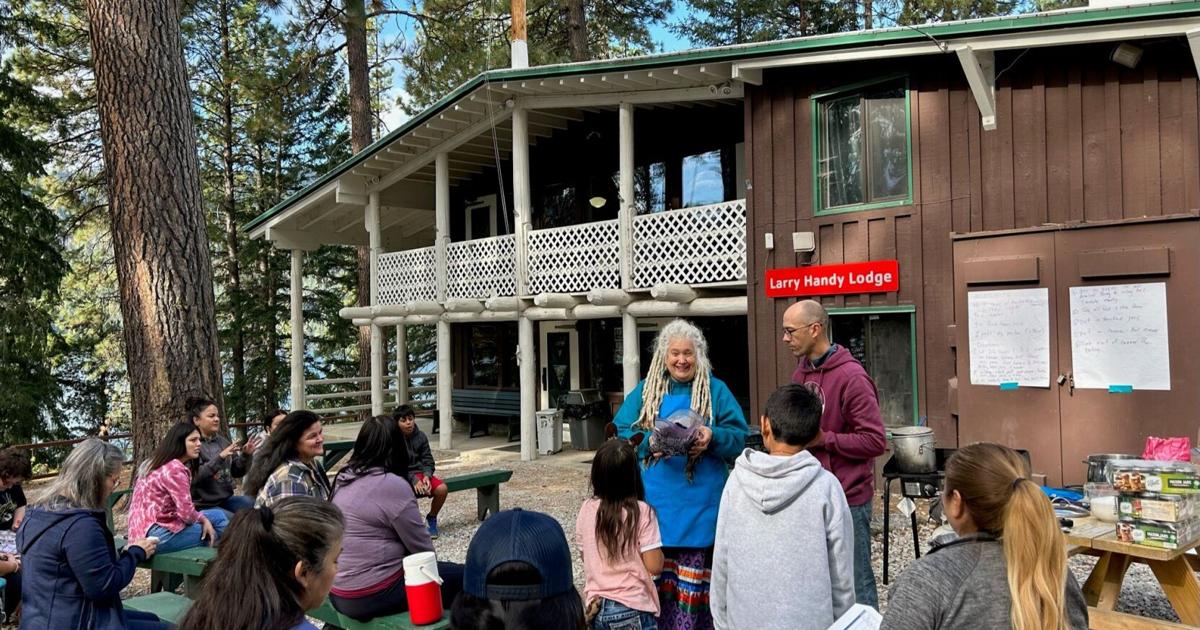
The third annual Huckleberry Camp was held in mid-September at the YMCA Lake Wenatchee Camp in Leavenworth. This year, registration opened to 130 tribal members and descendants from an infant to a 70-year-old. It filled up in less than 18 minutes. One family brought three generations.
IRRF co-chair Amanda Keewatinawin is an enrolled member of the Chippewa Cree Tribe in Rocky Boy, Montana and has attended Huckleberry Camp the last two years.
Keewatinawin explained that she wasn’t exposed to her culture growing up. The first year she attended Huckleberry Camp, she had recently lost her brothers and was working through her grief and attempting to reconnect with her heritage.
“It has been hard to find people to connect with, and it was one of the most welcoming environments that I’ve ever been in,” she said.
The crafts are no cost for the teachers. IRRF pays an honorarium to teachers for crafting supplies and they give out gas cards to those travelling to the camp. In the future, IRRF is hoping to host multiple camps with different cultural focuses.
“We want to reduce all barriers because there shouldn’t be barriers to learn your culture,” Big Bull-Lewis said.
Huckleberry Camp is also one of the first places Keewatinawin was able to teach a beaded earring class. Along with that, campers were also able to make drums, rawhide purses, weave baskets and enjoy a puppet show.
Big-Bull Lewis explained stories like Keewatinawin’s are not uncommon. Big Bull-Lewis’ uncle, Randy, is a local Indigenous leader. She explained he says Indigenous peoples have a sacred circle that has been broken with colonization, residential schools and in that time, they have lost their languages and culture. At Huckleberry camp, Big Bull-Lewis said they are “rebuilding that circle.”
“Every year when we’re done with camp, we just kind of sit in those feelings and that healing moment of like how good it is to be in community with each other, to have good conversations, to have healing conversations, and just feel comfortable in a space that is made for us,” she said.