

Control groups heard similar news stories about flooding, but were shown still photographs of places both familiar and unfamiliar. They did not report caring in the same way as those who were immersed in VR.
Bailenson is the founder of Stanford’s Virtual Human Interaction Lab, a research center studying the psychological and behavioral impacts of virtual and augmented reality, the latter of which overlays digital images onto the real world. He’s worked on experiments aimed at increasing people’s focus on climate change for more than a decade, having found some success. His team discovered that when people put on a VR headset and cut down a tree, feeling the vibration of the chainsaw, they use less paper afterward.
He’s also spent years and “hundreds of thousands of dollars” building virtual reality films that place the participant underwater, witnessing ocean acidification. When people put on the headset, these experiences changed their attitudes and behaviors. But when researchers installed the VR in a museum or other exhibit, people chose not to engage: It was too much doom and gloom.
The idea to simply travel to a new place through VR, hover above it, and check it out as a way of building a sense of connection came from the mind of Monique Santoso, a third-year doctoral student in Stanford’s communication department.
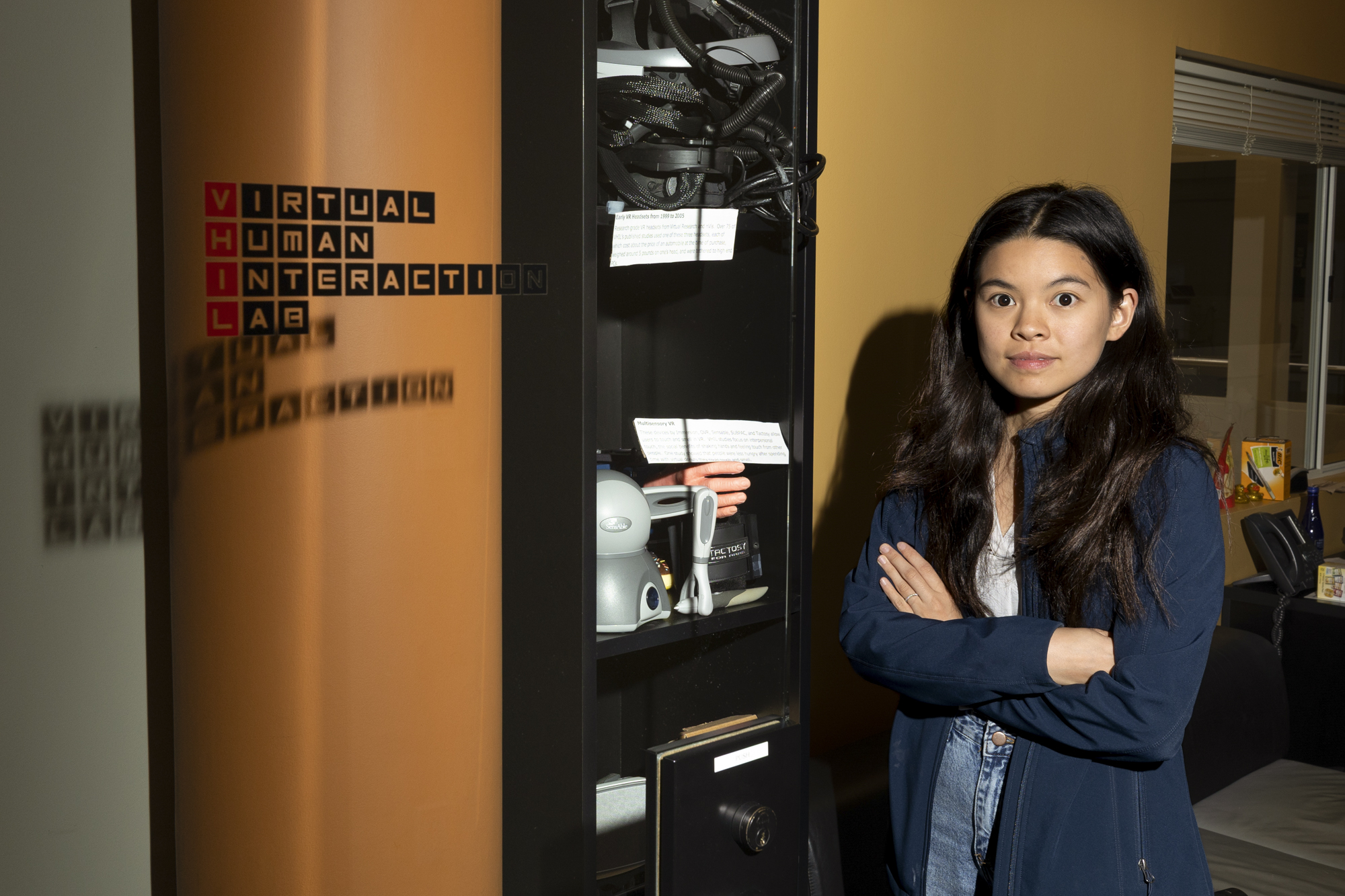
“I’ve always been very fascinated with this idea of psychological distance,” Santoso said. “What exactly is it that makes these issues that are actually very important seem super far away from us?”
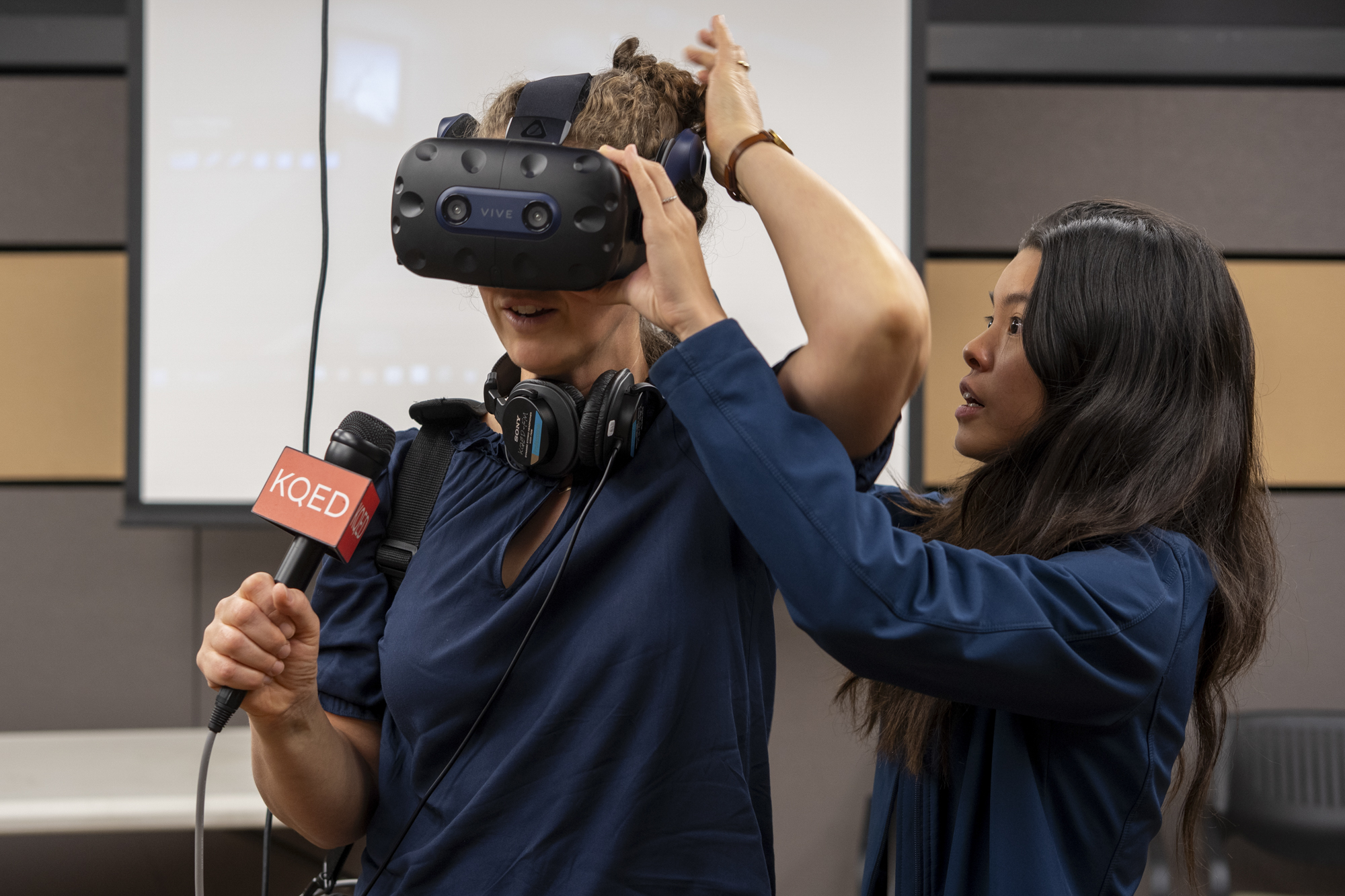
Santoso and her team, including her advisor Bailenson, used preexisting tools that are low-cost or free, like Google Earth and Google Fly, a VR app that allows you to explore the world by flying above it, plus a headset, to send people to another location.
With these tools, “you can poke your head over your neighbor’s fence and see what’s on the other side. You can fly through New York City,” Bailenson said.
When coral bleaching feels personal
Santoso’s idea came from her own life experience. She grew up in a small coastal community in Indonesia. Her backyard was a beach, and she spent hours scuba diving. She was deeply aware of ocean acidification and its effects on the coral she loved.
But when she went abroad to an international high school in Armenia, she was baffled when other people didn’t want to talk about climate change and its consequences, despite studying it in class.
“I think people just felt like it was not applicable to them,” Santoso said. She got her undergraduate degree from Middlebury College in Vermont, and further realized how far climate change was from people’s minds. Disheartened, Santoso looked for innovative ways to talk about an issue close to her heart.
She found storytelling was effective; she’d often tell her own stories of coral. Then she read Bailenson’s book Experience on Demand. She was so inspired by the central idea that virtual reality can be transformative that she applied to get her PhD at Stanford, focusing on using immersive technologies to foster empathy.
“I thought, ‘Wow, if this media could be done in scale, that could really potentially influence how people think and care about climate change,’” she said.
As the first of its kind, Santoso’s work still needs to be replicated, and across a much larger spectrum of people.
The research involved only 163 participants, all of whom are Stanford students. The results, therefore, “are a little bit less generalizable,” said Emiliana Simon Thomas, the science director at UC Berkeley’s Greater Good Science Center.
But “it’s really provocative that [the] team can get those systematic changes in kind of people’s feelings of connection to a cause or to an idea,” she said.
Santoso wants to look at how enduring these effects are, too, or if they would last longer if participants do this type of exercise on a few repeat occasions.
If the results of the first experiment hold, Santoso sees a future for this kind of VR in school curricula or for policymakers to have a better sense of the communities they represent.