

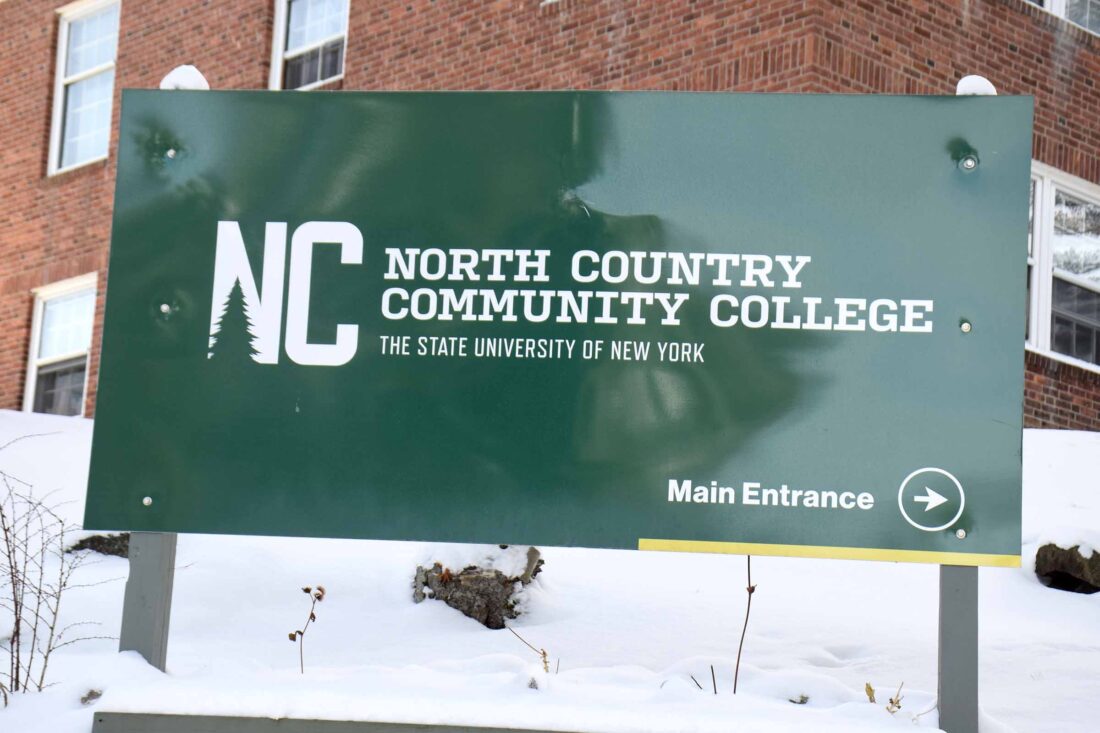
A North Country Community College sign is seen on Sunday in Saranac Lake.
(Enterprise photo — Chris Gaige)
SARANAC LAKE — College or career? It’s a question that many high school students wrestle with as graduation looms.
The Saranac Lake High School and North Country Community College take on the question a bit differently. The two educational institutions teamed up and were the recipients of a three-year, $150,000 “ADK Connect” grant from the Adirondack Community Foundation that funds college and career readiness.
The grant is premised on a “college and career” approach. SLCSD Superintendent Diane Fox said this doesn’t necessarily mean students have to go to college before getting a job, or vice versa. Rather, it’s an acknowledgment that the skill set needed to succeed at college is largely the same as what’s needed to advance in the workplace — and equipping high school students with these skills before they graduate sets them up for either direction.
“The idea is that no matter what path they choose after high school, they should be walking into that prepared,” said Luke Hudak, NCCC’s dual enrollment coordinator. “Our goal is to add another incremental change for the better in strengthening the academic infrastructure that we know we need in this community, for both students who plan to continue their education and those who plan to immediately join the workforce after high school.”
On the academic front, the grant enables SLHS to offer an NCCC college and career readiness course as an addendum to its high school economics and government classes, which most seniors take. SLHS is also able to offer a three-credit introductory NCCC English Course, and plans on adding a three-credit NCCC math course for the next school year. These courses are fully funded by the grant and are provided at no cost to students.
Hudak, who was part of the grant writing team, said that by passing these classes and graduating with the credits, students who go on to college don’t need to take remedial classes. Instead, they could immediately begin taking courses specifically needed for their degree or area of study, likely saving money and time in doing so.
Fox said students entering college needing to take a remedial class can spell trouble ahead.
“When you have to start with a remedial course that costs you money, but does not give you any credit toward graduation, that is a red flag as to students actually completing the college work,” she said.
The grant supports entry to the workforce in several ways. It helps students fund many of the “hidden costs” that come with some jobs, such as proper uniforms, equipment and transportation. The grant also facilitates local businesses to meet with SLHS students to discuss openings and career progressions. For students currently working with those businesses, Hudak explained that the grant also supports employers taking some time that would otherwise be on the clock to show the students what various mid- and upper-level position tasks and responsibilities look like.
Hudak said NCCC and SLHS have a memorandum of understanding with about a dozen local businesses currently through the grant, a number that he said is expected to grow. Hudak added that as NCCC and SLHS were writing the grant application, much of the legwork focused on interviewing local businesses. They asked what the most important skills and characteristics are needed in the workforce, what’s currently missing and how that could be strengthened.
“When we had feet on the ground and we were talking to employers, we were able to get a really good handle of what employers needed, what was lacking in the workforce and where the gaps were — not just in what potential employees were coming in with, but what some of the roadblocks were in terms of getting employers and employees connected,” he said.
It was through this process that Hudak said the college and career readiness overlap became apparent.
“One of the things that we heard was that some students come in and they don’t have the level of math or communication skills that we would expect from full-time employees,” he said. “Those foundational pieces translate directly to the mid-level skill set required to go and work anywhere within the community.”
The ADK Connect grant is in its first year, with the award announced in May. Hudak said that as it moves toward its second year, NCCC and SLHS are eliciting feedback from both participating students and employers to strengthen the implementation. Hudak said it’s rewarding to know that by the end of the grant, several hundred students will have been impacted by it, either through the academic credits, career assistance or both.
“The ultimate goal is exactly what it sounds like: to strengthen the Adirondack safety net so we have more families that have a reliable income and a qualified skill set to obtain that so they can be successful and contribute to this area’s vitality and future,” he said.
Kim Trombley, Adirondack Community Foundation’s community impact director, said it’s a goal the foundation is proud to support, and is part of its larger Social Safety Net initiative, which began after the coronavirus pandemic. She said it aims to identify and support opportunities to strengthen the basic needs system in the Adirondacks, including promoting workforce development to increase overall community vitality.
“Earlier this year, ACF awarded multiyear catalytic grants, paired with other professional support, to four innovative partnerships,” Trombley said. “The ADK Connect program was selected because it braids academic and career guidance and connects students with local employers and opportunities. We are thrilled about the long-term vision of this project and look forward to the positive impacts it will make on our community.”
Hudak said the program was off to a solid start, and has so far proven to be a good fit with NCCC’s mission, at the end of the day, to serve the community. He’s hopeful that if the success continues, the two educational institution will find a way to keep it running after the grant funding runs out.
“If it’s successful for our community, we have to make sure that it continues,” he said. “Maybe not in this exact form, but with the same philosophy and principles that are currently guiding it.”