

For many women, midlife health changes can feel sudden, confusing, and deeply personal. Weight gain despite “doing everything right.” Sleepless nights that stretch into exhausting days. Brain fog, aching joints, and an overwhelming sense of depleted energy.
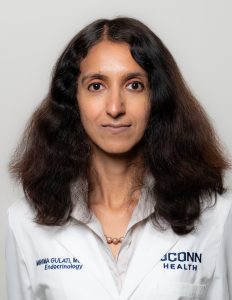
“These symptoms are real,” says Dr. Mahima Gulati, an endocrinologist at UConn Health and a leader in lifestyle medicine. “This is not something women are imagining, and it’s not ‘just aging.’ There are real biological changes happening, and women deserve evidence-based care and support as they move through them.”
At UConn Health, Gulati works with women across the lifespan from younger patients with polycystic ovary syndrome (PCOS) to women navigating perimenopause, menopause, and postmenopause. Central to her approach is lifestyle medicine, a growing medical specialty that focuses on treating and preventing disease through prescriptive, evidence-based changes in daily habits.
Rather than offering quick fixes, lifestyle medicine addresses the foundation of health that include how people sleep, eat, move, connect, cope with stress, and avoid harmful substances.
“These six pillars form the core of lifestyle medicine,” Gulati explains. “They give us practical, science-backed tools we can prescribe during a medical visit to help patients change their day-to-day habits in meaningful ways.”
Why Lifestyle Medicine Matters During Menopause
Menopause is often misunderstood as a single moment in time, the end of menstrual cycles. In reality, it is a long transition, sometimes beginning up to a decade before a woman’s final period and lasting years afterward.
During this time, declining estrogen levels remove what Gulati calls a “protective umbrella” that had previously helped regulate metabolism, bone density, muscle mass, cholesterol, and blood sugar.
“Once women enter their 40s, cardiometabolic risk can rise quickly,” she says. “We see changes in body composition, loss of muscle and bone mass, and unfavorable shifts in cholesterol, glucose, and blood pressure, sometimes even if lifestyle habits haven’t changed.”
Research also shows that after menopause, resting metabolic rate can drop by an average 100-250 calories per day, making weight gain more likely and weight loss more difficult. Many women gain 10 to 20 pounds during this transition, along with an increase in body fat and a decrease in lean muscle mass.
“That’s why lifestyle medicine becomes so critical at this stage,” Gulati says. “It gives women a sense of ownership over when their bodies may feel unfamiliar or frustrating.”
Pillar One: Social Connection – Not Suffering Alone
One of the most powerful and often underestimated tools Gulati uses is connection.
At UConn Health, she leads shared medical appointments, also known as group visits. These are doctor led medical visits where patients receive clinical care, lab review, and expert guidance alongside other women navigating similar challenges. Each session covers a different aspect of lifestyle medicine.
“For women to sit in a room and realize they are not alone is incredibly therapeutic,” she says. “Connection itself reduces the burden of chronic conditions.”
Patients often discover that changes they once thought were isolated such as new snoring, disrupted sleep, increased sensitivity to alcohol, or reduced energy are common experiences during this stage of life.
Group visits are available for those living with any type of chronic disease. The doctor-led visits are an opportunity to meet with other patients who may have similar concerns.
“They learn from one another,” Gulati says. “That shared understanding creates momentum for change.”
Pillar Two: Sleep – Addressing the ‘Energy Crisis’
Sleep disruption is one of the most common and debilitating symptoms of perimenopause and menopause.
“Estradiol impacts REM sleep,” Gulati explains. “Women often wake at 1 or 2 a.m., experience night sweats, and struggle to fall back asleep. When that happens night after night, it becomes an energy crisis not just fatigue.”
Her approach includes both education and practical strategies:
• Establishing consistent sleep routines
• Avoiding caffeine and alcohol in the evening
• Limiting blue light exposure after 7 p.m.
• Keeping devices out of the bedroom when possible
• Using relaxation practices like yoga and meditation
Hydration, she notes, is also key. “Adequate water intake during the day can help regulate body temperature overnight and reduce hot flashes.”
Pillar Three: Stress – Changing the Relationship, Not Just Reducing It
Rather than trying to eliminate stress a near-impossible task, Gulati helps patients redefine their relationship with it.
“We talk about embracing stress as a signal for growth,” she says. “What can I let go of? What can I say no to? And for the stressors I can’t avoid, who can I ask for help?”
This reframing helps women move from a biology of fear to a biology of courage and connection, encouraging resilience rather than burnout.
Pillar Four: Movement – More Than Just Exercise
Exercise becomes non-negotiable during midlife, but Gulati emphasizes that movement must be multidimensional.
“Strength training is essential,” she says. “Preserving muscle and bone is the goal not just losing weight.”
She also stresses the importance of breaking up long periods of sitting, incorporating balance training as women age, and prioritizing flexibility and mobility.
“It’s not just about a 30-minute workout,” she says. “It’s about how often we move throughout the day.”
Pillar Five: Avoiding Harmful Substances and Behaviors
Lifestyle medicine also addresses tobacco use, alcohol consumption, and behavioral addictions.
Alcohol, Gulati notes, is often tolerated differently after menopause. Even small amounts can worsen sleep, increase visceral fat, and raise the risk of breast cancer and osteoporosis.
She also addresses digital overuse, encouraging patients to limit screen time at night and avoid scrolling during overnight awakenings.
“These behavioral changes can dramatically improve sleep and overall well-being,” she says.
Pillar Six: Nutrition – Fueling the Body Through Change
Nutrition is one of the most requested topics in Gulati’s group visits. Discussions range from reading food labels to increasing vegetable and protein intake, improving hydration, and exploring foods that may ease menopausal symptoms.
“We focus on progress, not perfection,” she says. “And we emphasize celebrating what’s working, better sleep, improved labs, more energy, not just the number on the scale.”
Replacing Misinformation with Evidence
As menopause dominates social media feeds, Gulati urges women to seek credible, vetted sources of information.
She recommends organizations such as the American College of Lifestyle Medicine, the Endocrine Society, the North American Menopause Society, and trusted health systems like UConn Health, Mayo Clinic, and Cleveland Clinic.
“The only way to counter misinformation is to replace it with good information,” she says.
A New Narrative for Midlife Health
Gulati believes menopause should not be framed as decline, but as transition.
“There is emotional maturation that happens,” she says. “Women become clearer about priorities. They conserve energy for what truly matters.”
Lifestyle medicine, she says, supports that shift not by fighting change, but by helping women move through it with strength, clarity, and confidence.
“This is a journey,” Gulati says. “And it deserves care, compassion, and evidence-based support every step of the way.”
Referrals for lifestyle medicine appointments can be directed to Dr. Mahima Gulati , UConn Health, Endocrinology Division.