
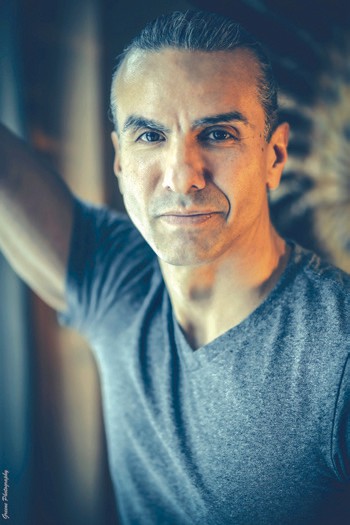

Anton Treuer
Editor’s Note: The 9th annual Harbor Springs Festival of the Book takes place this weekend, September 27-29 in venues throughout Harbor Springs. While the event is sold out, in anticipation of the variety of amazing authors coming to town, the Harbor Light Newspaper continues to feature some interviews with a select few as a way of introducing these artists to our readers who will be attending and those interested in learning more. We look forward to another outstanding event. For more information, hsfotb.org.
Dr. Anton Treuer (pronounced troyer) is Professor of Ojibwe at Bemidji State University and author of many books. His professional work in education, history, and Indigenous studies, as well as his long service as an officiant at Ojibwe tribal ceremonies, have made him a consummate storyteller in the Ojibwe cultural tradition and a well-known public speaker. Anton’s first book for young adults, Everything You Wanted to Know About Indians But Were Afraid to Ask (Young Readers Edition), won the SCBWI Golden Kite. Where Wolves Don’t Die is part coming of age story and part thriller. It is Treuer’s first novel and a must-read for all ages.

EMILY MEIER: Where Wolves Don’t Die is a beautiful story that blends mystery and coming of age. You have written a lot of nonfiction and now you have written this novel. How did this story come to you?
ANTON TREUER: I have nine children and we have been launching a teenager every couple of years for the past decade. I think about parenting, coming of age, and the recent passing of my own parents often. I also teach our tribal language, Ojibwe, and officiate at many of our traditional ceremonies. My life has been filled with young people and elders and the rich tapestry of our ceremonial culture with one foot in the northwoods and another in my academic work. Writing Where Wolves Don’t Die didn’t require me to imagine Indigenous culture or Native places. It provided an opportunity for me to open a window for the reader to get an authentic view of our universe.
EM: I read that you called this book a “human story set in an indigenous context”. It’s a perfect way of explaining how you braid in the more specific indigenous experience with the more general experience of being a teenager at that time in life when we all start to see
that our parents and elders are also very human. You balance this so well. Was this something that developed naturally with the story? Or came with hard work through revision?
AT: Everyone who lives into adulthood has a coming of age experience. That transcends our specific cultures. But coming of age, for all of us, happens in a specific cultural context. Colonization has centered the shared human experience of coming of age in white, Eurocentric cultural environments—British and American schools, towns, cities, and cultures. The assumption has always been that literature which shares about white coming of age experiences shares about the HUMAN experience. And literature that shares about coming of age in other cultures shares about MINORITY experiences rather than the HUMAN experience. The assumption is Eurocentric. All coming of age literature says something about the human experience of coming of age; and it says something about the culture in which it happens. Where Wolves Don’t Die speaks to both our shared human experience which transcends all the lines and divisions between us—breaking from and maintaining connection to our families of origin, leaving and coming home, freedom and belonging. And it also provides a very distinctive and authentic cultural tapestry for the storytelling, one that will resonate with Indigenous readers and be novel to others. A great story will effectively transport the reader into the characters and culture of the book and transform the reader through the journey.
EM: I have spoken with authors in the past whose tribes worried about them revealing too many specifics about ceremonies and customs in their stories. Was this a concern ever? And how do you know how to share with the reader while holding back the truly sacred?
AT: I am in an uncommon position in that I am a cultural gatekeeper. I officiate at naming ceremonies, first kill feasts, and even traditional Ojibwe funerals. I don’t take license to whatever I please or whatever I think will enhance a story. I am beholden to my community and the people I serve in our ceremonial space. So the substance of initiations into our sacred societies does not go in my books. People have to go to their elders and through their ceremonies for that. But everything else—how we hunt and harvest, the culture of our harvests, the nature of our communities, our humor, our reverence for elders, our shared history, and an authentic Ojibwe worldview, that’s as normal in a book like Where Wolves Don’t Die as a senior prom is in a classic book of white American literature.
EM: A reader can’t help but fall in love with your characters, especially Ezra’s grandfather Liam and his dog Buster. I love the smaller details in this book, like Liam’s belief that “dogs have a right to see” as he props him up so he can see through the windshield as they drive. I also love the way you open the book with the details of the Northeast Minneapolis snow. Michiganders understand this completely. Can you speak a bit about how this story changed through revisions? Did you have a lot of these wonderful details in the first draft? How did the story and characters evolve?
AT: Where Wolves Don’t Die did change through the revisions. The book is both a thriller and a tender coming of age story, so I had to tend to both elements. I had some sequences around a major storm that I ended up taking out so the tension in the thriller plotline didn’t abate. I rewrote both the fate and details of Ezra’s mother because my first draft would have needed more development to make it land right and it would have distracted from Ezra’s transformative journey. The details of the characters and the dynamics between them seemed to flow rather than require lots of wordsmithing once I got my roll on.
EM: I read that you grew up in a house without running water or electricity. Can you speak a bit about your trajectory from there to Princeton University, and now, as an educator and writer? What motivated you? Do you have different motivations now that drive you still?
AT: My parents both had humble beginnings, and there was a time when we kept an outhouse washed up in the creek, but I never experienced food insecurity. My childhood is full of happy memories. I certainly did have ambition, but it wasn’t limited to financial betterment. I finished high school with a plan to get out of town and never come back. I finished college at Princeton with a plan to come home and never leave. And that is exactly what I did. I fell in love all over again as an adult with our language, culture, and community. And I have devoted my life to their betterment ever since. I will always be a ceremonial servant to our people. I will always strive to revitalize our language and culture. My literary ambition, while profound, is less a goal in and of itself so much as a vehicle to support that broader mission.
EM: You are involved in teaching the Ojibwe language. I once had someone tell me that until you dream in a language it is not fully yours, you aren’t yet fluent. Do you dream in both languages? What are your thoughts on the ways in which language shapes stories and ideas?
AT: I do dream in both Ojibwe and English. I think it’s important to point out that someone is not “less than” if they didn’t get to grow up with their language handed to them on a silver platter. But I certainly agree that language shapes every unique worldview. In Ojibwe our word for elder “gichi-aya’aa” literally means “great being.” I can write a character like Grandpa Liam. And I can tell you what elders mean to us in the Ojibwe culture, but the language provides a depth of context that is hard to replicate in English. That’s why I used some Ojibwe in the book—not enough to make it hard for someone who’s not a speaker and certainly not as a form of identity politics, but where it enhanced the reader experience or let the reader more effectively transport into the story or understand our culture.
EM: What are you reading currently that you’d recommend?
AT: I read about 50 books per year. I’m actually reading And Then There Were None for a classic mystery now. But I have recently read Angeline Boulley’s new book Warrior Girl Unearthed and loved it. And Louise Erdrich’s latest, The Mighty Red is coming up soon.
EM: Do you reread books? Are there authors or books you return to every so often? What are they?
AT: I do reread some of my favorites. I’ve had immersive rereading experiences with George R.R. Martin, J.R.R. Tolkien, Edgar Rice Burroughs, and Ernest Hemingway. But I often venture into many varied types of writing. I’m insatiably curious.
EM: Is there anything else you’d like readers to know?
AT: I still feel like a bit of an outsider as a Native man doing Native literature. Most of the literature about Native people has been written by nonnative people. It’s been the “imagined Indian.” And the imagining has often been way off the mark. Over the past few decades there has been a lot more Native authored Native literature. I’m so grateful for that and honored to be part of it. But even there most of the literature is full of Native characters who lament the culture they never knew because of our experiences with residential boarding schools and urbanization. While I am telling a story full of drama and tension, I am trying to show our beautiful, living culture— to give a window in instead of an imagining of—and I hope that it will point the field in new directions.