

In 1961, during the height of the Cold War with the Soviet Union and in an address to a joint session of Congress, President John F. Kennedy challenged the country to land a person on the moon by the end of the decade.
“I believe that this nation should commit itself to achieving the goal, before this decade is out, of landing a man on the moon and returning him safely to the Earth. No single space project in this period will be more impressive to mankind, or more important for the long-range exploration of space; and none will be so difficult or expensive to accomplish,” Kennedy said.
A year later, in a speech at Rice University, Kennedy’s words would become forever connected with the Apollo program when he said, “We choose to go to the moon. We choose to go to the moon in this decade and do the other things, not because they are easy, but because they are hard.”
NASA and the aerospace industry met this challenge, and to this day, the United States is the only country to have ever sent humans to the moon. But that feat required steps. Before Apollo 11 saw Neil Armstrong and Buzz Aldrin set foot on the lunar surface, Apollo missions 4 through 10 laid the foundation for that historic accomplishment.

NASA’s Artemis II Commander Reid Wiseman, pilot Victor Glover, mission specialist Christina Koch, and Jeremy Hansen pose for a photo as NASA’s Artemis II (behind them) is rolled from the Vehicle Assembly Building to Launch Pad 39B at NASA’s Kennedy Space Center on January 17, 2026 in Cape Canaveral, Florida.
Joe Raedle/Getty Images
The U.S. is once again challenging itself to go to the moon, and this time, NASA and the Trump administration want to establish a long-term presence on the lunar surface. Before they can build a settlement, however, they need to show that our new moon mission rocket, spacecraft and technology work as intended.
Coming more than three years after the uncrewed Artemis I test flight, Artemis II will mark the first time humans have traveled beyond low Earth orbit in more than 50 years. The last mission to do so was Apollo 17 in 1972.
The Artemis II mission is a test flight that will send four astronauts on a more than 600,000-mile, 10-day journey around the moon (a lunar flyby) to test critical spacecraft systems ahead of Artemis III, which aims to someday land astronauts near the moon’s South Pole, a region never explored by humans.
Artemis II is testing the critical systems needed for a future lunar landing, much as the early Apollo missions prepared NASA to land humans on the moon.
Why is the mission called Artemis?
NASA selected the name Artemis for these missions after the twin sister of Apollo and goddess of the moon in Greek mythology.
Will astronauts be landing on the moon?
No. Artemis II is a crewed lunar flyby designed to demonstrate that the Space Launch System (SLS), the rocket that carries the astronauts into space, and the Orion crew capsule, which is their spacecraft to and from the moon, can meet the mission objectives, keep the crew safe in deep space and get them to the moon and back. NASA will test life support, communications, and navigation systems, as well as operating procedures, to prepare for later missions, including Artemis III, which will land astronauts on the moon’s surface.
Who is the Artemis II crew?
Reid Wiseman is the commander of the Artemis II mission. He is a former NASA chief astronaut, a U.S. Navy test pilot and he has already spent 165 days in space on the International Space Station (ISS).
Victor J. Glover Jr. is the mission pilot. He’s a NASA astronaut and a U.S. Navy captain. He’s the first Black astronaut to live on the ISS for a long-duration assignment, where he spent six months as part of the Crew-1 mission.
Christina Koch is a mission specialist and she holds the record for the longest single spaceflight by a woman at 328 days. She also performed the first all-woman spacewalk. A member of the Space Camp Hall of Fame, Koch attended the camp at the U.S. Space and Rocket Center multiple times in her youth.
Jeremy Hansen is the other mission specialist and part of the Canadian Space Agency. As part of the Artemis II crew, he will become the first non-U.S. astronaut to fly to the moon. Hansen is a colonel and an CF-18 fighter pilot.
The Artemis II crew named their Orion spacecraft “Integrity.”
When and where could Artemis II launch?
Where: Kennedy Space Center in Florida at Launch Complex 39B
When: There are three launch windows spread across Feb., March, and April. Feb. 6 is the first chance for NASA to send the rocket, spacecraft and crew to the moon. If weather or technical issues prevent a Feb. 6 launch, NASA can try again on Feb. 7, Feb. 8, Feb. 10 and Feb. 11. If the rocket and spacecraft aren’t ready in Feb., NASA has alternate dates in early March and April.
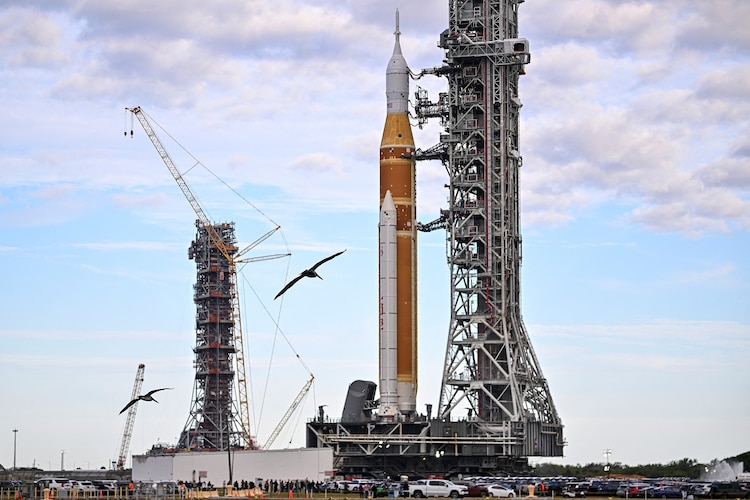
NASA’s Artemis II Space Launch System rocket and Orion spacecraft are rolled out of the Vehicle Assembly Building to Launch Pad 39B at Kennedy Space Center in Florida on January 17, 2026, ahead of the crewed lunar mission.
Miguel J. Rodriguez Carrillo/AFP via Getty Images
What needs to happen before lift-off?
NASA is targeting Feb. 2 for what they call a “wet dress rehearsal.” This is when they fuel up the rocket and test the countdown procedures. As the name suggests, the dress rehearsal checks all procedures and systems up to just before launch. NASA will then review the data before proceeding to a launch attempt.
During Artemis I, issues with fuel loading caused significant launch delays. NASA will closely monitor that part of the process before deciding whether the vehicle is ready to go.
How will the mission unfold?
The Artemis II mission begins with launch day. The SLS takes Orion and the Artemis II crew into space with the help of more than 8.8 million pounds of thrust. Once in orbit, Orion will deploy its solar array, and the spacecraft will settle into low Earth orbit for a few hours before heading to a higher Earth orbit where the crew will perform system checks and demonstrations, including manually flying the spacecraft around the upper stage (called a Proximity Operations Demo) to build experience for future docking missions.
If all of Orion’s systems are working correctly, the crew will begin their journey to the moon by engaging the spacecraft’s main engine for a translunar injection burn that will put it on the correct course to head to the moon and return to Earth. It will take three days to get to the moon.
The crew will fly by the far side of the moon (passing between 4,000 and 6,000 miles above it). The astronauts will spend the day observing and photographing the far side of the moon, parts of which have never been seen by human eyes, and then circle it for a return to Earth.
After the lunar flyby, the Earth-moon gravity field will help pull the spacecraft back to Earth over the course of its three-day return trip. The Orion service module, which contains the engines, propellant, water and experiments, will then separate from the crew module, exposing the capsule’s heat shield, which will protect the crew from the extreme temperature of re-entry. The service module will burn up in the atmosphere.
After re-entering the Earth’s atmosphere, the Orion will splashdown off the coast of San Diego (weather and systems permitting) with the assistance of two sets of parachutes designed to slow it down to a safe speed of about 17 mph. The U.S. Navy will then recover the astronauts and the spacecraft from the Pacific Ocean.
What happens at splashdown and how fast do they get the crew out?
Orion will splash down in the Pacific Ocean, off the coast of San Diego, with recovery operations conducted by the U.S. Navy and NASA.
NASA said a recovery ship will be stationed a few miles from the target site. Navy divers will be the first to approach the capsule, and NASA aims to have the crew transferred to the ship’s medical bay within approximately two hours of splashdown.
What science is riding along on Artemis II?
NASA said that Artemis II includes an “integrated research campaign” focused on how humans and spacecraft systems perform beyond low Earth orbit, including:
- Wearable sleep/movement monitoring of the astronauts during the mission.
- Blood and saliva sampling to measure immune biomarkers and examine how space alters the immune system.
- Radiation sensors on the crew and inside Orion will study the impact of radiation in deep space.
- Using “organ-on-a-chip” devices, the astronauts will study the impact on increased radiation and microgravity on crew health.
- Lunar observations, photography and video recording.
- Deployment of four international CubeSats satellites from Argentina, Germany, Korea and Saudi Arabia.
How Artemis took shape
The roots of the Artemis architecture, NASA’s plan for sustainable human lunar exploration, build on initiatives that date back to 2004, when Congress approved the Constellation program as part of President George W. Bush’s Vision for Space Exploration. The Constellation program aimed to “take us back to the moon, Mars and beyond,” developing the Ares I and V rockets, along with the Orion crew module, which is still in use today.
In 2010, NASA’s Constellation program was cancelled under the Obama Administration, citing an unrealistic schedule and funding shortfall. U.S. human spaceflight priorities shifted toward commercial missions to the ISS and research on reducing crewed spaceflight costs.
Work on the Orion spacecraft continued, initially to provide astronauts with an emergency return vehicle from the ISS. In 2017, President Trump signed Space Policy Directive 1, authorizing a lunar exploration program and officially setting the stage for Artemis, with Orion as a core component. The first milestone, Artemis I, launched in 2022 as an uncrewed lunar-orbit mission, laying the groundwork for future crewed flights.
What comes next after Artemis II?
NASA positions Artemis II as the critical bridge to Artemis III, the planned return to the lunar surface. Artemis III will carry astronauts to the moon using Orion, the SLS rocket and SpaceX’s Starship Human Landing System, where they will conduct moonwalks and experiments.
Subsequent missions, Artemis IV through VI, aim to lay the groundwork for a sustainable human presence on the moon and in lunar orbit by assembling the lunar Gateway space station and supporting additional crewed surface expeditions.