
After more than 50 editions surfing across the waves of the global Black diaspora with Nesrine, this will be my final dispatch for the Long Wave, as I move on to a new role on the Opinion desk at the Guardian. I am heartbroken to be leaving, but I am so thankful to all of our readers for being so encouraging and engaged throughout the past year.
Any who, time to cut the sad music (this is my farewell tune of choice), as I have one more edition for you. In late autumn, I took my first trip to Ghana for Accra Cultural Week. While there, I visited the historic area of Jamestown, which was reflected in an exhibition by artist Serge Attukwei Clottey.
Inside Accra Cultural Week
Visiting the exhibitions, installations and performances of Accra Cultural Week, I saw how the finest art nourishes and constructs a country’s history and identity. The centrepiece was no doubt Serge Attukwei Clottey’s exquisite [Dis]Appearing Rituals: An Open Lab of Now for Tomorrow, which put his pioneering afrogallonism on full display: a concept that transforms yellow jerrycans into illusory art pieces, mosaics of yellow, brass and gold. The show was conceived in tribute to the resilience of Jamestown, an historic area of Accra, which I take a walking tour of with designer, historian and exhibition co-curator Allotey Bruce-Konuah.
Here I learn that the area – predominantly inhabited by the Ga people, a fishing community – is also where many formerly enslaved people returned from Brazil and settled in the 1830s. The community, known as the Tabom people, brought Portuguese language and culture. Throughout Jamestown, you can see a mix of architecture. There’s Franklin House, or Fort Vicentia, with its distinct European-style brickwork and arched doorways – it was built in 1660 by the Portuguese to facilitate their trade with the then named Gold Coast, as well as to then auction enslaved people. And there is also the Jamestown Lighthouse, built by the British in 1871 (though its red-and-white-striped facade is the result of a 1930s revamp).
Also striking about Jamestown, is the presence of funeral posters. Everywhere you turn, whether plastered over alleyways or on larger billboards, you’ll see funeral details and the general tone of mourning (“painful exit” v “triumphant exit”). In Jamestown, as throughout Ghana, funerals are large-scale community celebrations and social events. Indeed, as my walking tour passes one on the street, we are invited to watch as a band plays music for us.
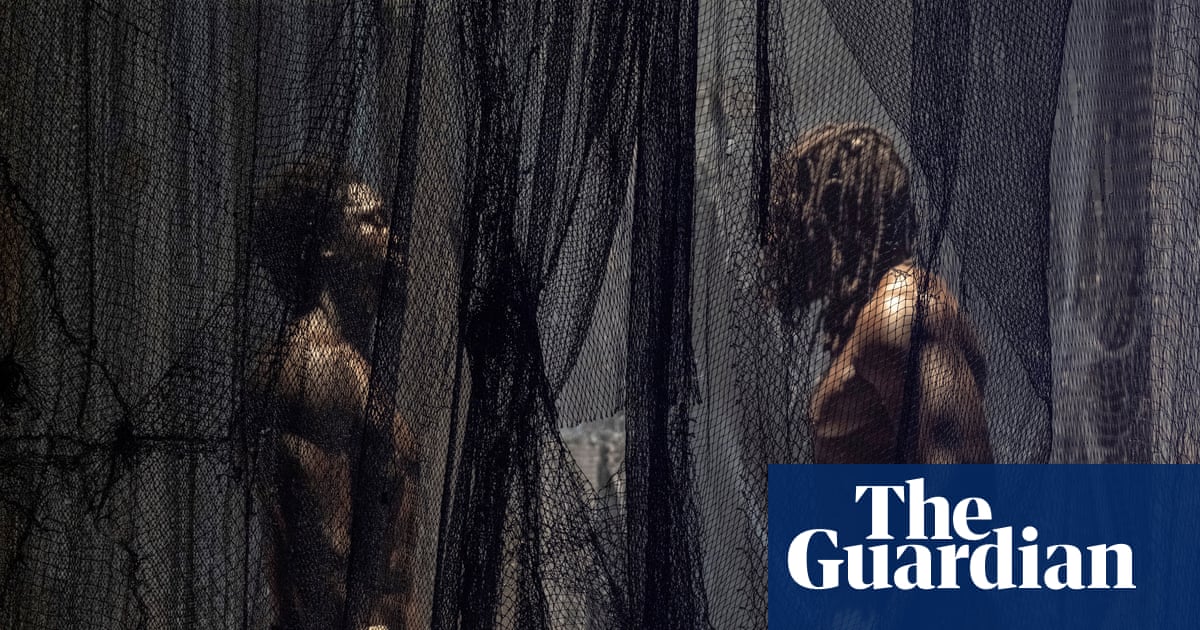
In Clottey’s spectacular exhibition, all of the sights, sounds and religious textures of Jamestown are present – particularly in the Jamestown nshonaa installation, which captures its beach. In this, you’re soothed by the sound of crashing waves and the sand at your feet, while beach huts and hanging fishing nets and the vision of boats honour its spirited, multigenerational fishing community. Yet standing in this exhibition space, I couldn’t help but think of the mountains of discarded clothing, plainly visible whenever you walked near water, that threatened the beauty and serenity of this area. Clottey’s work makes such incredible use of recycled materials that it conjures a spiritual and atmospheric quality, profoundly meditating on consumption and the cycles of life. And so, even with this troubling knowledge of fast-fashion dumping, I’m left with a vision of Accra that feels like a manifesto for environmental protection and the preservation of culture.
There is much more to Accra Cultural Week, too. Within an unfinished structure at the University of Ghana, and as part of a collaboration between Gallery 1957 and the Limbo Museum, the artist Reginald Sylvester II presented On the Other Side of Languish, an incredibly moving, minimalist exhibition that displayed sculptures and paintings created with welders from the city of Tema, as well as making use of found materials and objects.
after newsletter promotion
And then there is the Yaa Asantewaa Art prize for female Ghanaian artists, living in Ghana or in the diaspora. It featured the inaugural exhibition of the 2024 winner Denyse Gawu-Mensah, Lightyears of Us – which draws on familial archival records to produce a visual impression of life in post-independence Ghana – as well as the crowning of this year’s winner, Theresah Ankomah, whose multidisciplinary work is particularly invested in the weaving practices of the women in Dabala in the Volta region of Ghana.
While the diaspora have been increasingly drawn home to west Africa during the western hemisphere’s winter months for partying and entertainment, among other pleasures, more and more are considering travelling some months earlier to experience the region’s cultural season. Between Accra Cultural Week and Art X Lagos, what you’ll find are art scenes that are not simply nascent or “upcoming” but have built up an entire world that is here to stay.
This trip was provided by Gallery 1957.