

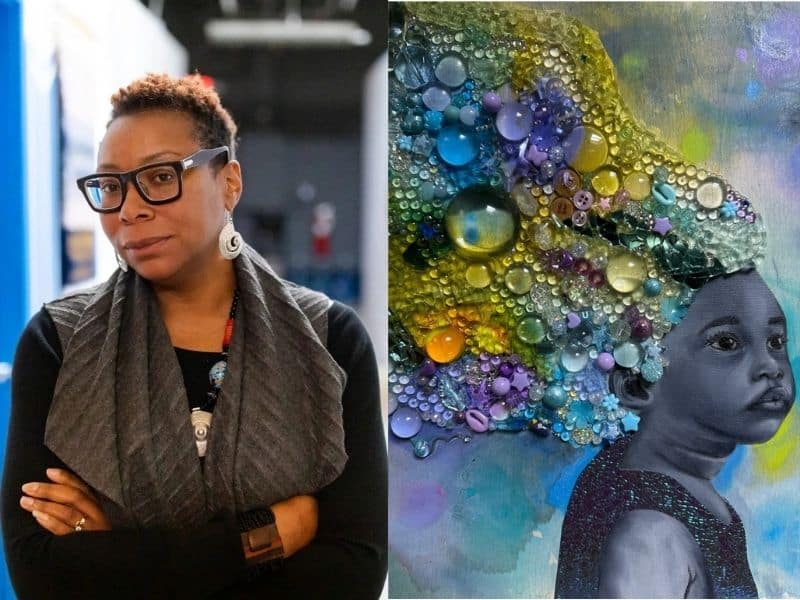
The Aminah Robinson house is filled with light.
Glass brick windows line the walls so that no privacy curtains or blinds are needed; only light traverses the glass unobstructed. And today in early January – the first bright day of the year – sunlight pours in and illuminates the vibrant tiles, resin, and paintings that enliven the late artist’s home.
“Aminah’s spirit is everywhere in this house,” April Sunami said, passing kitchen cabinets painted with the silhouettes of faces.
Sunami, a celebrated Columbus artist, has unrestricted access to the house as the 2026 recipient of the Aminah Robinson Artist Fellowship. In her multimedia work, Sunami often explores themes of ancestry and inheritance, making her both formally and thematically invested in reinvention. She uses what is around her to create something new – a practice she traces back to Robinson’s influence.
“Her fingerprint is on so many artists in Columbus,” Sunami said. “She would take regular, everyday stuff, place it into her art, and create such symbolism with it. I consider myself an artistic grandchild of Aminah, and there are so many other artists who are as well.”
Initially, Sunami planned to use her time in the house to continue with earlier projects, but now that she’s in the space, she intends to see where Robinson takes her. “Space affects my practice. Every studio I’ve worked in brings a different energy, a new way of working,” she said. “Here, I feel Aminah’s spirit and her permission to be bold, to try things I’ve been hesitant to attempt in my own studio. … I feel like she’s giving me permission to get funky.”
Such permission has spurred an increased interest in storytelling. “[Aminah’s] work goes back and forth between her own personal family history and larger stories about history – African American history, or the history of Columbus folklore,” Sunami said. “I’m inspired to incorporate a little more narrative elements in my work because of it.”
These stories are not confined to Robinson’s artistic works. As Sunami has started to familiarize herself with the space, she has spent much of her time exploring the library. Although many of the books were removed to make the home livable for the residency, the remaining collection has led Sunami to artists with whom she was previously unfamiliar, such as multimedia artist Willie Cole.
Even Robinson’s walls are alive with stories. Messages from friends and fellow artists written in marker are preserved throughout the space, allowing Sunami greater access into Robinson’s personal relationships. The artist was a private person, Sunami said, so anyone invited to write upon her walls must have been special. Here, too, Sunami finds new names, along with a few she is surprised to already know.
More than any stylistic influence of Robinson’s, it is this commitment to community that Sunami hopes to carry forward. “Her life was dedicated to art, but she was also very generous in what she gave to other artists,” the artist said. “That encouragement is what I want to pass on.”
To engage the community, Sunami plans to share her art at the residency’s open house, held at the end of the residency. She also plans to have a conversation with the public centered around social justice, community, and care – the dialogue from which she will later use to create a collaborative installation.
“I want everybody to be able to see themselves in the work,” Sunami said. “My work is part of a larger project about representation and visibility of Black women, and I think that’s for everybody.”
Such conversations may be more important now than ever. While Black women have never had fair representation in the United States – their bodies and labor depended upon while their voices are systematically silenced – the arts have offered one avenue for expression. Under the Trump administration, however, discussions of race, gender, and class are increasingly policed, and the arts defunded. “It’s dangerous,” Sunami said. “That’s why it’s being cut. As Toni Morrison says, art is dangerous in its ability to enact social change.”
When these restrictions ramped up beginning in 2024, they fueled Sunami’s anxiety and made it difficult for the artist to work. “Everything was moving at breakneck pace in terms of what this administration was doing,” she said. “But then last year, I created a body of work to calm me down. Whenever I don’t have direction in my practice, I lean on collage. So, I created a series called ‘Keep On.’ It was a pep talk to myself: No matter what’s going on in the world, just keep making art, keep creating, keep the faith, keep loving. … The imperative is that we keep creating, because that’s what keeps us human. That’s what keeps us connected.”
The connection Sunami described is evident between her and Robinson. Two artists who make new of their surroundings, they share a lineage, one that has spurred a bit of protectiveness in Sunami. As she offered a brief tour of the house, she paused before entering each room, as if revealing too much would be a breach of the artist’s trust.
“It’s a sacred space,” she explained.
Upstairs, Sunami stopped outside of Robinson’s writing room. The door is closed, and she makes no immediate move to open it. But the museum has decided to make Robinson’s house public, she reasoned, and she has no right to keep it to herself.
The room is small, furnished with little more than a desk, Robinson’s art, and more of those glass brick windows that let in the light. Such an astounding amount of light.
“I told you her spirit was here,” Sunami said.
It’s true. Robinson’s presence is palpable in the space. Whether she’s in the room, though, or within Sunami herself, it’s hard to say.