 TWH – New Year’s Day is widely observed as a national holiday, a moment when civic calendars pause, and households turn their attention to renewal, continuity, and collective memory. It marks not only the turning of the calendar but also a shared social reset, shaped as much by public observance as by intimate domestic practice. Across cultures, January 1 serves as a threshold—an opening through which hopes, intentions, and inherited customs move forward together.
In Haiti, New Year’s Day carries profound historical and cultural significance as Haitian Independence Day, commemorating the nation’s declaration of independence from France in 1804. Central to this observance is the preparation and sharing of Soup Joumou, a pumpkin-based soup once forbidden to enslaved Haitians and later reclaimed as a symbol of freedom, dignity, and survival. Families gather to cook, serve, and share the soup, transforming a meal into an act of remembrance and affirmation. In Haitian homes and diasporic communities alike, Soup Joumou embodies resilience, sovereignty, and the enduring meaning of liberation.
Elsewhere, New Year’s traditions often focus on inviting abundance, protection, and forward movement into the year ahead. Food plays a prominent role. In the southern United States, black-eyed peas are eaten for prosperity, their shape associated with coins, while leafy greens evoke paper money. The dish has been described as brown field peas cooked with rice, traditionally eaten to invite good fortune in the year ahead. In African American communities, the practice of eating rice and cowpeas is closely tied to Freedom’s Eve on December 31, 1862, when enslaved Africans gathered in churches across the South, awaiting confirmation that the Emancipation Proclamation would take effect and secure their freedom.
Pork is favored in many cultures because pigs root forward, symbolizing progress and momentum. In contrast, foods associated with backward movement, such as chicken, lobster, or crab, are often avoided on this day.
In Spain, Cuba, and throughout parts of Latin America, the midnight ritual of eating twelve grapes, one with each chime of the clock, maps intention onto the coming months of the year. In the Philippines, round shapes dominate celebrations: round fruits, polka-dot clothing, and circular designs echo the form of coins and cycles of wealth.
Actions marking the transition from the old year to the new are equally meaningful. Opening doors and windows at midnight signals release and welcome. Making noise, through music, fireworks, or banging pots, marks the boundary between years with sound and motion. In Scotland, the tradition of the “first foot” holds that the first person to cross a home’s threshold sets the tone for the year, especially if they arrive bearing symbolic gifts. Elsewhere, a kiss at midnight last affirmed connection, while walking with an empty suitcase gestures toward future travel.
Just as there are practices embraced, there are actions intentionally deferred. Many households avoid cleaning, washing, lending money, arguing, or breaking objects on New Year’s Day, choosing instead to let the day unfold gently and deliberately.
Across these varied traditions, New Year’s Day functions as a shared moment of alignment—between past and future, home and community, memory, intention, and possibility.
Happy 2026!
The Wolf SuperMoon joins us this weekend
A prior supermoon over TWH headquarters in Miami
EARTH – The next full moon will be January’s Wolf Supermoon, rising on Saturday, January 3, with peak illumination at 5:03 a.m. Eastern. As with December’s Cold Moon, it will appear low on the horizon and rise at roughly the same time over several consecutive nights, offering extended opportunities for viewing.
The Wolf Supermoon, usually known simply as the Wolf Moon, will emerge in the eastern sky around sunset on Friday and Saturday evenings, January 2–3. By midnight, it will appear larger and brighter, taking on a warm yellowish hue as it climbs higher overhead before setting toward the western horizon in the early morning hours.
This full moon marks the fourth supermoon in a row, following October’s Harvest Moon, November’s Beaver Moon, and December’s Cold Moon. The sequence is unusual, as most years see only three or four supermoons total, but rarely consecutively.
There is no universally agreed-upon astronomical definition of “supermoon.” But among skywatchers, a supermoon occurs when a full moon coincides with perigee, the point in the Moon’s elliptical orbit when it is closest to Earth. At perigee, the Moon is approximately 220,000 miles away, compared to about 250,000 miles at its most distant point, known as apogee. This difference in distance causes the Moon to appear noticeably larger and brighter in the night sky.
The January full moon also coincides with the peak of the Quadrantids meteor shower, capable of producing more than 100 meteors per hour under ideal conditions (that is, the zenithal hourly rate under dark skies), adding another layer of interest to the weekend sky. But the bright moon will likely overwhelm the brightness of most meteors, so check your local conditions.
According to the Old Farmer’s Almanac, the names of the twelve full moons are drawn from Indigenous traditions across North America. January’s full moon is thought to have become known as the Wolf Moon due to the belief that wolves were more frequently heard howling during midwinter, a behavior once attributed to hunger, though now understood as part of normal social communication. The almanac also records a wide range of seasonal names reflecting winter weather, animal behavior, and spiritual meaning, including Cold Moon, Great Moon, and Frost Exploding Moon (among the Cree), Freeze Up Moon (Algonquin), Severe Moon and Hard Moon (among the Dakota), Canadian Goose Moon (Tlingit), and Spirit Moon (Ojibwe).
In the Greek Orthodox Church, as well as in the Russian, Serbian, and Jerusalem Patriarchates, Christmas is celebrated on January 7, following the Julian calendar.
But on Monday, January 5, the Christian church marks the eve of the Feast of the Epiphany. In many countries, including Spain, Cuba, and across much of Latin America, the day is associated with gift-giving traditions.
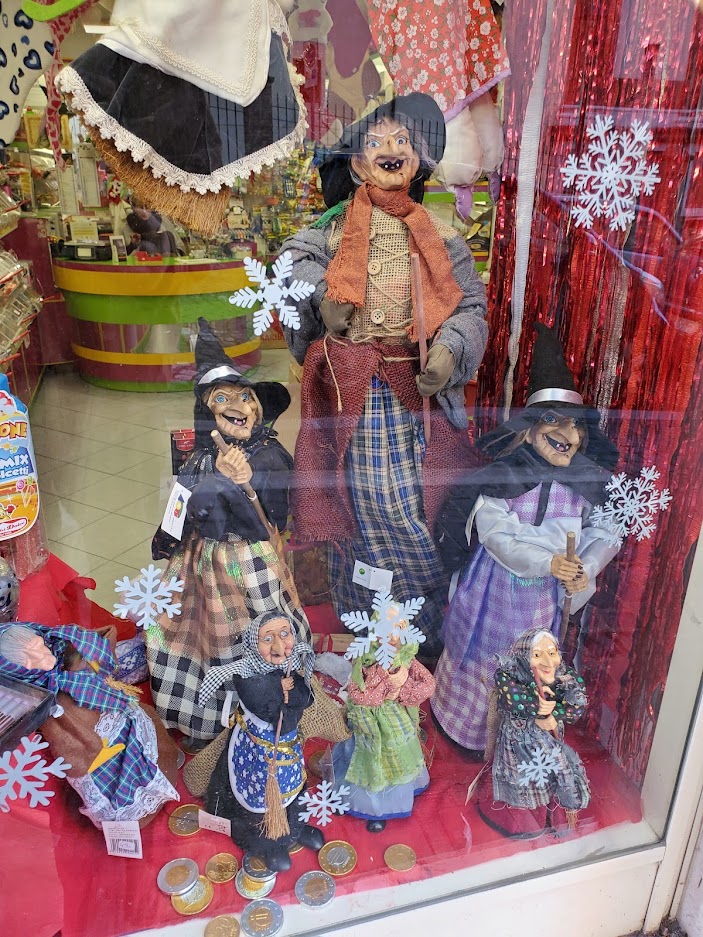
In Italy, and among many with Italian roots, that night belongs to La Befana.
La Befana is a beloved figure in Italian folklore, often described as a kind-hearted Witch. She flies through the night on her broomstick, delivering gifts to children. Like Santa Claus, she rewards good behavior with sweets and toys, while less well-behaved children find coal in their stockings, now mercifully rendered as candy.
Her story is woven into the Christian narrative of the Epiphany and the journey of the Magi. According to tradition, the Magi stopped to ask Befana for directions to the Christ child. She declined to join them, later regretted it, and set off on her own, forever searching and forever giving.
The Magi themselves are often referred to as “wise men,” thanks largely to the phrasing popularized by the King James Version. But the original language offers a richer picture. In the Greek text of the Gospel of Matthew, the word used is μάγοι (magoi), the plural of magos. That term traces back through Greek and Latin to ancient Persian roots, referring to a priestly class known for ritual practice and close observation of the stars.
In the ancient world, as in many traditions today, astrology functions as a sacred and interpretive system for understanding both spiritual and earthly forces. Those associated with its practice developed (and continue to develop) reputations for specialized knowledge. From ancient times, this combination of religious authority and celestial observation shaped how magos came to be associated with the occult, eventually giving rise to the English word magic.
There you go.
Back to La Befana.
Beyond theology and etymology, La Befana endures as a symbol of generosity, humility, and second chances. Her legend blends Christian storytelling with older folk traditions, reflecting Italy’s layered cultural history. Today, she remains central to Epiphany celebrations across the country, with markets, parades, and family rituals marking the close of the Christmas season.
A couple of years ago, our resident Strega spotlighted the traditions of La Befana, The Wild Hunt, reminding readers just how deeply she is woven into Italian cultural life.
We recognize that’s a fair amount of occult-adjacent material for some of our non-polytheistic friends to process.
So we’ll move along.
Thank you! Thank you! Thank you!
If you’ve been thinking about supporting The Wild Hunt, now is the time.
Events and Announcements
More Events at our new Events Calendar
Tarot of the Week by Star Bustamonte
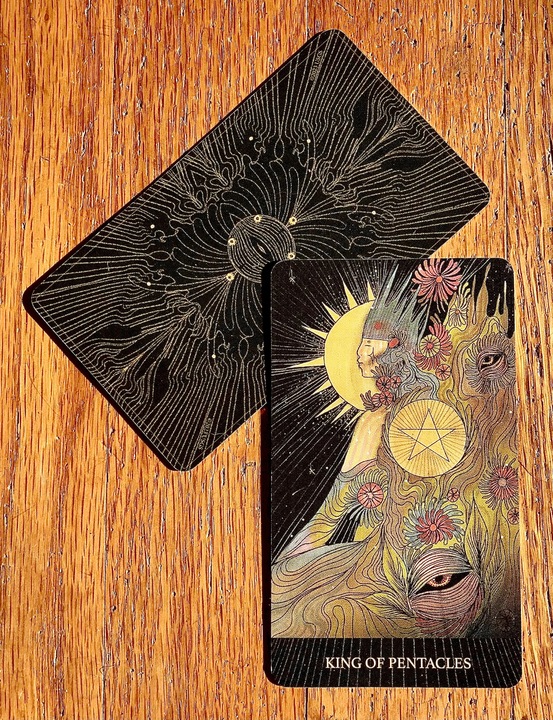
Deck: Dark Side of Tarot, artwork by Corrado Roi and Pamela Coleman Smith, text by Sasha Graham, published by Lo Scarabeo.
Card: King of Pentacles
The first week of the new calendar year is likely to have a focus on resources, financial health, and budgeting. Also likely, an emphasis on ensuring that there is a workable plan that will be successful. The ability to be secure and confident, especially as relates to resources, is highlighted this week. Additionally, those with expert knowledge may have opportunities to help and guide others to achieve similar success.
Conversely, if finances are not doing as well as one would like, it may be time to seriously consider the relationship held with money and wealth. Money is merely tool, though an important one, necessary to survive. It is not the end-all, be-all, however. Placing the acquisition of wealth above all else is unlikely to feed the soul in the long term.
Professor Hutton on Hecate!
Professor Ronald Hutton, CBE, is well known to Pagan communities through his influential scholarship, including The Triumph of the Moon (1999) and The Witch: A History of Fear, from Ancient Times to the Present (2017). He is Professor of History at the University of Bristol, where his teaching and research have earned multiple awards.
Last week, Gresham College released a new lecture from Hutton on YouTube. In the lecture originally from late November, Hutton traces the complex historical evolution of Hecate, whose origins lie in the ancient Anatolian region of Caria, where she first emerged as a powerful local goddess. As her cult was absorbed into Greek religion, Hecate became uniquely associated with the ability to move freely between all realms of the cosmos—earth, sea, and sky. This liminal authority placed her under the guardianship of travelers, thresholds, crossroads, and the restless dead.
Over time, these associations reshaped her image. Increasingly linked to night, the moon, and magical practice, Hecate’s character darkened in the cultural imagination. By the Roman period, she had become the preeminent goddess of sorcery, invoked in rituals and enchantments of every kind, benevolent and otherwise. In late antiquity, this role expanded further, transforming her into a savior figure—one who enabled direct human access to the divine.
The lecture follows Hecate’s powerful and evolving journey across cultures and centuries, illuminating how a regional deity became one of the most enduring and complex figures in the Western magical tradition.
👉 Don’t forget: supporting The Wild Hunt helps sustain independent Pagan journalism.
In this New Year, please remember that countless Pagan and Pagan-allied groups are doing extraordinary work on behalf of our community and would welcome your support as well.
Tax-Deductible Donation
PayPal
Patreon
As always, our deepest gratitude to everyone who has brought us this far.


 TWH – New Year’s Day is widely observed as a national holiday, a moment when civic calendars pause, and households turn their attention to renewal, continuity, and collective memory. It marks not only the turning of the calendar but also a shared social reset, shaped as much by public observance as by intimate domestic practice. Across cultures, January 1 serves as a threshold—an opening through which hopes, intentions, and inherited customs move forward together.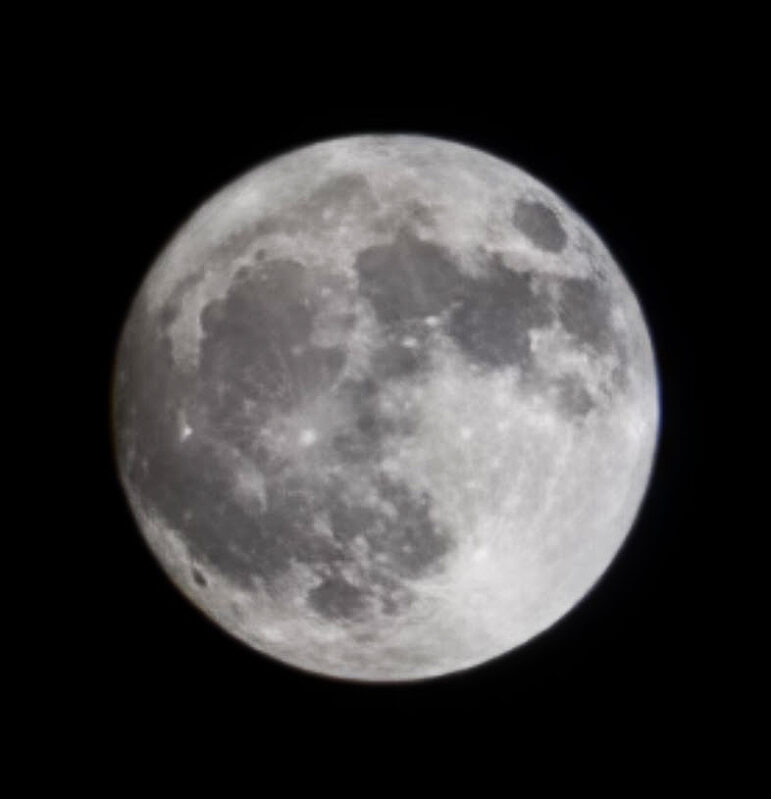

 Deck: Dark Side of Tarot, artwork by Corrado Roi and Pamela Coleman Smith, text by Sasha Graham, published by Lo Scarabeo.
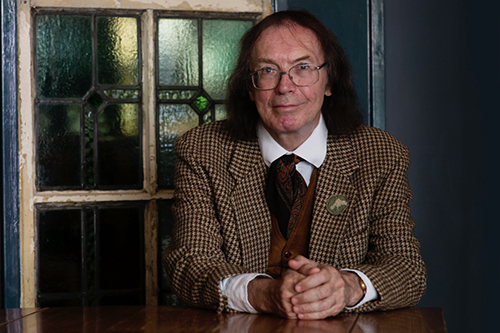 Professor Ronald Hutton, CBE, is well known to Pagan communities through his influential scholarship, including The Triumph of the Moon (1999) and The Witch: A History of Fear, from Ancient Times to the Present (2017). He is Professor of History at the University of Bristol, where his teaching and research have earned multiple awards.