


Purchase this image
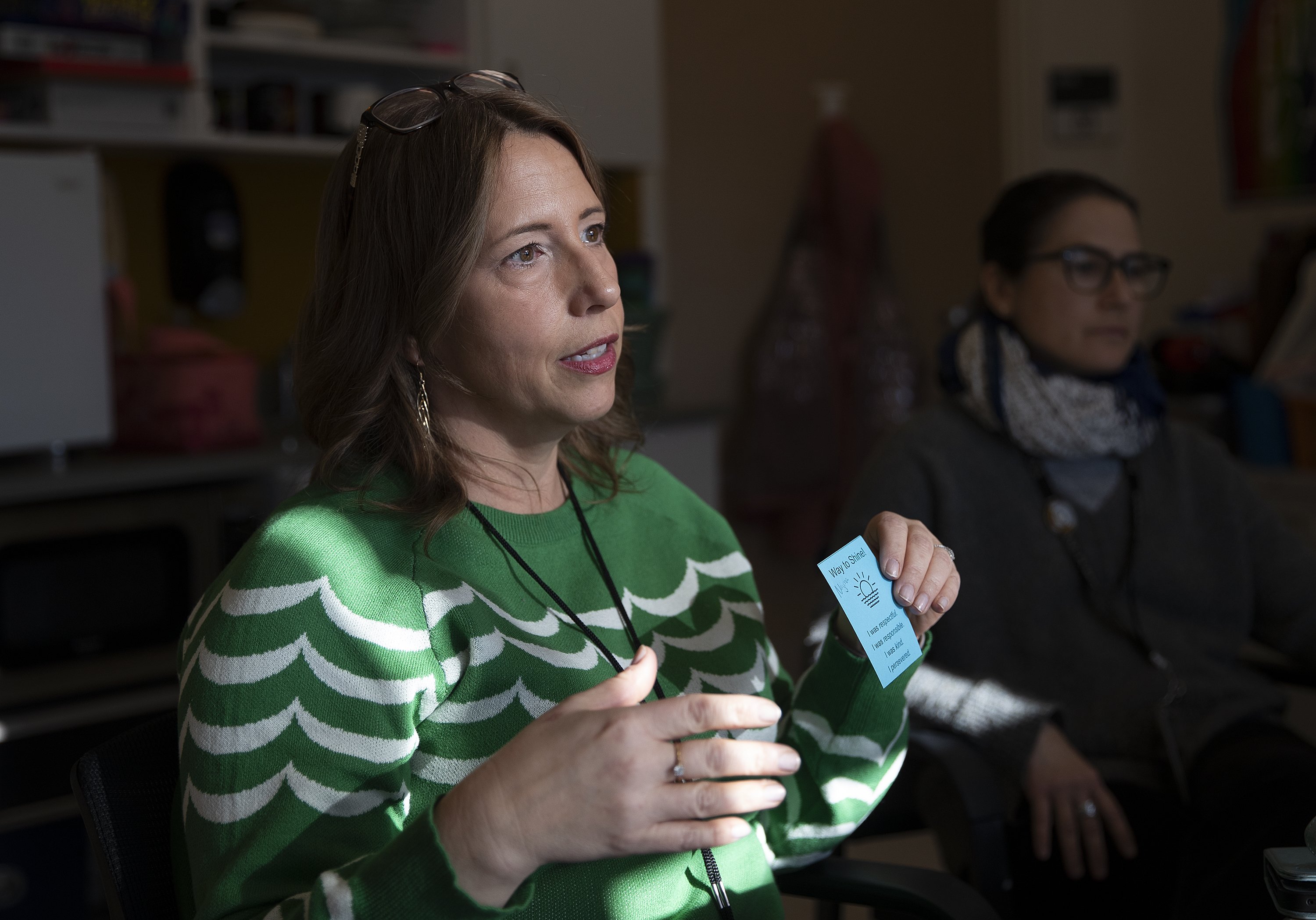
PORTLAND — On Dec. 1, Kelly Thornhill stood at the head of the cafeteria, a stack of blue cards in hand, and looked out on a group of East End Community School third graders.
“One, two, three, eyes on me!” the assistant principal called out. “So today, I am in here to celebrate students’ attendance.”
One by one, she summoned every student who had perfect attendance or missed only one day during November. She handed each a card with a graphic of the sun on it. The students beamed as they accepted their awards to the cheers of classmates.
“Now, if you missed more than one day, are you in trouble?” Thornhill asked.
“No!” the students shouted.
“Are we mad at you?” she asked.
“No!” they shouted back.
This monthly ceremony, called Way to Shine, is one of several initiatives East End is undertaking to get kids to miss fewer days of school. Administrators and teachers are focused on celebrating positive attendance rather than perpetuating a culture of shame.
Chronic absenteeism, defined as missing 10% or more of the days in a school year — about 18 days — doubled nationally and in Maine in the years after the COVID-19 pandemic. Ever since, school districts have been fighting to rebuild attendance habits.
For Portland Public Schools, the state’s largest and most diverse district, battling chronic absenteeism has meant transforming the school-wide culture around attendance.

At East End, the rate dropped from 25% during the 2022-23 school year to 13% last year. Thornhill credits a lot of that to the school-wide interventions.
“We may not be able to fill all the gaps that families are experiencing, but we can make school a place where kids want to come,” said Angela Atkinson Duina, Portland’s assistant superintendent of elementary schools.
ABSENTEEISM SPIKES
That trend is mirrored in Maine. During the 2021-22 school year, about three in 10 Maine students were chronically absent. Last school year, that rate dropped to 24%, according to state Department of Education data. But that still means about one in four students missed more than 10% of days last year.
There are three main reasons rates jumped following the pandemic, said Jess Anderson, director of the statewide attendance resource organization Count ME In. First, expectations around when a student should or shouldn’t go to school based on sickness have changed. Second, as schooling shifted online, more students felt they could learn remotely without attending school. And finally, Anderson said, mental health challenges among young people increased.
Parents also don’t always recognize how much learning happens in early grades, said Atkinson Duina. Among the elementary years, chronic absenteeism is most common in kindergarten.
In June 2024, Portland set the goal of reducing chronic absenteeism to below prepandemic levels (15%) by 2027 as part of its strategic plan. Atkinson Duina thinks it’s doable, and said she’s informally aiming for the state’s lower goal of 10%.
So far this year in Portland, the number of students with no absence issues is 62%, more than 10 percentage points higher than each of the last three school years. District-wide, chronic absenteeism was at 18% as of Dec. 1
But some challenges persist. For example, tackling absenteeism in middle and high schools is complicated, and the district has seen less progress at those levels. Preteen and teenage students have much more freedom, and are more likely to be dealing with jobs or responsibilities outside of school that affect attendance. Transportation is also more complex for them.
Another consistent concern: students experiencing homelessness. Chronic absenteeism hasn’t declined for them at all, said Anderson of Count ME In.
In the years after the pandemic, chronic absenteeism rose to the point where districts simply didn’t have the resources to work with every student individually, Portland district leaders said.
“Many of our attendance approaches or chronic absenteeism approaches were initially at the very individual student and family level,” Atkinson Duina said. “And we were spending a lot of our time and our energy on those, and when we had so many students that were chronically absent after the pandemic, it necessitated a shift.”
A CULTURE OF ATTENDANCE
At East End, Thornhill is spearheading several interventions to make attendance fun.
In addition to the the Way to Shine ceremony, once per week, she spins a big wheel with every student’s name on it for the ‘Are You Here?’ raffle. If that student is present, they get a sticker, a bracelet and a big round of applause. The school hosts community dinners, one of which they dedicate to teaching families about the importance of attendance.
Reiche Elementary in the West End has run its own fun interventions, like its Every Day in May event last year, where students could enter a raffle for prizes if they missed no days during the month of May.
Other solutions reflect the sobering social circumstances that can contribute to chronic absenteeism. East End, along with Reiche, recently got a grant from Whirlpool to install washers and dryers. They hope this will encourage attendance among students who stay home from school because they don’t have clean clothes.
There are also simpler strategies used across the district. Each month, every parent in the district receives a monthly attendance report on their student, even if they didn’t miss any days.
For students who are chronically absent, or trending toward it, the district still uses an individualized approach. They reach out to the families of those students. They send personalized nudges, or interview students to understand the root causes of the problem. Depending on the answer, the district may try to find an individualized solution, like giving a student an alarm clock.
Joanna Frankel, the district’s elementary director of culture and climate, said there used to be a lot of shame and blame around attendance.
“And now, the general thinking is … that we celebrate positive attendance as a strategy to maintain positive attendance,” she said.

Thornhill said one of her favorite interventions at East End was also the simplest, and it’s something the school rolled out even before the pandemic. Previously, when students arrived late to school, they would get a “late card” to bring to their teacher.
The school converted that slip into a “welcome card.”
“And that little piece is like, ‘You’re welcome, we want you here,’” Thornhill said. “And at the end of the day, we try to say, ‘See you tomorrow!’ to every student.”