

LAS VEGAS — Some athletic directors are starting to believe that collective bargaining agreements might be coming to college sports, even if the NCAA and its member schools have long said such labor deals are financially unfeasible.
With the U.S. Congress failing to act on a key piece of legislation on Dec. 4, there was a growing sense of frustration among college sports executives who met this week at Sports Business Journal’s Intercollegiate Athletics Forum in Las Vegas.
Meanwhile, a group of state attorneys general are urging their schools not to sign an agreement sent out by the newly created College Sports Commission that would set the guidelines for new rules to pay players.
Against all that, a few ADs see collective bargaining as something that could be inevitable, even if it would take some creativity to make it work without crushing the finances of their sports programs.
“Look, I think we have to give our athletes a bigger voice in all of this,” Ohio State University athletic director Ross Bjork said. “It’s really complicated. You have state law. You have private universities and public universities. These students are not employees. They’re student-athletes, so employment compensation, you set that aside.
“Structurally, it’s really, really complicated. No one has come up with the panacea. Everybody’s got all these proposals. It’s not that straightforward.”
The idea of a collective bargaining agreement would have been unthinkable not long ago, but so was name, image and likeness compensation — now part and parcel, particularly for more lucrative sports such as football and basketball — along with what is essentially free agency through the transfer portal and relaxed rules on immediate eligibility.
Athletes.org, a players association for college athletes, offered a 38-page proposal of what a CBA could look like. The group argued that a CBA would create uniform standards, decrease the risk of litigation, and offer legal protections for athletes not covered under current rules.
The NCAA and others have argued that if athletes are considered employees, it could result in schools having to take on costs such insurance and retirement contributions, as well as regulations they can’t afford. That could mean universities cutting some sports to help financially make up the difference.
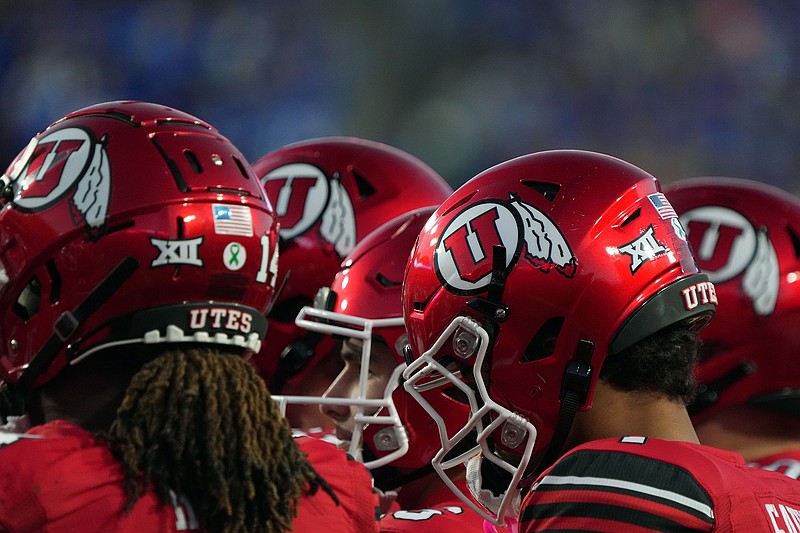
University of Utah football players huddle during the Utes’ Big 12 road game against in-state rival BYU on Oct. 18 in Provo. The Utes announced Tuesday they have entered into a partnership with a private equity firm to help generate new revenue streams for the school’s athletic department.
Joe Castiglione, who is in his 28th year as the University of Oklahoma’s AD and has announced he will retire from his full-time position this academic year, said college officials should study how businesses outside of sports address similar issues.
“I think they have to be part of the conversation for sure,” Castiglione said of collective bargaining agreements. “Undoubtedly, there’s a lot for us to figure out. There are a lot of components to that that aren’t easily managed. That being said, we should not let the difficulty deter us from having a full conversation about how we can create a sustainable environment for college athletics. We certainly don’t have that now.”
The NCAA and its members know they can’t rely on federal legislators to come to the rescue.
The House of Representatives declined last week to vote on a bill that would shield the NCAA from antitrust lawsuits. The SCORE Act failed to come to the floor despite backing not only from the NCAA, but also from the U.S. Olympic and Paralympic Committee, the White House and some athletes.
The bill has faced opposition from unions and the attorneys general for various states.
“I would love to say we’ve got to rely on ourselves to figure something out, but I know it’s been very challenging,” University of Maryland AD Jim Smith said. “There’s been a lot of people working on it over a period of time, so I can’t say it’s frustrating Congress isn’t helping. I think they are trying. It’s just a very complicated issue with a lot of people with a lot of opinions.”
In June, a federal judge approved a $2.8 billion settlement in the House v. NCAA antitrust lawsuit that set the stage for rewriting rules involving paying players in college sports, including schools’ athletic departments paying players directly via revenue sharing. That led to the creation of the College Sports Commission, which oversees the players’ NIL contracts. In November, the CSC announced it had given the OK to $87.5 million in deals for athletes.
With so much money involved, schools are trying to come up with creative ways to raise revenue to not only run day-to-day operations, but also to attract top recruits to be competitive in the different athletic arenas. The University of Utah entered into a partnership Tuesday with a private equity firm with the hopes of raising $500 million.
“Importantly, the university is not selling parts of our athletics department, ceding operational control to a third party or relinquishing control of any facilities,” Utah president Taylor Randall and AD Mark Harlan wrote in a joint message to the Utes community. “Decisions regarding sports, coaches, scheduling, operations, student-athlete care and other athletics matters will remain solely with the athletics department.”
Other athletic departments have resisted taking such a step as seeking private equity, but the talk at the forum was the Utes’ foray into this venture might prompt more schools to do the same.
“We have the biggest operating budget in the country — $320-ish million — and we spend every penny,” Ohio State’s Bjork said. “It’s not like we’re spitting off a 10% profit every year. We have to operate basically 34 sports (of 36) at a loss, and if we have the same number of sports as, say, Texas (with 21 teams), we have a $60 million problem.
“We don’t, so we need to be creative. We need to drive more revenue. If that’s a permanent capital revenue partner, maybe that’s the way to do it.”