
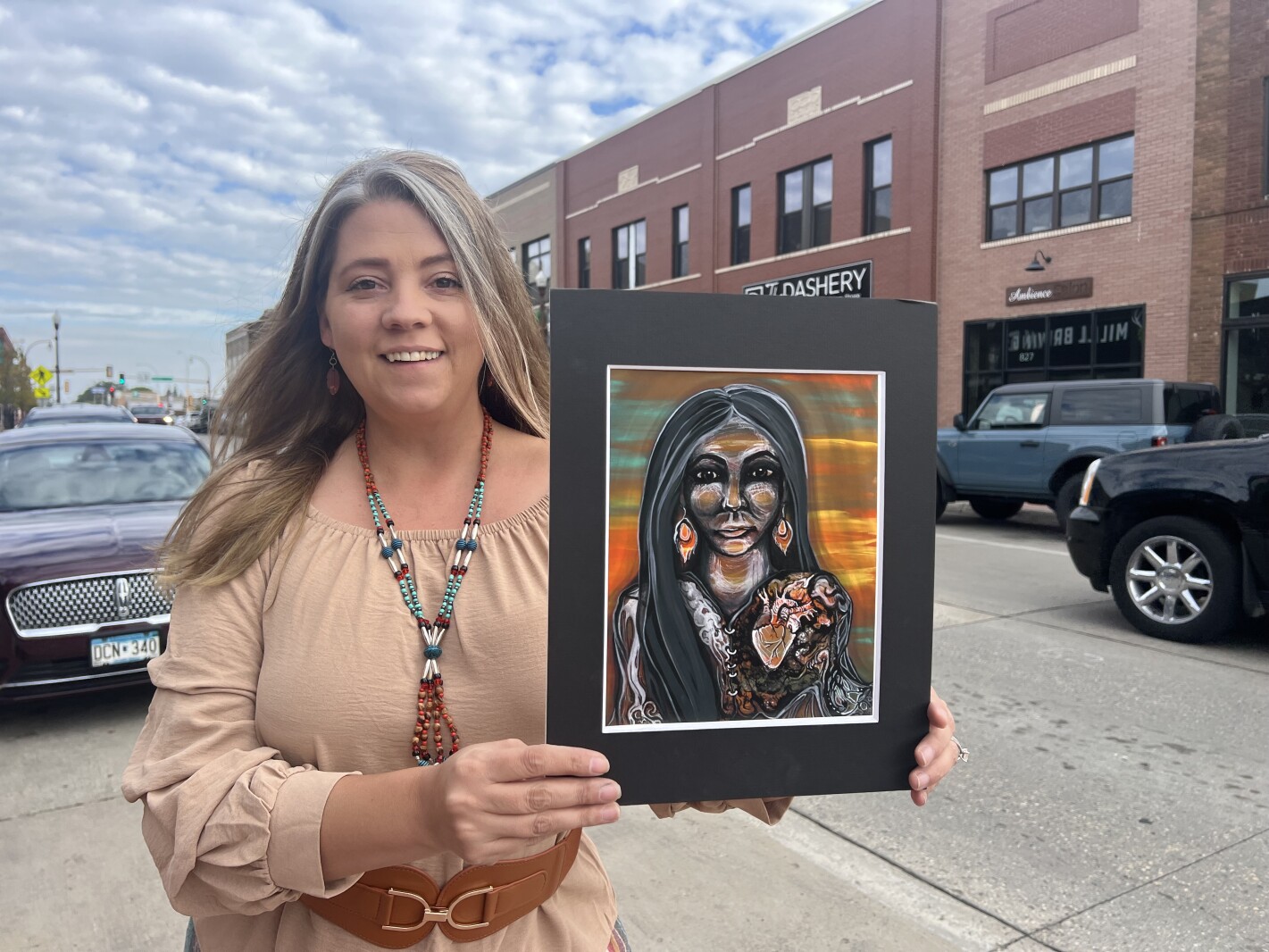
— Anishinaabe artist Katie Lou Muzquiz’s work has helped her overcome uncertainty, connect with her culture and heal. Starting on Oct. 7, visitors can see the visual representation of the Detroit Lakes resident’s journey at the Dr. Robert Powless Cultural Center in Duluth.
Her work will be featured in an exhibit titled Ezhi-Dibaajimomagakin Gide’inaanin: The Way Our Heart Tells Stories. Muzquiz’s work will be featured alongside that of Indigenous artist Chimakwa Nibawii Stone of Lac Courte Oreilles, Wisconsin.
It’s an exciting time for Muzquiz, whose primary medium is oil paint, as it’s the largest exhibit of her work so far. About 12 to 15 of her oil paintings will be on display, as well as two sculptures, a new medium she’s begun experimenting with.
“I’m nervous, excited. We’re going to have drum group there for the reception, so I’m always honored when I get to hear that … it’s kind of my equivalent to bungee jumping,” Muzquiz said Wednesday ahead of the Saturday, Oct. 5, gallery reception. “I’m not a risk taker or an adrenaline junkie but when you put your art out there for the world to see it is very intense.”
And it’s understandable why it feels so intense for Muzquiz, as her paintings are deeply personal. An artist her whole life, putting paint on canvas has long been a method of healing and reassurance during times of uncertainty.
Muzquiz has a genetic disorder that causes blood clots. Since she was 19, she’s been on blood thinners to prevent pulmonary embolisms, thrombosis and other types of clots. But even with medication, clots have formed, requiring surgery.
“I’ve had four open heart surgeries and five lung surgeries, so a lot of what I’ve experienced I’ve put into my work and as self-narrative, it’s also healing,” she said.

Contributed / Katie Lou Muzquiz
Her painting “Future Self Portrait,” which will be displayed at the Duluth exhibit, was one such work that helped her through a dark period. About eight years ago, while at the Mayo Clinic in Rochester, Muzquiz got the devastating news that she would need a third open heart surgery.
Depressed, she got home, set up her easel on her living room coffee table, took out her painting supplies and got to work. As Muzquiz described it, she enters a state of flow while painting and can keep at it until her “eyes go blurry.”
“I thought, no, I’m going to still be here until I have gray hair, and now I do, I painted gray hair in there,” she said. “That is one of the ways I deal with that information and process it, then turn it into a product.”
And while painting has played a healing role for Muzquiz, it has also connected her with her Anishinaabe heritage. Growing up, she was alienated from the culture, and seeking to learn more about it, she enrolled in the White Earth Tribal Community College in 2017.
“I had to go out and relearn the language and revitalize it, and I’ve only taken a year and I fell like it’s important work,” she said. “I don’t know if it’s my age or maturity, I just realize it’s important to preserve that.”
She graduated with her associate’s degree in 2019 and began attending Minnesota State University Moorhead to attain her bachelor’s degree in art education, with minors in art therapy and studio art. At MSUM, Muzquiz has fine-tuned her voice and closely embraced her cultural identity, which attending White Earth Tribal Community College helped kickstart.

Contributed / Katie Lou Muzquiz
At her MSUM professors’ encouragement to find to her find her voice, she began thinking about art beyond the moment-to-moment processes and started ruminating on the healing properties of creating.
“And then I started using it to capture some of my culture, personal narratives, dreams, I do a lot of impressions of landscapes I’ve been at,” she said. “The main thing is I’ve been keeping in practice daily, doing something with some medium to keep creating.”
While earning her degree, she’s also had the chance to work with several Indigenous artists who have helped her refine her craft, particularly during the COVID-19 pandemic when people were seeking out connections during a prolonged period of isolation.
Her education has stopped and started over the years as health issues flared up, but she is now in her senior year, and with her diploma within reach, she has her sights set on hosting art workshops and providing art education opportunities in Detroit Lakes and surrounding communities. That’s something she’s already familiar with, having instructed classes in Detroit Lakes, Mahnomen, Frazee and Perham over the years.
Art has been healing for Muzquiz, and she knows it can be healing for others too — veterans, youth, elders, anyone.
“I’ve realized that it’s not just a hobby, it’s to help — I want to help others as it’s helped me,” she said.
Ezhi-Dibaajimomagakin Gide’inaanin: The Way Our Heart Tells Stories officially opens to the public on Monday, Oct. 7, and runs until Dec. 20 at the Dr. Robert Powless Cultural Center, 202 W Second St. in Duluth. Viewing hours are Monday through Friday, 10 a.m. to 5 p.m.
More information about the exhibit can be found at
https://www.aicho.org/way-our-heart-tells-stories24.html#/
.

Contributed / Katie Lou Muzquiz

Tris Anderson / Detroit Lakes Tribune