
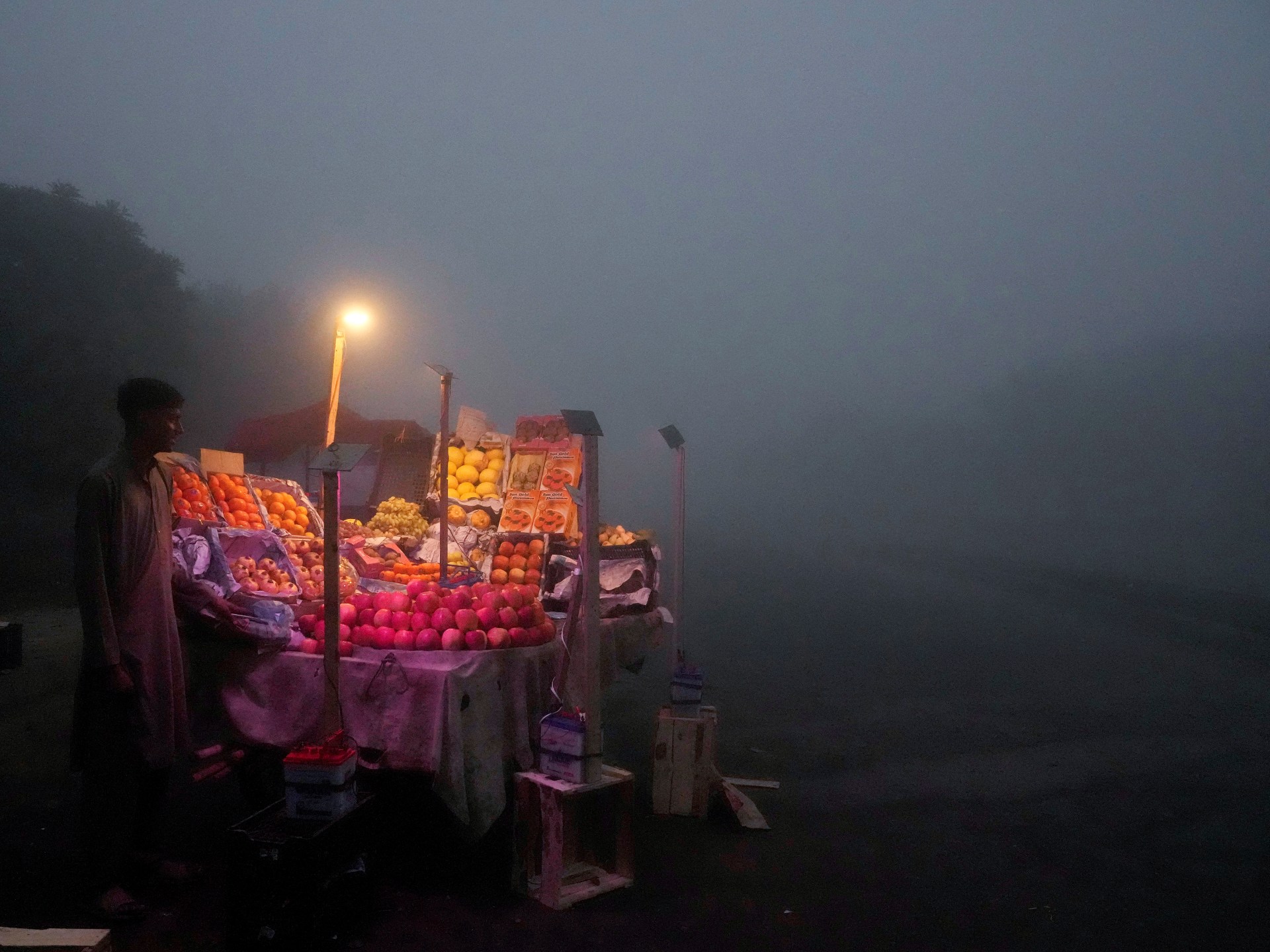
Lahore, Pakistan – Fourteen-year-old Fatima has woken up coughing, with a fever, on a Monday morning in early November.
“My throat hurts, and it feels like the smog is coming in through the rooftop,” she says while rubbing her left eye beneath her thick round glasses.
Outside her window, Lahore – Pakistan’s second-largest city and the cultural heart of Punjab – is wrapped in a thick, grey haze which is suffocating its residents through the winter months. While smog has plagued the city in previous years, this year the air quality has become dangerously poor, reaching levels far beyond what is considered safe for human health.
The Air Quality Index (AQI) is a measure of pollution in the air, with higher numbers indicating greater health risks. Levels above 300 are considered dangerous.
“Stuff I could never even imagine, going beyond 2,000 Air Quality Index (AQI). We’re at 2,500 to 2,600,” says Ahmad Rafay Alam, a Pakistani environmental lawyer and activist. “And it’s not only a Lahore-based problem. It’s a Kabul-to-Calcutta problem. A yearlong, regional, public health emergency,” he adds.
“While we tend to think it’s seasonal, it also isn’t, because the things causing air pollution today are the same things causing air pollution in June. It’s just that hot air rises in June, and you have the monsoon, so for most of the year, winds and rain dissipate the air pollution.”
Choked by a mix of vehicle emissions, industrial pollution, brick kiln fumes and residue from crop burning, Lahore has earned the unfortunate distinction of being one of the world’s most polluted cities.
“The primary yearlong air pollutant is automobile exhausts, and we know this because the petrol available in Pakistan is some of the dirtiest in the world,” Alam says.

‘It’s like a jail’
On the same Monday morning that Fatima wakes up with her hacking cough – November 4 – Punjab’s education authorities have closed all the primary schools in Lahore to protect children’s health. Like millions of other pupils throughout the country, even if she could return to school if her health returned, Fatima is now confined indoors.
Sitting in her favourite hanging egg chair, she peeps through the gaps in the bamboo blinds on her balcony. She can only see the faint outline of neighbouring houses, their walls barely visible through the thick air. Even the usual chatter of street vendors has fallen silent. It’s as if the city itself is disappearing.
Fatima’s home is in a neighbourhood close to the western bank of the Lahore Canal, a key waterway that runs through the city. Situated between the vibrant Walled City and the more refined Lahore Cantonment, her area – like the rest of Lahore – is blurred.
“At first, it felt like a holiday,” Fatima says of being confined to the house, her voice cracking as she fights back a cough. “But now, it’s just boring. I can’t even go outside to play.”
Fatima’s mother, Rashida Khurram, sighs. “I’ve had to keep her indoors for her health, but she doesn’t understand why.”
“No cycling, no playing on the street, just staying inside all day,” she continues. “Going outside, even for just a short while, is like a refreshment for children. But when we have smog, they are screen-bound,” she said, her exhaustion evident in her voice.
Fatima’s younger siblings, her 12-year-old sister Zainab and eight-year-old brother Khizar, are also stuck within the home’s four walls.
“It’s like a jail for them. They’re trapped inside,” says Rashida.

The children look for ways to express their frustration in their own way.
Their father, Khurram, a Lahore-based fashion designer, does his best to uplift his children during school closures. He gives them new colouring books and crayons and guides them as they draw.
Together, they channel their energy into sketching scenes of Lahore that capture the harsh reality of Pakistan’s smog crisis.
Zainab’s artwork, divided into four panels, tells a story of chaos and entrapment amid the smog crisis. One panel shows her school marked “Closed” with cars outside it involved in an accident, symbolising the dangers of poor air quality. Landmarks like the Badshahi Mosque and Minar-e-Pakistan appear beneath polluted skies, overshadowed by smoke-spewing factories.
The most striking image is a personified Earth, sketched fleeing a smoky landscape, with tears streaming down its masked face as it pleads, “Save Me”. Is this Zainab’s fear speaking, or some profound awareness of the planet’s fragility?
A 2011 study in the Procedia – Social and Behavioral Sciences journal highlights “emotional indicators” in children’s drawings, noting that for young children, “pencil, brush, and paper are the best means of conveying their fondest hopes and most profound fears”. The study further explains that “it is through their drawings that children express their views and interpretations of their experiences”.
“I sat alone in my room, shut the door, and finished my drawing,” says Fatima. Her artwork shows factories releasing smoke, green trees standing against the haze, and a panicked smog cloud, personified with fear.
At the bottom, her handwritten message urges action: “Let’s Beat the Smog.” Drawn on green paper, her work symbolises hope – trees as a solution, against pollution and calling for preserving nature to reclaim clean air.
Meanwhile, eight-year-old Khizar draws his favourite superhero – Spiderman.
“Look, Mama! Spiderman is fighting the smog with his web shooters,” he says, proudly pointing to his artwork.
Full of childlike optimism, these drawings are more than art – they’re a window into a world in which children believe air pollution can be defeated. Yet, the stark reality is that it’s a battle Pakistan appears to be losing.

Smog – as bad as smoking?
Watching Fatima closely, Rashida’s concern grows as her fever fails to break. “I worry about the long-term effects of this. This constant sickness and the tiredness. It’s not good.”
The fear is real – smog and air pollution cause much more than just coughing fits. They are linked to increasingly serious health problems, especially in children.
Dr Kamran Khalid Cheema, an expert pulmonologist specialising in lung and respiratory health, in Lahore, tells Al Jazeera: “We now know that one of the reasons for developing lung diseases as adults is stunted lung growth during childhood. This is usually attributed to malnutrition and childhood infections, with the added dimension of smog. Smog is likely to affect the windpipes, causing swelling and inflammation, which can lead to diseases such as asthma and chronic obstructive pulmonary diseases [COPD].”
In children who already have asthma – “which is definitely related to the environment” – smog makes the symptoms worse. It leads to breathing disturbances, disturbed sleep, breathlessness during sport, absences from school, and the need for rescue medication, says Cheema.
Cheema also points to another lung disease which causes the air sacs, tiny structures within the lungs, to become abnormally dilated, damaging the walls between them and reducing areas for gas exchange. This condition, known as emphysema, is commonly linked to smoking. He warns that the high levels of smog in Lahore could cause similar damage in children, potentially leading to emphysema later in life.
“If smog has a similar effect to smoking, then I dread to think what these children will have to face over the next 15 years,” he adds.

A 2018 study in the Polish Journal of Environmental Studies compared children from high-pollution urban areas with those from less-polluted regions. It found that children in polluted areas had significantly lower haemoglobin levels and red blood cell counts, and were nearly four times more likely to develop anaemia and other health issues.
The study suggests that exposure to air pollution damages children’s red blood cells, significantly increasing their risk of further health problems.
This may be playing out in Pakistan. Alongside her cough and chest infection, Fatima’s blood tests have revealed low haemoglobin levels, suggesting anaemia.
“Unfortunately, there isn’t much that parents can do, other than moving away from this part of the world or leaving the cities to live in villages,” Cheema says.
There are preventive measures parents can take, such as ensuring timely flu shots and consulting experts if their children develop symptoms. “In some cases, starting inhalers early can prevent symptoms from progressing to the point where they start affecting the child’s life,” he adds.
Cheema also notes that while the impact of smog on restrictive lung diseases remains unclear, substances like silica and coal dust which may be present in the air are known to cause lung fibrosis, and understanding how smog contributes to this will require long-term, population-based studies of children.
Alam points out that there is still little to no research on the public health impacts of air pollution in Pakistan. “There is no documentation in Pakistan that we can take to policymakers or the media and highlight the problem.” However, he mentions two studies, one by the Aga Khan University in Karachi and the other by the Children’s Hospital in Lahore.
“The study by the Children’s Hospital reports a three-time increase in the number of kids admitted because of respiratory diseases between 2008 and 2018. It’s a back-of-the-envelope study,” says Alam.
“In January 2024, when we had the air pollution episode coming to an end, there were at least 500 kids reported to have died of pneumonia in Punjab alone. That was just in January,” he says.
“These aren’t abstract figures, kids are going to get more sick. Kids are dying, and the same pollution that affects them in January is the same in June, and it’s the same pollution right now.
“The thing about air pollution is that you don’t just die. This takes weeks and months to gestate in your system and show itself as some problem,” he adds.

Another layer of struggle for parents
Smog is not just a health hazard, it also takes a psychological toll on children and disrupts their education.
Natasha Wali, a psychological therapist, specialising in child therapy, explains how these disruptions affect children’s emotional wellbeing.
“I have observed many parents and their children go into a sort of anxiety or helplessness whenever schools shut down,” she said.
“When our children are struggling to breathe while also getting less physical activity than they developmentally need, we will see this impact their mood, concentration, sleep and stress levels. There are studies that have linked people who have had long-term smog exposure to developing a range of mental disorders.”
Limited access to online education adds yet another layer of hardship during school closures.
In many households like Fatima’s, technology is a scarce resource. With just one device to share among her siblings, attending online lessons becomes a struggle.
“Since they all attend different schools and classes, their schedules often clash,” explains Fatima’s mother. “One child logs in first to mark attendance, and then I have to quickly switch to another’s class, deciding which is more important at that moment. Usually, it’s Khizar, the youngest, who ends up missing his lessons.
“If they miss a class, teachers record the lesson and share it, displayed on the blackboard.”
While helpful, these video lessons may lack the personal connection and immediate feedback of live sessions, making it harder for children to engage and ask questions. “Sometimes, the children don’t even want to take online classes at all, and I have to really push them to participate,” adds Rashida.
Complicating an already difficult situation, Wali explains, “Smog season adds another layer of struggle to parenting.
“The smog crisis doesn’t seem to be going away any time soon, with families needing to put plans in place by asking the questions of: how can we restrict smog exposure? How can I get extra support during smog season? What indoor physical activities can my child be involved in during this time? What are my expectations for online school or home learning? What are my own plans for self-care during this time?”

Just 15 minutes from Fatima’s home, 16-year-old Eshal is stuck at home in the northeastern suburbs of Lahore, facing similar issues. “The smog irritates my eyes,” she says.
Eshal spends school closures attending online classes from 9am to 2pm. “At first, not having to wake up early and rush to school felt like a relief,” she admits. “But then, I started missing my friends, my teachers and the classroom environment. I enjoy my physics classes the most.”
The school closures remind Eshal of the COVID-19 lockdowns, but this time, it’s not a virus – it’s the air she breathes.
Ironically, during the COVID-19 lockdowns in Pakistan, Lahore experienced something of an environmental reset as everything shut down. The skies turned blue, the air became cleaner and the congested streets emptied. For the first time in years, pollution levels dropped dramatically in many cities across the country.
“We saw butterflies again after a long time,” Cheema says.

Now, frequent power outages, caused by a combination of factors, including ageing energy infrastructure, low installed capacity, and rising fuel costs – along with slow internet speeds across Pakistan – make it difficult for children to keep up with their schoolwork. When they do manage to join online classes, the video and audio quality is often poor, with frequent disconnections, audio delays and visual glitches – yet another burden for pupils and teachers.
Mahnoor Shahid, 22, a private homeschool tutor who is training to be a medical lab technologist, tells Al Jazeera: “My workload has increased during tuition hours because I need to cover the material students miss at school. This leads to extra work in the evening as I catch up with those who miss their classes.”
For tutors like Mahnoor, it’s no longer just about teaching. Her work has become about filling the gaps in a system that cannot fully support these children.
Educational experts warn that prolonged school closures could have long-term consequences for children’s academic progress and social development.
Sabahat Rafiq, an educational technology philanthropist, says: “For children, these arbitrary lockdowns are particularly damaging. Schools are crucial to their development, not just academically but socially and emotionally. Frequent, unplanned closures disrupt routines, hinder learning and leave children isolated and idle.
“Lockdowns are reactive measures, not solutions, and their continued use reveals a state that lacks both vision and accountability.”
Instead, the authorities should be taking on the real and complex work of reducing emissions, enforcing environmental regulations and investing in sustainable urban planning, she says. “The government shifts responsibility onto its citizens by confining them to their homes, as though this can somehow reduce the poisonous air they still must breathe.
“So long as the government continues to lock down, rather than clean up, it betrays its disregard for the future it claims to protect. This state of policing a population into submission cannot continue if there is any hope of overcoming the environmental crisis that so desperately needs genuine reform.”

‘We need superheroes’
School closures in Pakistan are increasingly common. In May 2024, intense heatwaves forced schools in Punjab to close for several days. Later, in July 2024, school summer holidays in southern Pakistan were extended by two weeks due to dangerously high temperatures, affecting more than 100,000 schools.
Previously, in October 2023, an outbreak of conjunctivitis, or pink eye, led to the closure of more than 56,000 schools across the country.
In October 2023, during last year’s smoggy season, Fatima also suffered from viral conjunctivitis, triggered by bacterial infections, allergens like pollen or dust, and irritants such as smoke and harsh chemicals.
“My eyes were red and watery,” she recalls.
Pakistan is not alone in facing these challenges. Countries including Bangladesh, the Philippines and Sudan have also closed schools due to severe heatwaves, air pollution and other climate-related crises.
As long as the causes are not addressed, say experts, the situation will only worsen.
One issue is the sheer volume of road traffic, says Cheema. “Motorbikes are a major contributor to Pakistan’s smog problem,” he explains. “They serve as a primary mode of transport for the lower-middle class, which makes up the vast majority of our population. Unless electric bikes are made affordable and accessible to them, I don’t see a solution any time soon. The only hope is that, over time, we move from fossil fuels to cleaner energy. That is the only way to save our children.”
Even if this is achievable, it won’t be enough, says Alam. “Unless there are air quality monitors at home, the children are still going to get the same level of pollution inside their homes as they would be outside. So, it’s not actually improving the situation.”

The lack of data on pollution levels in Pakistan is also a major problem, he adds: “There are very few air pollution monitors, run by private individuals, and they only monitor one or two types of air pollution. What we need is a robust network throughout the province, if not the country, so it can provide real-time, yearlong information on how bad the air pollution is, where it is, and what it’s composed of. This would allow us to make appropriate policy responses.”
In countries where governments have committed to long-term measures to reduce the use of fossil fuels, air quality has improved, he says, proving that sustainable development and public health can go hand in hand.
For example, authorities in Beijing, China, which suffered severe smog in 2015 resulting in school closures for several days, have since taken action. Today, public schools are equipped with advanced air purification systems, ensuring cleaner air for students in classrooms. Additionally, all school buses are fitted with air filtration systems to protect children during their commutes.
“We need to foster the sense of community awareness because air pollution or improving air quality isn’t really stuff you can do on an individual level,” says Alam. “I don’t think there are individual things that young kids can do on their own other than mobilise collectively, socially and politically, to ask for a clean air future from their elected representatives.”
With their drawings scattered around their home, Fatima, Zainab and Khizar are piecing together sketches of superheroes and crying Earths, their message clear: “Save Us.”
But will policymakers finally act, or will Lahore’s youngest continue to carry the heaviest burden?
Perhaps it’s time to become the superheroes our children wish for.