Close Menu
  • Breaking News
  • Business
  • Career
  • Sports
  • Climate
  • Science
    • Tech
  • Culture
  • Health
  • Lifestyle
  • Facebook
  • Instagram
  • TikTok
Categories
  • Breaking News (5,811)
  • Business (331)
  • Career (4,858)
  • Climate (225)
  • Culture (4,831)
  • Education (5,095)
  • Finance (231)
  • Health (898)
  • Lifestyle (4,641)
  • Science (4,783)
  • Sports (353)
  • Tech (189)
  • Uncategorized (1)
Hand Picked

xAI faces backlash after Grok generates sexualized images of minors

January 2, 2026

Four realistic resolutions and how to keep them | Life and style

January 2, 2026

‘More Neanderthal than human’: How DNA from our long-lost ancestors affects our health today

January 2, 2026

Doug Kaercher Retiring after 37 Year Public Service Career – Hi-Line Today

January 2, 2026
Facebook X (Twitter) Instagram
  • About us
  • Contact us
  • Disclaimer
  • Privacy Policy
  • Terms and services
Facebook X (Twitter) Instagram
onlyfacts24
  • Breaking News

    xAI faces backlash after Grok generates sexualized images of minors

    January 2, 2026

    Tommy Lee Jones’s daughter Victoria dies in suspected overdose at hotel

    January 2, 2026

    Five things you need to know about protests in Iran | Protests News

    January 2, 2026

    Berkshire Hathaway shares dip as Warren Buffett exits and Greg Abel era begins

    January 2, 2026

    ‘Real Housewives’ star ran a cult-like church, family members claim

    January 2, 2026
  • Business

    Mapping trends in digital business research: from bit transformation to sustainable data-centric enterprises

    December 18, 2025

    YouTube 2025 Top Creators and Trending Topics List and Recap

    December 17, 2025

    Brussels aware of DPS initiative to clean up voter lists in the Western Balkans

    December 16, 2025

    Communicators know business acumen matters. Most don’t feel ready.

    December 12, 2025

    AI investment is a hot topic in the business community and policy authorities these days. As global ..

    November 26, 2025
  • Career

    Doug Kaercher Retiring after 37 Year Public Service Career – Hi-Line Today

    January 2, 2026

    Madison Rayne Announces Retirement After 20-Year Career

    January 2, 2026

    Dylan Guenther News: First career hat trick Thursday

    January 2, 2026

    ‘The Motor Doctor’ puts the brakes on 47-year career | Local News

    January 2, 2026

    News Flash • Career Day

    January 2, 2026
  • Sports

    National Football League (NFL) – statistics & facts

    December 27, 2025

    Thunder’s Nikola Topic returns to court amid cancer treatment

    December 23, 2025

    The Seahawks’ win Thursday is still a hot topic around the NFL, not just for how special the game was but what it meant

    December 20, 2025

    Yahoo! Sports UKNikola Topic out here in pregame warmups. First time …Ben Stokes and Jofra Archer were involved in a heated exchange as England toiled in Adelaide and Australia tightened their grip on the Ashes….4 hours ago

    December 19, 2025

    Collective bargaining for college sports becomes hot topic for athletic directors

    December 12, 2025
  • Climate

    Environment and Healthcare, a two-way traffic: Challenges, Impacts, and Sustainable Solutions

    January 2, 2026

    PA Environment Digest BlogStories You May Have Missed Last Week: PA Environment & Energy Articles & NewsClips By TopicPA Environment Digest Puts Links To The Best Environment & Energy Articles and NewsClips From Last Week Here By Topic–..1 day ago

    December 16, 2025

    PA Environment & Energy Articles & NewsClips By Topic

    December 15, 2025

    PA Environment & Energy Articles & NewsClips By Topic

    December 8, 2025

    ‘Environmental Resilience’ topic of Economic Alliance virtual Coffee Chat Dec. 9

    December 7, 2025
  • Science
    1. Tech
    2. View All

    CES 2026 trends to watch: 5 biggest topics we’re expecting at the world’s biggest tech show

    January 1, 2026

    turbulent year for end-device and downstream applications

    January 1, 2026

    a year of strategic realignment for global semiconductors

    December 30, 2025

    CES 2026 trends to watch: 5 biggest topics we’re expecting at the tech show

    December 24, 2025

    ‘More Neanderthal than human’: How DNA from our long-lost ancestors affects our health today

    January 2, 2026

    15 skywatching events you won’t want to miss in 2026

    January 2, 2026

    How to watch 1st 2026 meteor shower, supermoon in Louisiana | News

    January 2, 2026

    The Galaxy Next Door – NASA Science

    January 2, 2026
  • Culture

    Center for Religion, Culture & Democracy Kicks Off 9th Annual D.C. Fellowship – News

    January 2, 2026

    THE POP CULTURE NEWS BULLETIN 223: THE FIRST OF THE NEW YEAR

    January 2, 2026

    Vintage Vibes and Fresh Finds: My pop culture year wrapped | To Do

    January 2, 2026

    Los Guadalupanos shares their culture in Highlands | Highlands News-Sun

    January 2, 2026

    St. Joseph Retro Con returns with pop culture icon

    January 2, 2026
  • Health

    Quote of the day by Millie Bobby Brown: ‘Mental health is not a taboo topic; Remember, we are human beings’ |

    January 2, 2026

    Native Plants and Soil Health Topic of Jan. 8 Herb Society Meeting

    January 1, 2026

    LA County Public Health – Health Education Administration

    December 31, 2025

    Stars who have spoken out on the topic of mental health

    December 25, 2025

    Medical evacuations out of U.S. Central and U.S. Africa Commands among the active and reserve components of the U.S. Armed Forces, 2024

    December 23, 2025
  • Lifestyle
Contact
onlyfacts24
Home»Science»15 skywatching events you won’t want to miss in 2026
Science

15 skywatching events you won’t want to miss in 2026

January 2, 2026No Comments
Facebook Twitter Pinterest LinkedIn Tumblr Email
AXzMJTftmHAvM4q6zMGut9 1920 80.jpg
Share
Facebook Twitter LinkedIn Pinterest Email

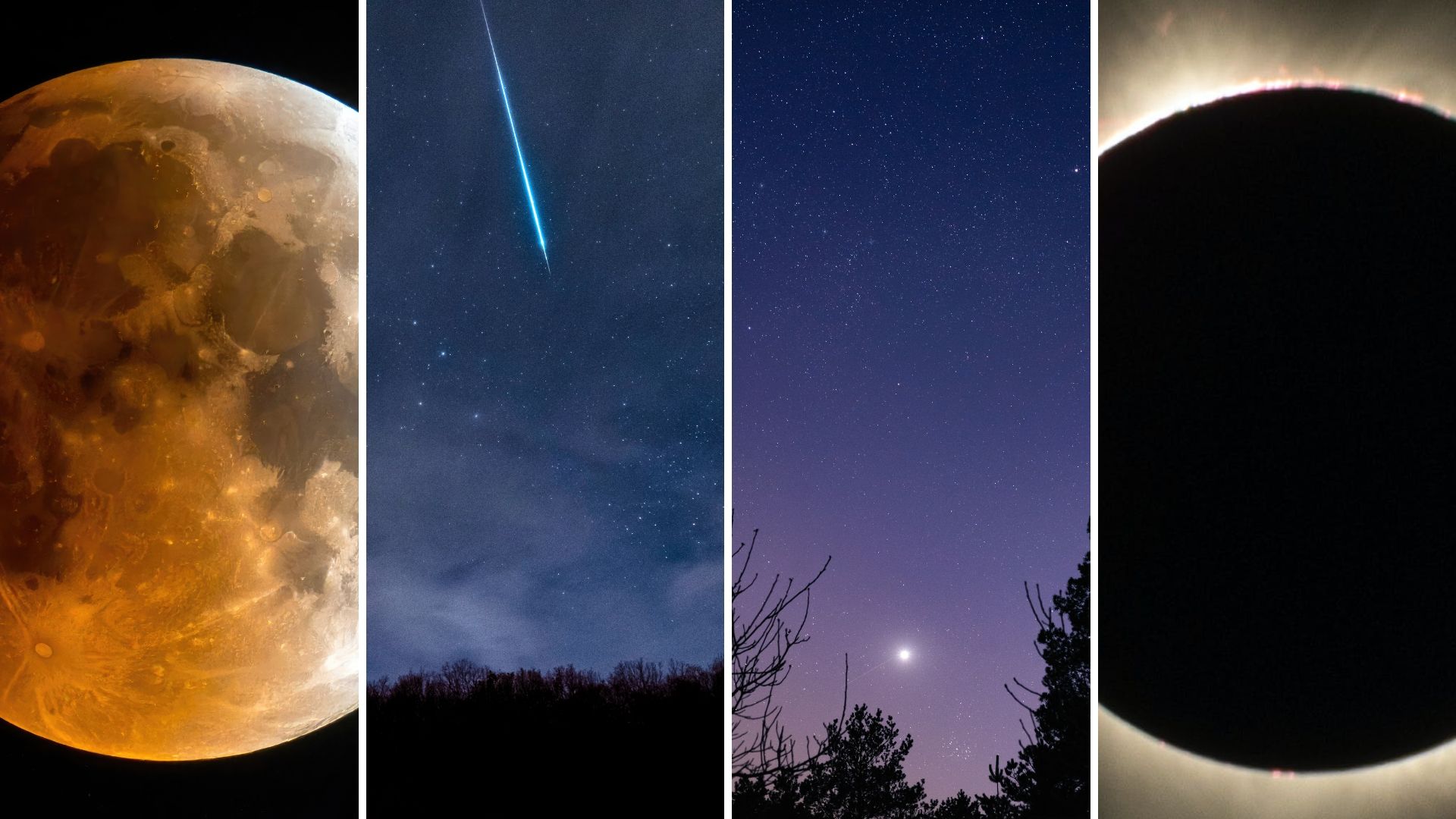
Skywatchers have plenty to look forward to in 2026, with a lineup of dazzling naked-eye events in the night sky throughout the year. From total solar and lunar eclipses and brilliant planetary conjunctions to iconic meteor showers peaking under moonless night skies and a festive supermoon, there’s something for everyone to enjoy.

Although all of these events will be visible to the naked eye, a nice pair of binoculars and a good beginner telescope can significantly enhance your experience.

Here are 15 must-see skywatching events to mark on your calendar for 2026.


You may like

1. Jupiter at opposition: Jan. 10, 2026 (all night)

A blue and yellow night sky glows over a forested green landscape with a bright dot in the center of the image.

Jupiter will reach opposition on Jan. 10, 2026. (Image credit: Alan Dyer/Stocktrek Images/Getty Images)

Jupiter will dominate the night sky in early 2026. In early January, the gas giant will align with Earth and the sun to reach its full phase, called opposition. This happens once every 13 months, and it’s the best time to observe the giant planet. That’s partly because it’s the brightest it will be all year but also because it rises in the eastern sky at sunset and sinks in the west at sunrise.

2. “Blood moon” total lunar eclipse: March 2-3, 2026 (night to early morning)

A composite image showing three phases of a lunar eclipse against a black background, with the moon going from gray on the left to blood red on the right

See a total lunar eclipse on March 3, 2026. (Image credit: Westend61/Getty Images)

During the first and only total lunar eclipse of 2026, March’s full Worm Moon will pass through Earth’s shadow, making it appear as a reddish-orange “blood moon” for 58 minutes. The March 2026 total lunar eclipse will be visible across western North America, Australia, New Zealand, East Asia and the Pacific. It will be the last total lunar eclipse until a rather special one on New Year’s Eve 2028-2029. In North America, totality will occur on the night of March 2 or early morning hours of March 3, depending on the time zone.

Related: March 2026 total lunar eclipse: Everything you need to know about the next ‘blood moon’

3. Close conjunction of the moon, the Pleiades and Venus: April 19, 2026 (after sunset)

A labeled night sky image showing labeled dots for the moon and Venus near the center of the image

See the moon, the Pleiades and Venus together in April. (Image credit: Stellarium)

4. Eta Aquarid meteor shower: May 5-6, 2026 (before midnight)

A streak of green is seen over a sunset sky with a dark silhouette of a tree in the bottom right of this long exposure image

The Eta Aquarid meteor shower is caused by Halley’s Comet. (Image credit: Diana Robinson Photography/Getty Images)

The Eta Aquarid meteor shower produces up to 50 meteors per hour, making it one of the most prolific meteor showers of the year and the clear highlight of spring’s “shooting star” season. The last-quarter moon rising around midnight makes early evening the best time to see the Eta Aquarids (also spelled Eta Aquariids), which are caused by the debris from Halley’s Comet left in the inner solar system, although the best views will be from the Southern Hemisphere.

Breaking space news, the latest updates on rocket launches, skywatching events and more!

5. Conjunction of Jupiter, Venus and Mercury: June 9, 2026 (after sunset)

A dark blue night sky image with labeled dots for Venus and Jupiter in the center of the image and Mercury toward the bottom right of the image

Jupiter and Venus will be seen close together on June 9, 2026. (Image credit: Stellarium)

The two brightest planets in the solar system, Venus and Jupiter, will shine together for a few evenings, getting as close as 1.5 degrees — about the width of a finger held at arm’s length against the sky. The duo will be visible in the western sky just after sunset, with the best view on June 9. As a bonus, Mercury will make a rare appearance below the two bright planets.

6. Total solar eclipse: Aug. 12, 2026 (daytime)

A glowing halo of light encompassing a dark circle with a bright ball of light at the bottom left is seen in front of a dark background

See mainland Europe’s first total solar eclipse since 1999. (Image credit: Edwin Remsberg/Getty Images)

The celestial highlight of the year will be the total solar eclipse on Aug. 12, 2026, which will be seen from eastern Greenland, western Iceland and northern Spain. As the first total solar eclipse in mainland Europe since 1999, it is bound to be busy, especially because it falls during the European holiday season. Iceland has not seen a total solar eclipse since 1954, and Spain has not since 1906. (Spain will also see one in 2027.) The Mediterranean will be busy with cruise ships for a close-to-sunset totality, but maximum totality will occur for 2 minutes, 18 seconds off the coast of Iceland. A partial solar eclipse will be visible in parts of Europe, northwestern Africa, Canada, Alaska and the northeastern U.S.

Related: Total solar eclipse 2026 — Everything you need to know


You may like

7. Perseid meteor shower: Aug. 12, 2026 (night)

A figure with a tripod stands near a light illuminating a frozen lake with silhouettes of the mountains in the background with streaks of light filling the night sky above as the Perseid meteor shower gets underway

2026 is a good year for the Perseid meteor shower. (Image credit: Haitong Yu/Getty Images)

The Perseid meteor shower was pretty much a washout in 2025, with the peak night blighted by moonlight. Happily, the Northern Hemisphere’s favorite display of “shooting stars” will fare much better in 2026. In fact, the peak night, Aug. 12-13, will occur just hours after a total solar eclipse, which, by definition, can happen only during a new moon. Eclipse chasers in Spain, in particular, could see two of astronomy’s most spectacular events on the same day. About 60 to 120 Perseid meteors are expected to radiate from the constellation Perseus, but they may appear anywhere in the night sky from late night to predawn.

8. Venus as the “evening star”: Aug. 15, 2026 (after sunset)

A deep blue night sky shines over a series of rocky plateaus while a bright dot, Venus, is seen in the center of the sky

Venus will dominate evening skies in summer 2026. (Image credit: Alan Dyer/Stocktrek Images/Getty Images)

Because it’s an inner planet as seen from Earth, Venus alternates between being visible before sunrise and after sunset. In 2026, it will appear as the “evening star,” reaching its farthest distance from the sunset in August. After that, Venus will gradually sink in the sky; it will become half-lit by the sun in August, before reaching its brightest in late September, when it will be low on the horizon.

9. Partial lunar eclipse: Aug. 27-28, 2026 (night)

A thin sliver of the surface of the moon is seen against the darkness of space

See a deep partial eclipse of the moon in August 2026. This photograph shows a stunning lunar eclipse over Bogota, Colombia on Nov. 19, 2021. (Image credit: NurPhoto/Getty Images)

It won’t quite be a “blood moon,” but the August 2026 lunar eclipse is as close as it comes. It will be a very deep partial lunar eclipse, with over 96% of the moon entering Earth’s shadow, although it will not become total. For observers on Earth’s night side in North America, South America, parts of Europe and Africa, the chief sight will be the edge of Earth’s shadow creeping across the lunar surface, and perhaps a hint of red as totality is approached but then snatched away.

10. Saturn at opposition: Oct. 4, 2026 (night)

A close up of Saturn in the darkness of space, its rings glowing golden and white

Saturn will peak in brightness in late 2026. Here is an image of Saturn and several of its moons, captured by the James Webb Space Telescope’s NIRCam instrument on June 25, 2023. (Image credit: NASA, ESA, CSA, Matthew Tiscareno (SETI Institute), Matthew Hedman (University of Idaho), Maryame El Moutamid (Cornell University), Mark Showalter (SETI Institute), Leigh Fletcher (University of Leicester), Heidi Hammel (AURA); Image Processing: Joseph DePasquale (STScI)))

Earth passes between Saturn and the sun once each year. At that time, the ringed planet is closer, and thus bigger and brighter, from our point of view. In 2026, that will happen in October. Look for Saturn’s golden glow in the east after dark from August onward, with notable conjunctions with the moon on Sept. 27, Oct. 24, Nov. 20 and Dec. 18.

11. Close conjunction of the moon and Mars: Oct. 5, 2026 (before sunrise)

A labeled night sky image with two glowing dots toward the top center of the image labeled moon and mars and a dot lower down labeled Jupiter.

See the moon and Mars in a close conjunction in October. (Image credit: Stellarium)

Just one day after Saturn peaks in brightness, Mars and a 32%-illuminated waning crescent moon will meet in the early-morning sky, with only about 1 degree between them. Just beneath the pair will be the beautiful Beehive Cluster (Messier 44) and Jupiter.

12. Conjunction of Jupiter and Mars: Nov. 14-15, 2026 (before sunrise on Nov. 15)

A purple night sky is full of labeled dots, with Mars, Jupiter and Regulus close together toward the top center of the image and Mercury, Venus and Spica toward the bottom left of the image

See Jupiter and Mars in a close conjunction in November. (Image credit: Stellarium)

There will be plenty of opportunities to see the planets together in 2026, but this close conjunction of the fourth and fifth planets from the sun is likely to be the highlight. Mars and Jupiter will appear closest — just 1 degree apart — in the predawn sky on Nov. 15, though, to the naked eye, they’ll appear very close for a few evenings before and after that. Venus and Mercury will also be on display, with the former in shining close with bright star Spica.

13. Christmas supermoon: Dec. 24, 2026 (dusk)

A glowing yellow moon is seen in a dark blue night sky over a series of snowy mountain peaks

A very bright full moon will grace the skies on Dec. 23, 2026. (Image credit: traumlichtfabrik/Getty Images)

November 2025 may have seen the biggest full moon since 2019, but in December 2026, our natural satellite will go one step further by getting closer to Earth than at any point since 2018. The moon’s orbit is elliptical, so some full moons appear bigger and brighter from Earth. These are known as supermoons, and there will be three of them in 2026 — on Jan. 3, Nov. 24 and Dec. 23. Catch them at moonrise for the full “moon illusion” effect.

14. Leonid meteor shower: Nov. 17-18, 2026 (night)

Glowing green and red northern lights are reflected in a still lake with a streak of light toward the left of the image

The Leonids will peak on Nov. 17-18, 2026. (Image credit: Marc Guitard/Getty Images)

2026 should be a good year for the Leonid meteor shower, a display of particularly fast-moving “shooting stars” from Comet Tempel-Tuttle. This year, the peak coincides with a near-first-quarter moon, which means dark, moonless skies after midnight — exactly when about 15 meteors per hour are expected. The Leonids tend to storm roughly every 33 years, with the next possibility around 2032 to 2033.

15. Geminid meteor shower: Dec. 13-14, 2026 (night)

A series of white streaks from the Geminid meteor shower are seen in a gray blue night sky with yellow tree tops at the bottom of the image

The Geminids will peak in moonless night skies in December 2026. (Image credit: Nick Fitzhardinge/Getty Images)

We obsess over the Perseids in August, but it’s December’s Geminids that bring the most “shooting stars,” albeit in much colder temperatures in the Northern Hemisphere. Expect up to 120 bright and colorful meteors per hour under optimum conditions during the peak of the Geminid meteor shower. The cause of this annual event is a mysterious asteroid called 3200 Phaethon.

Jamie Carter is the author of “Stargazing In 2026: 50 Things To See In The Night Sky From North America.”

Share. Facebook Twitter Pinterest LinkedIn Tumblr Email

Related Posts

‘More Neanderthal than human’: How DNA from our long-lost ancestors affects our health today

January 2, 2026

How to watch 1st 2026 meteor shower, supermoon in Louisiana | News

January 2, 2026

The Galaxy Next Door – NASA Science

January 2, 2026

Michel Siffre: The Man Who Spent 2 Months Living In A Cave And Accidentally Invented An Entirely New Field Of Biology

January 2, 2026
Add A Comment
Leave A Reply Cancel Reply

Latest Posts

xAI faces backlash after Grok generates sexualized images of minors

January 2, 2026

Four realistic resolutions and how to keep them | Life and style

January 2, 2026

‘More Neanderthal than human’: How DNA from our long-lost ancestors affects our health today

January 2, 2026

Doug Kaercher Retiring after 37 Year Public Service Career – Hi-Line Today

January 2, 2026
News
  • Breaking News (5,811)
  • Business (331)
  • Career (4,858)
  • Climate (225)
  • Culture (4,831)
  • Education (5,095)
  • Finance (231)
  • Health (898)
  • Lifestyle (4,641)
  • Science (4,783)
  • Sports (353)
  • Tech (189)
  • Uncategorized (1)

Subscribe to Updates

Get the latest news from onlyfacts24.

Follow Us
  • Facebook
  • Instagram
  • TikTok

Subscribe to Updates

Get the latest news from ONlyfacts24.

News
  • Breaking News (5,811)
  • Business (331)
  • Career (4,858)
  • Climate (225)
  • Culture (4,831)
  • Education (5,095)
  • Finance (231)
  • Health (898)
  • Lifestyle (4,641)
  • Science (4,783)
  • Sports (353)
  • Tech (189)
  • Uncategorized (1)
Facebook Instagram TikTok
  • About us
  • Contact us
  • Disclaimer
  • Privacy Policy
  • Terms and services
© 2026 Designed by onlyfacts24

Type above and press Enter to search. Press Esc to cancel.