

Holding handmade signs with pleas for more funding and support, groups of educators and their supporters gathered at intersections in Wake County on Wednesday.
The groups were among the hundreds of teachers calling out of school to push state lawmakers for higher pay for advanced degrees, a cap on how much their health care premiums can go up and the restoration of health benefits when teachers retire.
North Carolina Teachers in Action organized the callout, and plans to have one monthly through April, on the seventh day of each month.
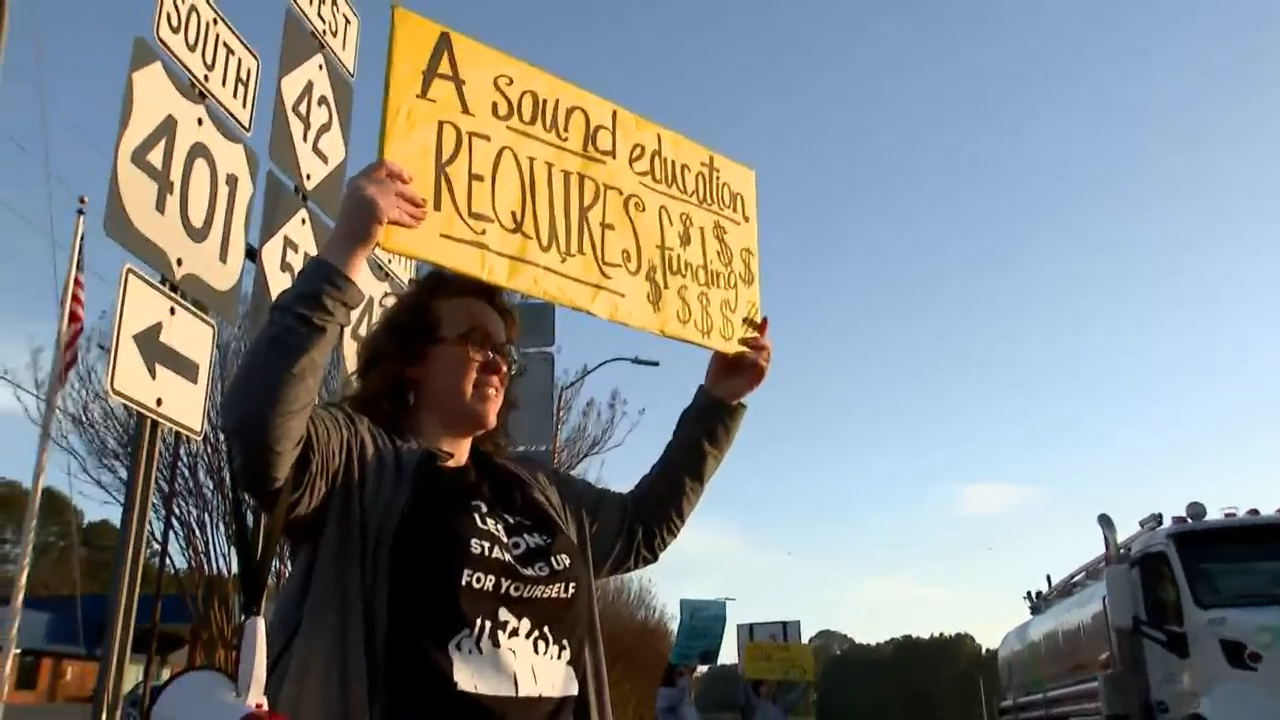
> > Watch protests in Cary on NW Maynard and Chapel Hill roads
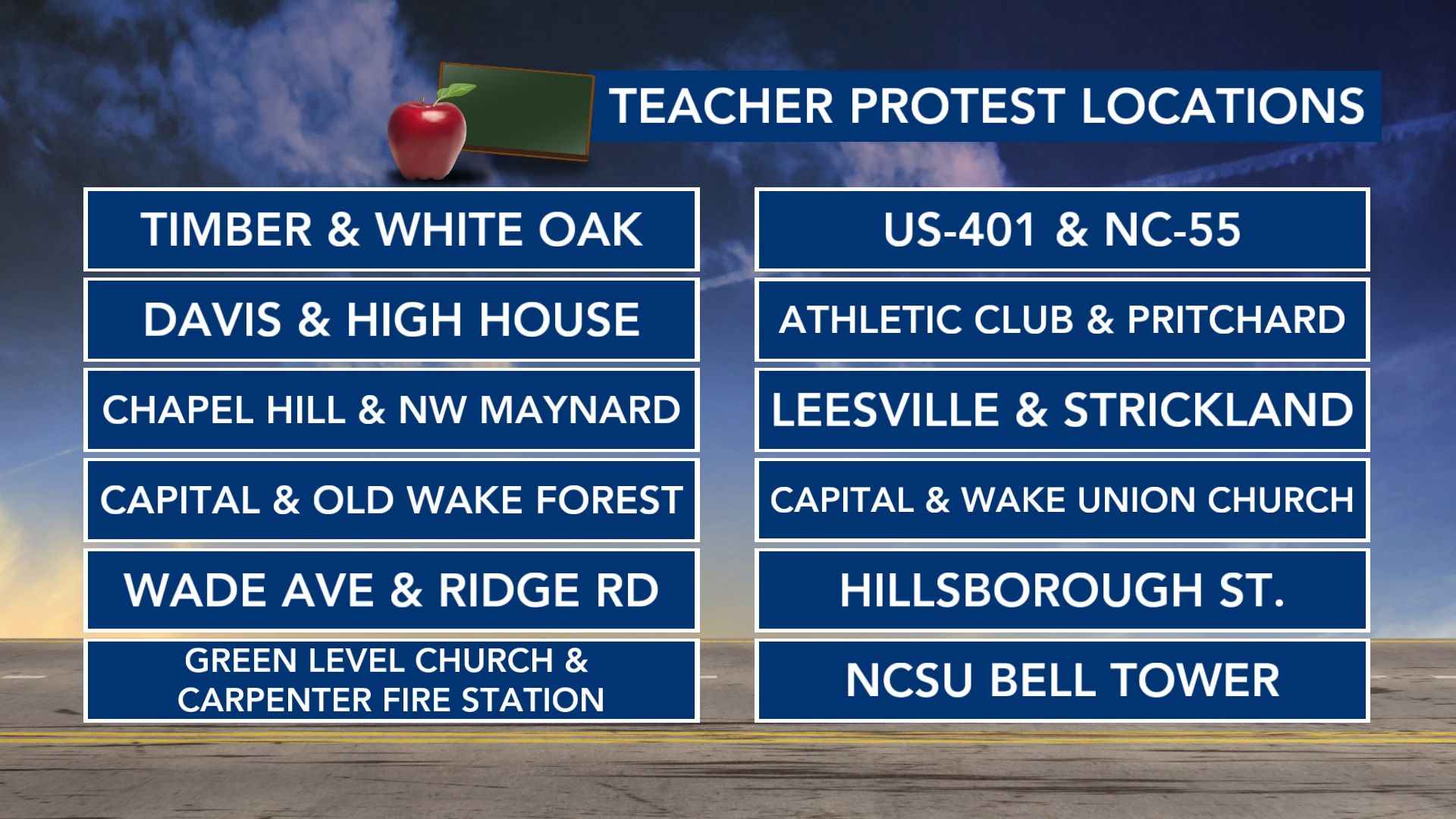
Wednesday’s demonstration involved teachers from at least 50 schools who were expected to be at more than a dozen intersections, mostly from and in Wake County. Organizers said at least 250 teachers planned to call out.
Groups of educators and their supporters were starting to gather just after 8 a.m. in Fuquay-Varina and north Raleigh.
WRAL crews and SKY 5 saw crowds demonstrating on US-401 and NC-55 in Fuquay-Varina and at Capital Blvd and Old Wake Forest Road in Ralegh. In Cary, crowds formed at Chapel Hill and Northwest Maynard roads and at Green Level Church and Carpenter Fire Station roads. Teachers even gathered at the N.C. State Bell Tower.
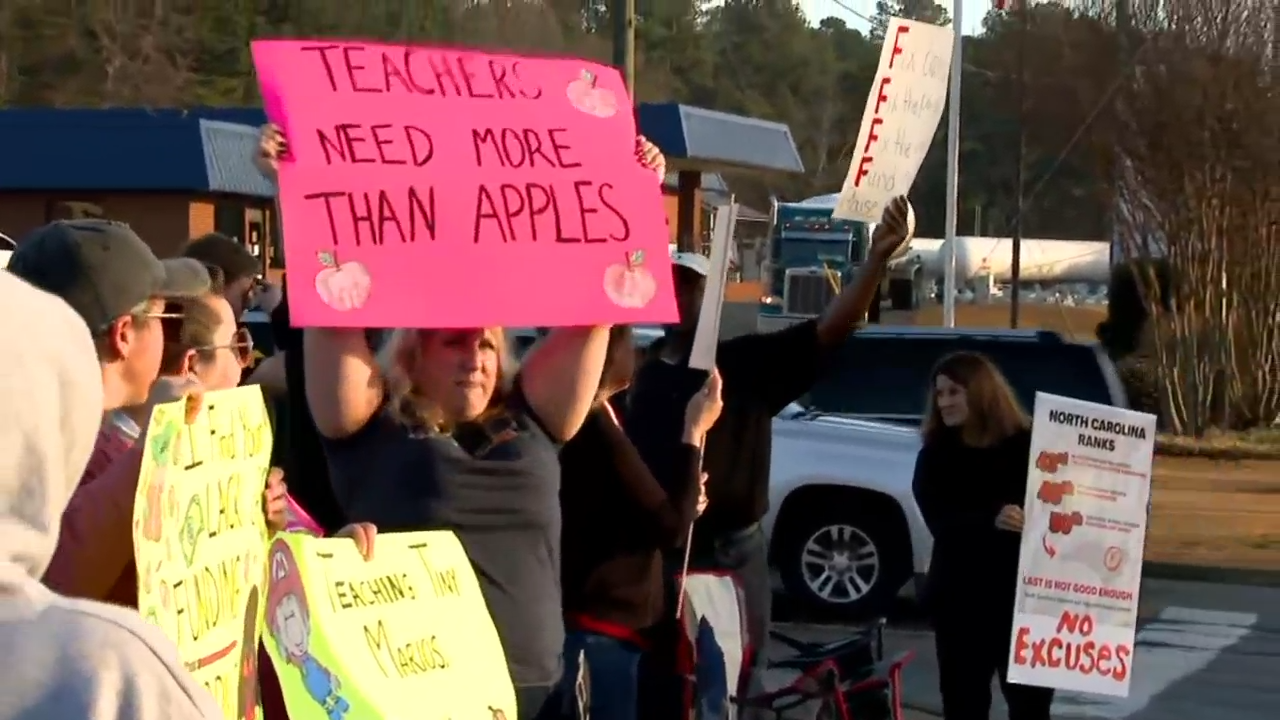
Wake County Public School System officials told WRAL News on Tuesday that they don’t expect a major disruption from the walkout, because 98% of the substitute teacher requests had been filled.
“Advocacy can do something for kids that deserve a shot, and advocacy can maybe do something to save the teaching profession in North Carolina,” said Matt Townsend, a Durham Public Schools teacher who plans to participate.
The group is asking for:
- Higher pay for advanced degrees.
- A cap to how much their health care premiums can go up.
- Unfreezing experience pay increases for experienced teachers.
- The restoration of health benefits when teachers retire.
“We’re getting hit harder and harder, and so a lot of educators are at a breaking point where we can’t survive this anymore,” said co-organizer and Wake third-grade teacher Jennilee Lloyd.
State data shows that salaries haven’t kept up with inflation, with steps being thousands of dollars less in 2025 dollars than they were a few to 20 or more years ago.
State House of Representatives Speaker Destin Hall, R-Caldwell, noted to WRAL News the House budget, which has not been approved by the Senate, would provide raises and restore extra pay for having a Master’s degree.
Hall said in a statement that teachers “pour so much time, energy and care” into their students and it was important to invest in them in return.
“Rather than abandoning their classrooms and students, teachers should urge the Senate to take up the House budget or the standalone bill we passed that delivers an 8.7% raise,” Hall said.
Spokeswomen for state Senate leader Sen. Phil Berger, R-Rockingham has not responded to WRAL News’ questions about the group’s planned walkout and requests.
The House budget would accomplish some of them, such as restoring additional pay for teachers with master’s degrees in their subject areas and unfreezing step pay increases.
The Senate budget is seeking further tax cuts and doesn’t propose those things.
In December, House Speaker Destin Hall said on social media that tax cuts had already helped businesses and kept revenue stable.
“Because of those policies, our state can afford to be the number one in teacher pay in the South,” Hall said in a post on X. “That is what my colleagues and I in the House are fighting for.”
No state budget
Both chambers of the legislature are at a stalemate over the budget, largely because of disagreements over the extent of tax cuts and differences in belief over the impact of certain cuts.
State lawmakers haven’t passed a budget for the current fiscal year or for the next one that would fund step increases for everyone who would normally get one. A new budget would also likely include raises for teachers and other state employees.
Gov. Josh Stein, who has the power to sign or veto any budget bill sent to his desk, has said he prefers the House version.
“The House’s proposed budget isn’t perfect,” Stein said in a May statement. “But I am pleased that the House raises teacher pay to make North Carolina’s starting teacher salaries the second-highest in the Southeast and rewards our state employees with a raise.”
Stein told WRAL News on Tuesday that lawmakers need to invest more in education, the way they’ve invested in making the state a leader in attracting and supporting businesses.
“We have to invest in educators so that they can pour into our children and our children can have a brighter future,” he said. “It is so basic. We have to open up doors of opportunities for our young people.”
Teachers have complained recently of higher health insurance premiums, which recently went into effect. The State Health Plan Board of Trustees approved salary-based premiums last year to help shore up losses for the health plan.
Health insurance premiums are rising this school year for more than 80% of Wake school employees, district officials said last year. Some, but not most, have ultimately taken home a smaller paycheck this school year.
Many of them have received step increases for another year of experience from a state “mini budget” approved earlier last year, but many have not, either because step increases for their positions weren’t funded in the mini budget or because they have more than 15 years of experience and their salaries have flattened.
Changes by lawmakers
Only state lawmakers can approve of the changes the group is asking for, and Republican leadership years ago spearheaded many of the decisions Lloyd and her fellow teachers are trying to reverse. That includes bills that eliminated paying educators extra for having a master’s degree, budgets that largely flattened teacher pay after 15 years and the merging of “longevity pay” into the salary scale while maintaining longevity pay for other state employees.
Lawmakers at the time cited research that indicated that Master’s degrees did not improve student outcomes. Since then, some research has shown having a Master’s degree can improve student outcomes when the degree is in the subject area the teacher teaches.
Instead of rewarding teachers for a Master’s degree, the state adds pay for those who have earned National Board of Professional Teaching Standards certification, an incentive that’s an outlier among states and has resulted in North Carolina outpacing the nation in having certified teachers. That certification process is rigorous and backed by research on student outcomes.
Since the incentive was passed, however, certification no longer covers a teacher for 10 years, instead now requiring renewal every five years.
Other states typically reward teachers for having master’s degrees, and some states even require them.
Lawmakers years ago also flattened the teacher pay scale in an effort to move later-career earnings to the beginning of a career.
Disagreement over funding ability
North Carolina first-year teacher pay ranked 39th in the United States during the 2023-24 school year, according to the latest teacher pay report from the National Education Association, a national teachers’ union.
“I’ve talked to teachers who … can’t start a family right now because they know that they can’t afford to start a family,” Lloyd said.
Lloyd and many others argue the state has the money to increase investments in education.
State lawmakers are deliberating income tax cuts and funding for other programs, while weighing vary levels of funding increases for education. The House budget proposal contains a larger funding increase, including larger raises for teachers.
A recent report from the Education Law Center ranked North Carolina 50th out of 50 states and the District of Columbia in what it deemed “funding effort”
— the percentage of spending on education as compared to gross domestic product.
A recent report from libertarian think tank Reason Foundation found that North Carolina teacher salaries didn’t kept up with inflation from 2020 to 2023.
First of several callouts
North Carolina Teachers in Action is organizing publicly after anonymous graphics surfaced this fall encouraging teachers to call out Nov. 7 and 10, leading to frustration among many educators that it wasn’t organized and no one was taking credit for it.
The callout led to higher-than-usual staff absences at some schools but generally didn’t disrupt the school days.
The anonymous posts prompted some educators, including Lloyd, to start a public, organized campaign.
They’ve been asking teachers to use personal leave to request Wednesday off.
On that day, the plan is for those teachers to assemble on the sidewalk at an intersection near their school and demonstrate, wearing matching T-shirts and calling for changes.
“They are going to be going out into the public, taking a day for advocacy, and they’re going to invite people to have a conversation,” Townsend, the Durham teacher, said.
As of December, the group had 10 walkout locations in Wake County, two in Gaston and one in Mecklenburg. More are likely, Lloyd said.