
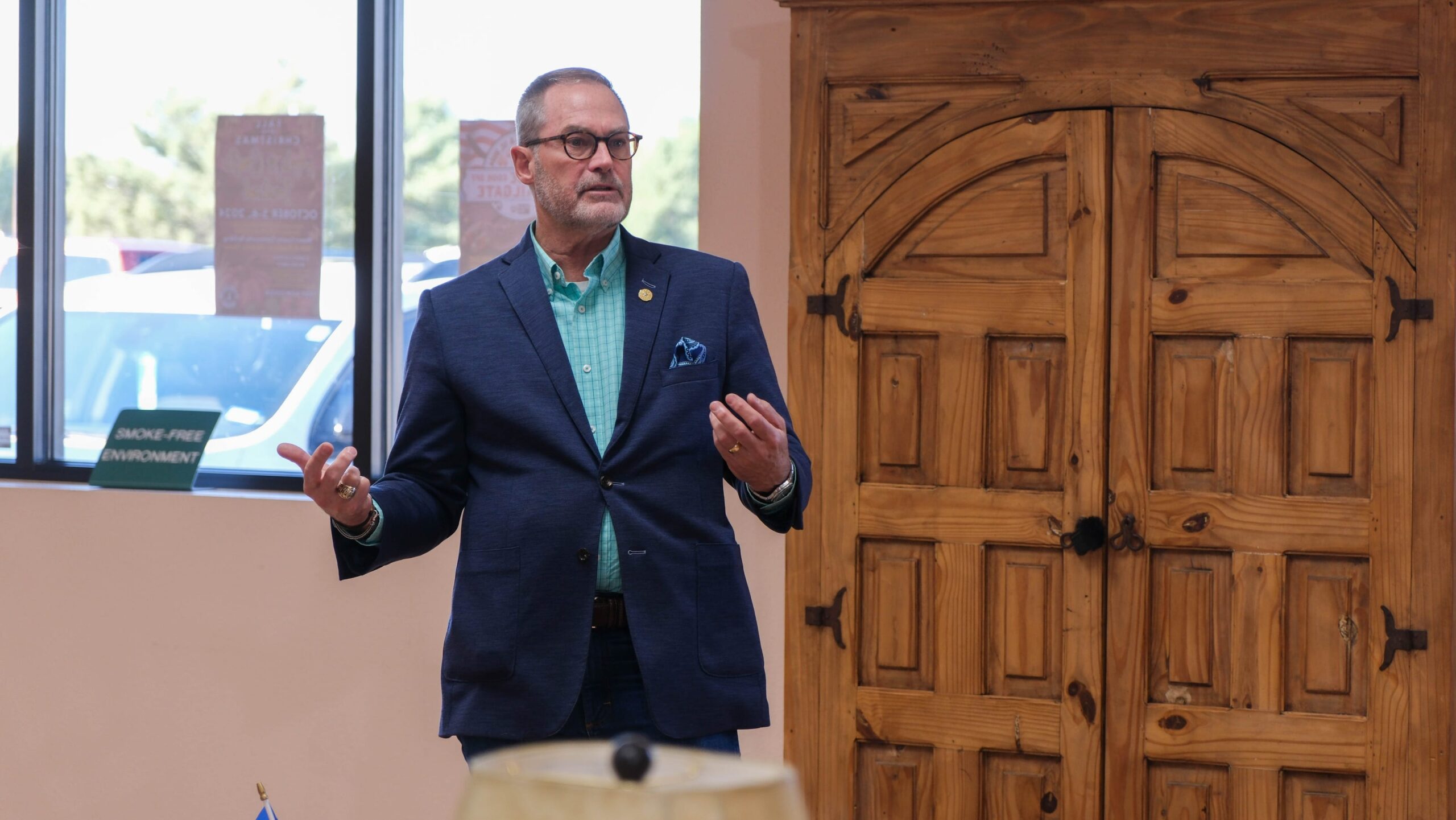
DUMAS – State Senator Kevin Sparks, R-Midland, met with constituents on Monday at the Dumas/Moore County Visitors Center and Chamber of Commerce for a town hall event, covering various local and state issues. Sparks, a native of Midland, has done a barnstorming tour of the Texas Panhandle over the past two days, doing town halls in 11 cities throughout the area. He opened the Dumas event by discussing his personal journey before turning to pressing concerns facing his district.

Voter engagement takes center stage
A major theme of Sparks’ address was voter engagement, particularly the need for stronger turnout in one of the most conservative districts in Texas. He pointed out that despite the district’s political leanings, voter participation has been low, a trend he’s eager to change ahead of the November elections.
“I represent more than 900,000 constituents across 45 counties,” Sparks said of the 31st District. “Our district covers 44,000 square miles — that’s larger than 17 states. But our voter turnout is only about 30 percent. That’s not representative government.”
As an example, Sparks cited the last election in Midland, where only 16,000 out of 92,000 registered voters cast ballots. He urged constituents to mobilize and ensure their voices are heard. “We need to talk to our neighbors, our Sunday school groups, and make sure they get registered and show up at the polls,” he emphasized, adding that this upcoming election could have long-lasting implications for the state and nation.

Concerns over population growth and immigration
Sparks expressed concern about Texas’ rapidly growing metropolitan areas, including Dallas, Austin, Houston, and San Antonio, and the political shifts that accompany such growth. He noted that this influx of new residents could change the state’s political landscape, making rural turnout more crucial than ever.
“We’ve got to turn out in big numbers to offset the population moving into Texas,” Sparks warned. “This election is one of the most critical we’ve faced. From inflation to the federal government’s failure at the border, we’re seeing the effects of these policies now.”
Sparks discussed how illegal immigration is straining resources throughout Texas, particularly in rural areas. “We’re seeing food banks run out of supplies due to increased demand, and local law enforcement is stretched thin. I have compassion for those seeking a better life, but it needs to be done lawfully. Otherwise, we risk overwhelming our infrastructure.”
He also linked the rise in crime across rural Texas to increased drug trafficking and illegal immigration. “This is happening across the district and is placing an enormous burden on our communities,” he said, pointing to the need for stronger border enforcement.

Legislative achievements and future priorities, challenges
Turning to legislative matters, Sparks highlighted his accomplishments, including securing funding for a new mental health hospital in Amarillo. “We’ve completed the land swap for the property, and construction is expected to begin early next year,” Sparks said. The facility, which will take approximately 18 months to build, aims to address a critical gap in mental health services for the region.
Sparks also discussed Texas’ reliance on wind and solar energy, which he views as unreliable. “Over 40 percent of our electricity in ERCOT comes from wind and solar, and that’s a problem. We need to invest in dispatchable power like gas-fired plants to ensure grid reliability,” he said.
Water infrastructure was another priority. Sparks referenced a statewide water plan spearheaded by State Sen. Charles Perry, R-Lubbock, which aims to improve water distribution through new pipelines and develop desalinization projects for both coastal and brackish water. “With Texas’ population growing, even major cities like Austin and Houston could face water shortages. This is a challenge we need to address now.”
During the Q&A session, Sparks addressed concerns about rural healthcare and education. Local residents expressed frustration over the difficulty of attracting healthcare professionals to rural areas, a problem compounded by wages that have not kept up with inflation.
“We’ve seen rural hospitals close in the past three months alone, and without a long-term plan, more could follow,” Sparks said. He stressed the importance of finding sustainable solutions to keep rural healthcare accessible.
Education also emerged as a key issue, particularly for districts with high numbers of English language learners. One attendee noted that finding certified teachers to meet the needs of non-English-speaking students has been a persistent challenge in rural areas.
Sparks acknowledged these concerns and expressed his frustration that a school funding bill tied to school choice did not pass in the last legislative session. He vowed to make school funding a priority in the upcoming session, saying, “Our rural schools need more resources, and we can’t wait any longer to address this.”

Post-town hall interview: Focus on school funding and border crisis
Following the town hall, Sparks provided additional insight into the most frequently raised issues from his district.
“I’d say school funding and illegal immigration are the two biggest concerns I hear about,” Sparks said. “School funding is urgent because we failed to pass a funding bill last session, and rural districts are really feeling the strain. We’re going to prioritize this and hopefully get something done early next session.”
On the issue of illegal immigration, Sparks reiterated how the ongoing border crisis is placing immense pressure on Texas communities. “Our social services, law enforcement, and schools are all feeling the strain. This situation will only worsen unless we get serious about securing the border and addressing this at a federal level.”
Local leaders commended Sparks and the Texas Legislature for passing SB 22, which provided essential funding for rural law enforcement. Moore County officials noted that the additional resources allowed the sheriff’s office to increase staff to combat rising crime rates. However, some officials pointed out challenges in the allocation of funds, saying they received more money than they could use, leading to a surplus.

Sparks acknowledged this issue and invited officials to provide further details. “This might be an oversight in the bill. We’ll look into it and make sure these funds are being used as intended,” he said.
Sparks concluded by urging residents to remain engaged and take action in the upcoming November election. “Your input is critical to ensuring that we have a government that truly represents the people,” Sparks said. “Let’s turn out in big numbers in November. This election will shape the future of our district and state.”
After the formal Q&A, Sparks and his team, including Chief of Staff John Dallas and District Director Shannon Parker, stayed behind to meet individually with attendees. Sparks emphasized that his office is always open to hearing concerns and suggestions from constituents.