
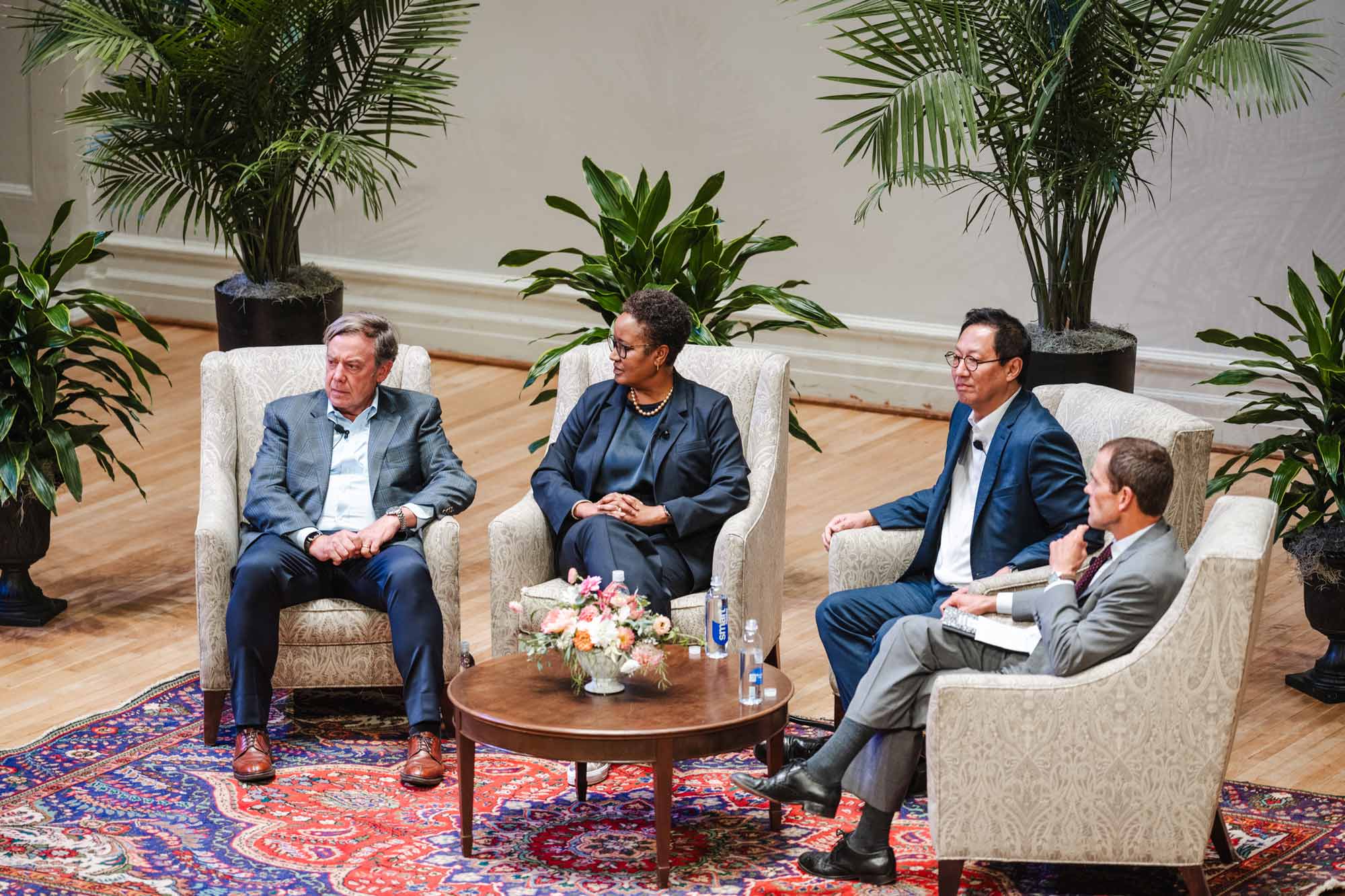
It continues to fill the niche purpose it was built for. She boasts 950 “nerds” across 12 STEM majors, with an alumni pool of 8,000. Nembhard is specific about what kind of student she hopes to produce.
“You hear students say they distinguished themselves because they were the engineer who could write,” she said. “Soon, it’ll be the engineer who can talk still to humans.”
In addition to reimagining internal ecosystems, University of Michigan president Santa Ono said universities, especially public institutions, have a responsibility to be part of the larger higher education ecosystem and collaborate with one another.
He would love, he said, to build partnerships with UVA, a school of similar size and research mission.
“We have an important role to innovation, to job creation and the economy,” he said.
And, changes should be timely and linked to public impact and value, Crow said. “Society’s becoming increasingly unhappy with us. Our real job is empowering citizens.”
The panel was the first signature event of the Futures Initiative, launched in January under the auspices of the Provost’s Office and spearheaded by Phil Bourne, dean of the School of Data Science; Ken Ono, a math professor and STEM adviser to the provost; and Jason Nabi, project manager.
Members of the Futures Initiative Working Group – a task force made up of representatives from all 12 of UVA’s schools, four of its pan-University institutes, and several of its administrative and academic divisions – have been exploring how to answer Ryan’s charge to reimagine UVA to position it to thrive in an evolving world.
The panel concluded a day’s worth of activities hosting the visiting presidents, including a tour of the Lawn and Rotunda with Louis Nelson, architectural history professor and the vice provost for academic outreach, and a special roundtable with members of the Futures Initiative Working Group.