
As Oklahoma leaders search for ways to improve the state’s education ranking and test scores, News 9 examined what some have called the “Mississippi Miracle.”
For generations, Mississippi was a punchline in conversations about public education.
The state was consistently ranked 50th. Always last.
“I would tell them my name and that I was from Mississippi, and this would be the look that I would get,” said Erica Jones, Executive Director of Mississippi’s Association of Educators.
But the joke isn’t on Mississippi anymore.

A Griffin Media survey of 256 Oklahoma teachers shows behavior issues, large class sizes, and low morale are major concerns in 2025. Here’s what educators said.
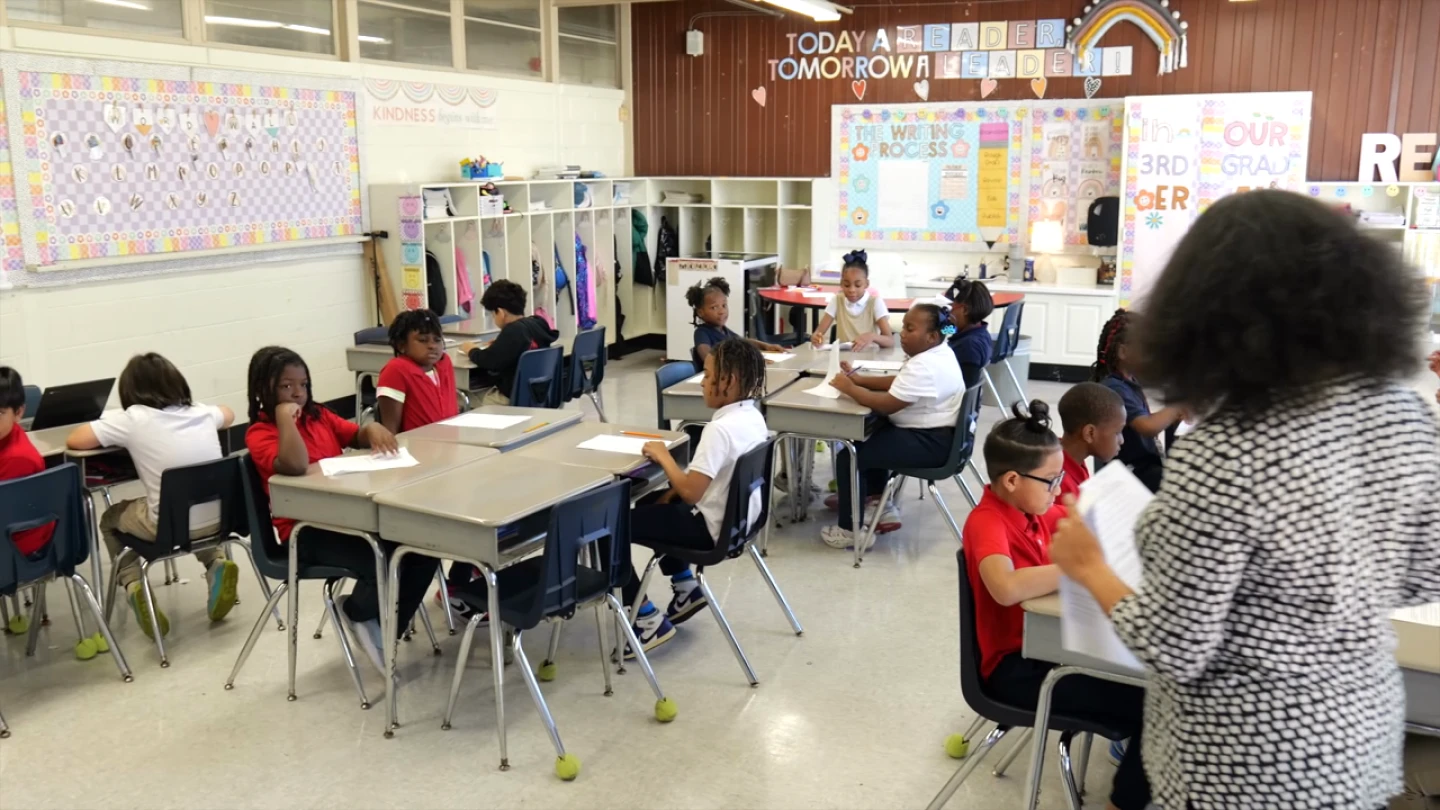
A state known for its rhythm, soul, and long fight for equality is now recognized as one of the most dramatic education turnarounds in the country. That shift is evident in classrooms, like a 3rd-grade reading class in Jackson Public Schools, taught by Barquita Stanton.
“We have high expectations for them. We understand that some scholars may struggle sometimes, but because we hold high expectations, they are motivated to learn, and we are just teaching them to be professionals, so when they go out to the real work, they can be their very best,” Stanton said.
Every 90 minutes, a fresh group of students rotates through Stanton’s classroom. Her instruction centers on the science of reading.
“My approach to teaching reading is grounded in the science of reading,” said Stanton, “I provide my scholars with explicit instruction in phonics, fluency, and vocabulary comprehension.”
A Shift in How Students Learn to Read
In many Oklahoma classrooms, students memorize sight words like “the” and “you.”
But Mississippi changed course more than a decade ago. A 2013 law required teachers to adopt a phonics-based approach—teaching students how to sound out words rather than memorize them.

We asked Oklahoma teachers how they feel about education in the state, what’s holding them back from supporting students, and how likely they are to stay in the classroom. Watch the full roundtable discussion of our survey results with 3 teachers from across the state.
Erica Jones had spent nearly two decades teaching first and second graders when the law passed.
“So I wanted to push back because I thought my method was working. Again, I would get first graders at the beginning of the year. They didn’t recognize letters. They didn’t recognize sounds, and by the year I would have them reading,” said Jones
Even so, she returned to the classroom—this time as a learner.
“Once I started exploring and really doing a deep dive into the science of reading materials, and the materials that were given to us. I noticed a difference in my teaching method.”
Ending Social Promotion
A key piece of Mississippi’s reform was eliminating social promotion. Students who cannot pass the 3rd-grade reading test at the end of the year do not advance to 4th grade.
“Now, as a teacher, I was not on board with an additional assessment for our third graders. But, looking back at all that, I know it made the difference,” said Jones.
“It really measures our students’ understanding of literacy.”
“Over the past couple of years, I believe our percentage of passage has been over 75% statewide, which is really good,” She said.
The Investment
Mississippi invests about $15 million a year into this initiative—covering teacher training and classroom materials. The return has been substantial: Mississippi 4th graders now outperform the national average in reading.
Some observers call it a miracle. Jones sees it differently.
“For an educator, a teacher who was actually in the classroom, sometimes it’s a slap in the face for it to be called a miracle,” she said. “When I experienced how much hard work, dedication, and time it took for us to move from the bottom with our education to now, towards the top.”
The Oklahoma Comparison
At one time, Oklahoma and Mississippi had similar policies—both tested 3rd graders to ensure they could read.
But in 2014, Oklahoma ended the practice of holding back students who didn’t pass the reading test. Mississippi did not.
Today, Mississippi 4th graders rank in the top 10 in the nation for reading.
In Oklahoma, the Council of Public Affairs says 75% of students struggle to read.
During our conversation, we asked Jones what Oklahoma lawmakers should do.
“You can’t cheat. There’s no cheap way of doing it. There’s no cheat code for it. But we really did this by having effective, quality teachers in the classroom and by partnering with our legislators and then providing the central funds that we needed, because it did take money,” said Jones.
In September, Oklahoma Governor Kevin Stitt appointed Lindel Fields as the state’s interim Superintendent after Ryan Walters resigned.
Fields has said a focus on literacy is one of his priorities through the end of 2026. Fields and Stitt have also put a “turnaround team” in place to suggest ways lawmakers can improve education in Oklahoma.
Former Oklahoma Gov. Brad Henry told News 9 he believes education will be the biggest issue in the 2026 governor’s race.