

Carson Summers-Pelkey, lead teacher for the toddler class at The Neighborhood Schoolhouse in Brattleboro, plays with some of the children in the classroom on Thursday, Sept. 5, 2024.
BRATTLEBORO — Local resident and teacher Carson Summers-Pelkey said he “kind of backed” his way into early childhood education.
“I didn’t take the most common path,” he said.
Summers-Pelkey studied philosophy during his first time in college then fell into food service. After nearly a decade as a cook, he described feeling “absolutely burnt out.”
“Naturally, I went into another career famous for burning people up,” he said.
Looking at career paths, he found three to be viable: chimney sweep, registered nurse and early education teacher. He decided on the latter and found a job at Neighborhood Schoolhouse in Brattleboro, where he’s been working for three years now.
“They gave me a wonderful opportunity to jump into a field with little to no experience,” said Summers-Pelkey, who had previously been a camp counselor and martial arts teacher.
Initially, he started as an assistant in the infant room. Last week, he began the school year as a lead teacher.

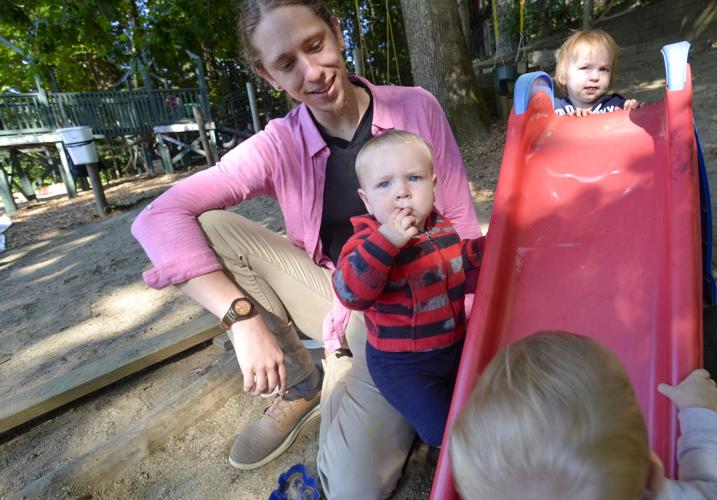

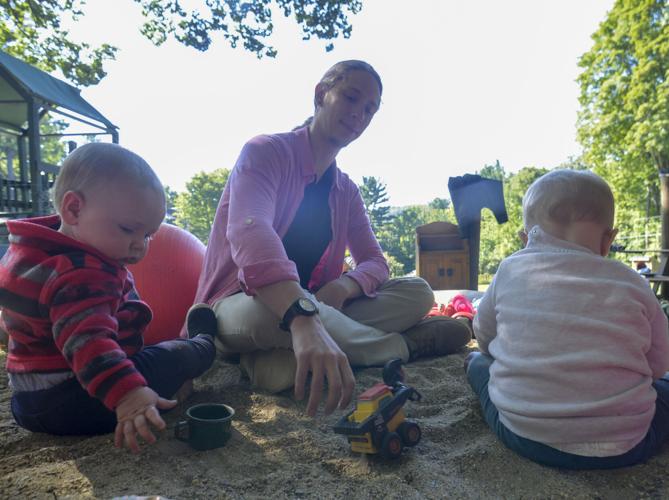

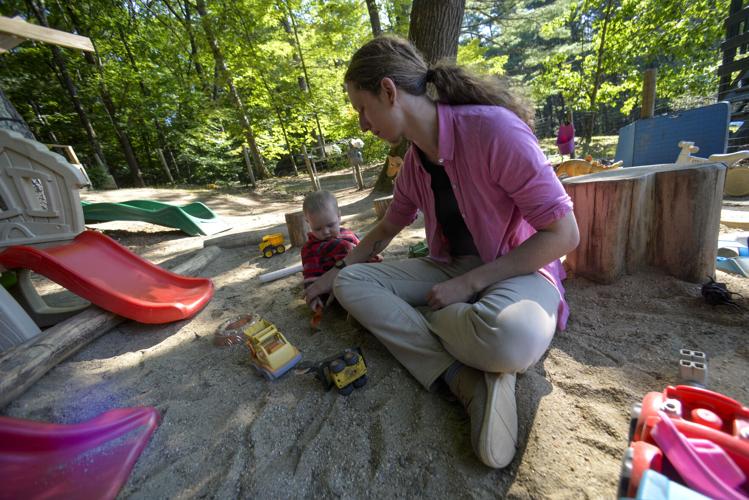



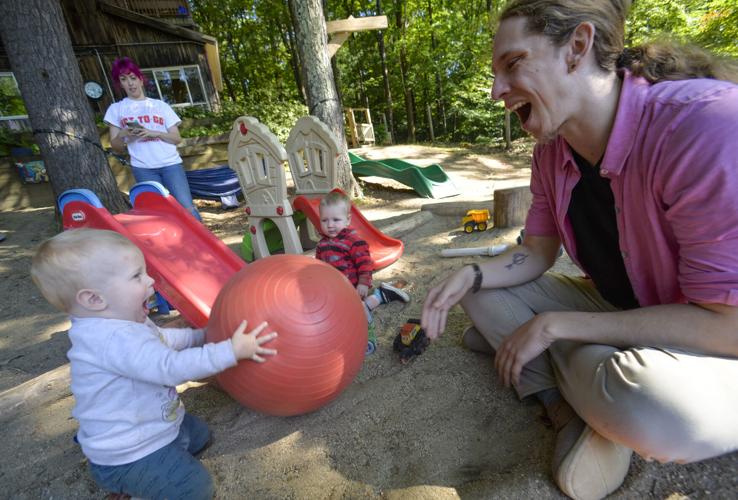
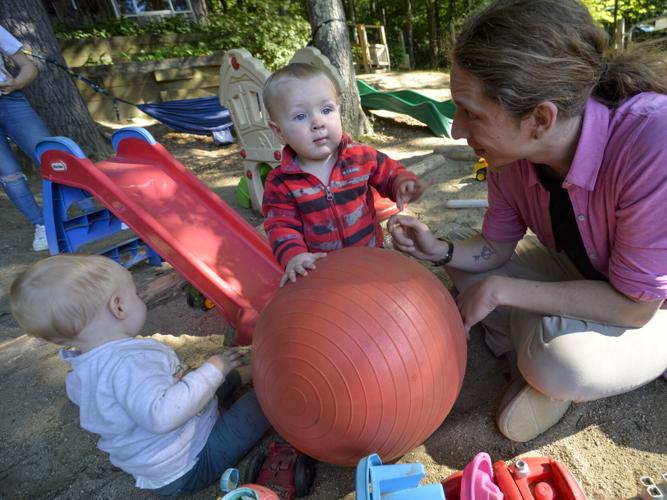
Carson Summers-Pelkey, lead teacher for the toddler class at The Neighborhood Schoolhouse in Brattleboro, plays with some of the children in the classroom on Thursday, Sept. 5, 2024. Purchase local photos online.
Summers-Pelkey said he worked his “way through opportunity to opportunity” to get where he is now. That included taking courses at Community College of Vermont.
“Vermont, very thankfully, has a pretty aggressive teacher recruitment right now,” he said, citing the 802 Opportunity and Pell grants.
Summers-Pelkey said he’s on his way to getting an associate’s degree primarily for licensing reasons, and it’s all being paid for by the state. He called tuition “essentially free.”
“And licensing requirements are all being covered, so I don’t have to pay for any of that,” he said. “I just have to go back to school, which isn’t easy for me. I’m not the best of students, but I’m trying really hard.”
Summers-Pelkey said he always enjoyed working with kids and taking on mentoring roles. At Neighborhood Schoolhouse, he’s seen one male leave due to the position not being a good fit, and another was escorted off the premises after a background check came back. He called the field “kind of isolating at times.”
Parents sometimes look at him with some skepticism or surprise, he said. He’s even turned down offers to work with older kids at the school because he likes the younger group.
Some female assistants have been more reluctant to engage in “big body play” or rough play, which he sees as really good for the children to develop balance and muscle tone.
Experience in martial arts and outdoor programming informs some of his teaching style. He likes to instill confidence and courage in the students, which can involve redirecting their attention from a tumble by telling them they’re brave.
Stigma and wages keep other men from joining the field, Summers-Pelkey said. He credited the financial support with making the career path possible for him. To normalize men caring for children, he would like to see more of an emphasis on paternity leave and diaper changing stations in men’s restrooms.
“From what I’ve seen, there’s this weird inverse where early education is dominated by women in the field and then secondary education and college, you see way more men as professors,” he said, describing “institutional patriarchy and sexism” in educational systems.
More job fairs or open houses at schools might be held to invite people into the field, Summers-Pelkey said. He noted schools can feel really intimidating to newcomers since they’re such a protected space.
Leslie Johnson, associate academic dean and early childhood education expert at CCV, said only about 5 to 10 percent of students in early education programs at CCV are men. She noted the college is committed to increasing representation of diverse identities in all fields.
“Historically, early education has been a female dominated profession,” she said. “And for kids early in life, having role models in their lives that represent the range of people that they’re going to encounter is really important for their development. It teaches children lessons early on when they see role models in their life about what it means to be male, what it means to be female.”
Early childhood education programs at CCV have “a really long history at the college,” Johnson said. CCV currently offers an associate degree program in early childhood education and three certificate programs she sees as “an on-ramp into a career path that hopefully leads people” to the degree.
A child care certificate program allows someone to move up into a role, such as a lead teacher or a job in a registered home setting.
“That’s by far our most popular certificate program,” Johnson said.
An early childhood education administrator certificate is designed for individuals in the field who want to move into administrator roles. Another certificate is for after school youth work including summer camps and youth enrichment programs.
CCV also supports Northern Lights, a workforce development program funded by the state’s Child Development Division. Johnson said career advising, guidance on professional development and support with ongoing needs are offered to the nearly 8,000 people working in early education and after-school settings in Vermont.
“The state has made some great investments in trying to encourage people to go to college, encourage people to advance their careers and come into the field,” she said. “And we actually have seen an increase in our enrollment at CCV over the last, let’s say, five years. There’s been a pretty substantial increase in enrollment in our programs.”
Marty Cohn, member of the Windham County Child Care Counts Coalition, said a major goal of the coalition is to explore ways to increase the number of early education professionals regardless of gender.
“There’s always a hope that our teachers represent the diversity of our community,” said Chloe Learey, coalition initiator and executive director of the Winston Prouty Center for Child and Family Development.
Johnson said the hope is that the supports provided at CCV will encourage more people to enter and stay in the field.
“I like to say that our early childhood educators are like superheroes, right?” she said. “They do this critically important work to support the development of our children and families in the state, and it’s so important to the infrastructure of our society as a whole for our functioning. But it’s difficult work, and it’s work that it doesn’t always pay well for people, and so there’s lots of work ongoing in the state to try to change that.”