A local nurse at HCA Florida Highlands Hospital in Sebring had no idea that two months later her educational program on stroke signs and symptoms would literally save a man’s life.
After reviewing data with her team, HCA Emergency Room Manager and Stroke Coordinator Tabitha Mann discovered a healthcare disparity that could be altered to improve outcomes. Too many patients were waiting too long to seek care for a stroke, therefore reducing the opportunity for positive life altering treatments. She took stroke education beyond the walls of the hospital and brought it to the community to make a positive impact. She shared educational materials at health fairs, attended community events to educate the public and was the keynote speaker at a Chamber of Commerce luncheon to spread her message on the signs and symptoms of stroke.
In May, she presented to the Leadership Highlands class, not knowing an audience member, Dr. Mike McLeod, would be affected two months later when he suffered a stroke. His wife, Kris Juve, who was also in the audience, knew the severity of the situation and advocated for him until they got a proper diagnosis based off her knowledge from Mann’s presentation.
“Stroke: Time is Brain” was the title of her presentation. She taught the signs and symptoms of stroke. Even though Juve, who works at South Florida State College, has previous experience as a pediatric nurse she still was not familiar with all the signs of a stroke until Mann explained them.
Later in July, McLeod was doing his regular morning routine after waking up by getting his coffee and taking the dog for a walk. He loaded the dog in the car and decided to get gas first. Juve explained that he overshot his turn and fell asleep at the dog park.
“He felt sleepy in the morning and that’s not like him,” Juve said. “His tone was flat, he was tired,” she said after she talked to him on the phone through Snap Chat.
“I asked him to smile. It looked good but something was off.”
She called her boss at work to explain what was happening and raced to the house to McLeod.
“I went home. I asked him to raise his hands, checked his blood pressure and it was high. His gait was fine. He was not talking right,” Juve said as she described her husband’s symptoms. “I told him we need to get to the hospital and he didn’t argue.”
Juve said he looked normal to someone who did not know him, but she knew something was not right.
“You have to advocate for the patient if you know something is wrong,” Juve said.
She knew his past medical conditions of Atrial fibrillation (AFib), pre-diabetes and heart stints. When local medical staff would not listen to Juve, she stuck to her guns and advocated for her husband. He was later transported to Orlando where he spent three days in an intensive care unit. Fortunately, he did not need surgery and received outpatient therapy and home care.
“I had a stroke over a month ago,” McLeod said. “She (Mann) saved my life.”
“We are forever thankful that Tabitha spoke to our Leadership Highlands Class in May this year. Because her presentation was fresh in my brain, I was able to act and advocate for the love of my life,” Juve said.
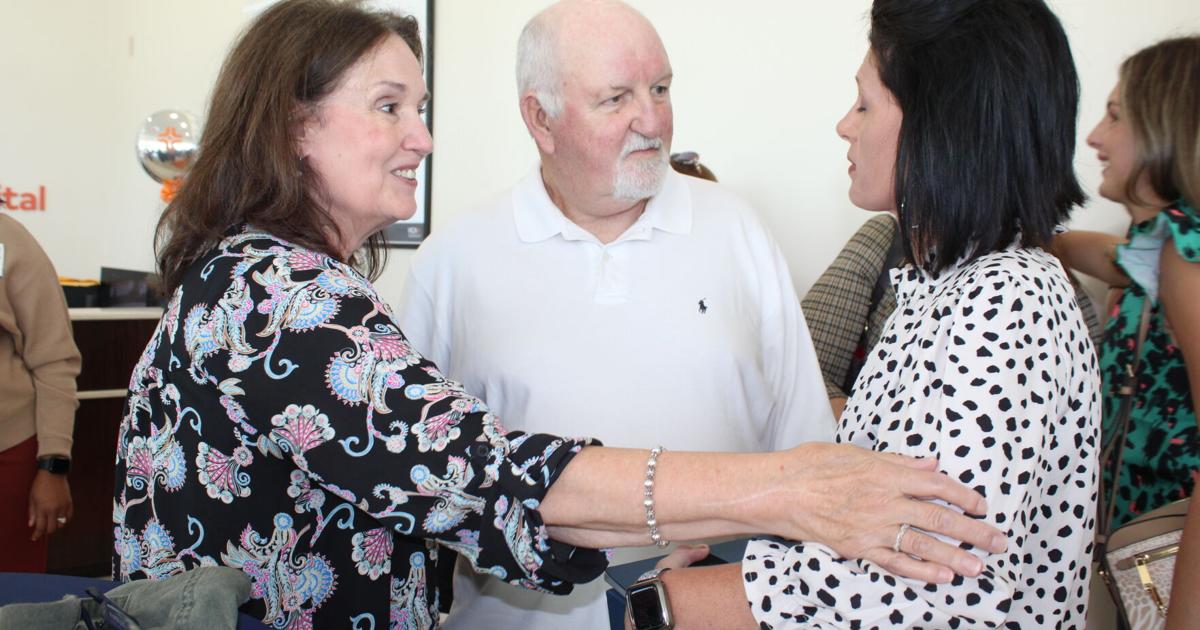
Juve and McLeod were both present at the awards ceremony honoring Mann and three other award recipients at HCA on Friday to show their appreciation to Mann.
“We are both thankful to have been able to thank Tabitha Mann in person today,” Juve said.
Mann was presented the Frist Humanitarian Award which was named after Dr. Thomas Frist Sr., one of HCA Healthcare’s founders. It was created in 1971 to honor outstanding individuals for their humanitarian and volunteer activities.
As Mann accepted the award, she said it was an emotional decision to leave the bedside of working with patients to go into educating the public for the hospital. It was a hard decision but she saw her potential to educate people.
“This is an honor and joy,” she said of receiving the award.
Juve could not stop emphasizing how important education is for people in the community to know the signs and symptoms of stroke. She also added that it is different for each person. “Every minute counts,” she said.
HCA also presented three other awards on Friday to staff. Other awards and winners were:
• The Innovators Award was won by Debbie Samples, Environmental Services Supervisor. This award recognizes individuals who advance the mission of the organization through innovation, solving a problem and improving efficiency. Samples worked with the Plant Ops team to merge a typical environmental services cart with compartments, buckets and hooks for mops and brooms and mounted it to the back of a workstation on wheels, which includes her laptop, clipboard, and phone. It has been scaled across other hospitals in HCA’s East Florida division already.
• Excellence in Nursing: Compassionate Care was won by Jonnah Olano, Clinical Nurse Coordinator in the Medical/Surgical Department. It is given to a nurse who demonstrates exceptional nursing knowledge and expert skills and consistently applies both with compassion and integrity. She was nominated by many of her colleagues for her kindness, gentleness, understanding and resourcefulness. She’s willing to help in anyway. She remains calm in times of stress.
• Excellence in Nursing: Professional Mentoring was won by Tammy Brown, Vice President of Quality. This award recognizes a nurse who advances nursing practice by guiding or supporting career development for individuals or groups or by advancing evidence-based nursing knowledge. Tammy teaches, coaches, guides, and develops those around her for the betterment of our patients. She played a valuable role in educating the leaders on what to look out for when conducting rounds to prepare for an upcoming evaluation. She also combated higher-than-average readmission rates by implementing ‘zone tools’ and educated nurses on how to better equip their patients for home care. The tools tell the patient what symptoms to look out for and what steps to take. Other facilities in HCA’s East Florida division are now implementing these zone tools in their facilities.