Since 2022, many households and businesses have experienced significant pressure on their finances, but
most have managed to adjust to continue servicing their debts. These pressures are expected to ease over
the next couple of years based on the economic outlook presented in the February Statement on
Monetary Policy. However, a key risk to this outlook is that inflation and interest rates remain
higher for longer than currently anticipated. This Focus Topic investigates the ability of mortgagors and
larger businesses to service their debts under both scenarios. The key findings are:
- Most mortgagors and larger businesses would be able to service their debts even if pressure
on their finances remained elevated for a more extended period. Accordingly, the risks
to financial stability under the higher-for-longer scenario remain limited. - However, under both scenarios, conditions will remain challenging throughout this year for
the mortgagors already facing acute budget pressures. More persistent budget pressures
are expected to result in a slight increase to the (small) share of borrowers most at risk of
becoming unable to service their debts. - Ongoing high interest rates would have a moderate effect on the ability of indebted listed
companies to service their debts. However, the firms assessed in this exercise are
larger companies that tend to be less exposed to interest rate risk. Smaller businesses would be more
vulnerable to such a scenario, but data limitations precluded their coverage in this analysis. Even
still, related risks to the financial system would be restricted by the relatively small share of
banks lending to smaller firms.
The Scenarios
We used scenario analysis to help us understand how different economic conditions might affect the ability
of mortgagors and large businesses to service their debts. Such analysis shows how changes in inflation
and interest rates can impact indebted households and firms in order to identify potential
vulnerabilities. Ultimately, the insights gained from this analysis help us better understand some of the
interactions between monetary policy and financial stability.
The two scenarios considered are:
- The February Statement scenario – As per the outlook presented in
the February Statement, inflation returns to the target range in 2025, the cash rate is
assumed to decline in line with market expectations (at the time of the Statement) and real
wages growth is positive over the next few years. - The Higher-for-Longer scenario – Inflation proves more
persistent than expected in the February Statement, which leads to a model-based assumption for the
cash rate path that is 50 basis points higher than the path assumed in the February
Statement scenario. (This is an illustrative scenario only; the actual
policy response in the event would depend on the specific circumstances.) Inflation then returns to
the target range slightly later and real wages growth is lower than forecast in the February
Statement scenario.
Most mortgagors are expected to remain able to continue servicing their debts under both scenarios.
Methodology
We assess mortgagor resilience in two steps. First, we use the
RBAs Securitisation System loan-level data to estimate how many borrowers with
variable-rate owner-occupier loans would experience a cash flow shortfall − that is,
their minimum mortgage payments and essential expenses exceed their income. Then, we
estimate how many of these borrowers with a cash flow shortfall might run out of savings
buffers by 2025.
To complete these steps, we use
a mix of observed and estimated information. We observe borrowers minimum mortgage
payments and the prepayments they have made into their offset or redraw accounts. Then we
estimate their current incomes and essential spending needs. We proxy borrowers
essential expenses using the Melbourne Institutes Household Expenditure Measure
(HEM). We estimate their current income by growing their income reported at loan
origination in line with the Wage Price Index (WPI). This estimate is conservative as it
does not allow for increases in borrowers incomes that arise from promotions and
job switching over time or for incomplete income disclosure by some borrowers when
applying for a loan.
It is important to note that our
measure of cash flow shortfall is unlikely to directly translate into mortgage default,
as there are other adjustments households can make to adapt to financial pressures.
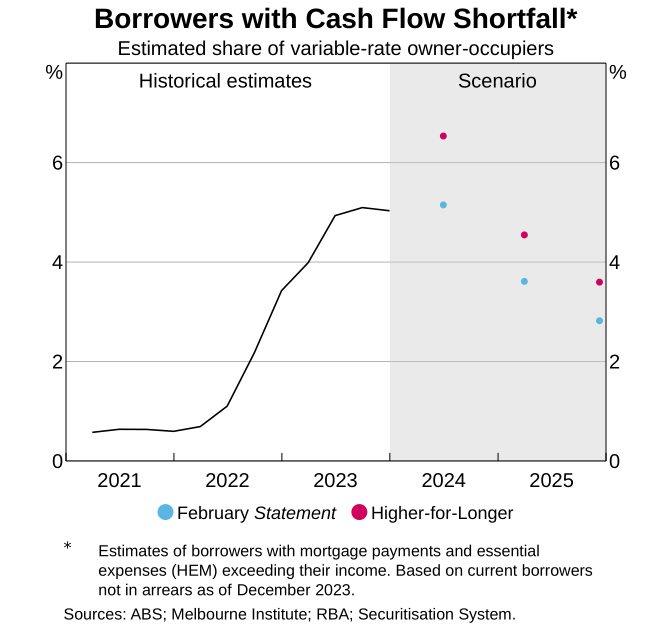
Most borrowers are projected to have sufficient income to meet their debt-servicing obligations
and other essential spending needs out to 2025 even if interest rates were to increase by another
50 basis points. The Higher-for-Longer scenario raises the share of borrowers
estimated to have a cash flow shortfall by around 1 percentage point compared with the
February Statement scenario for 2024 and 2025. The share in the
Higher-for-Longer scenario is estimated to peak above 6 per cent in mid-2024, before
declining below the December 2023 estimate by the start of 2025 (Graph 4.1.1).
Graph 4.1.1
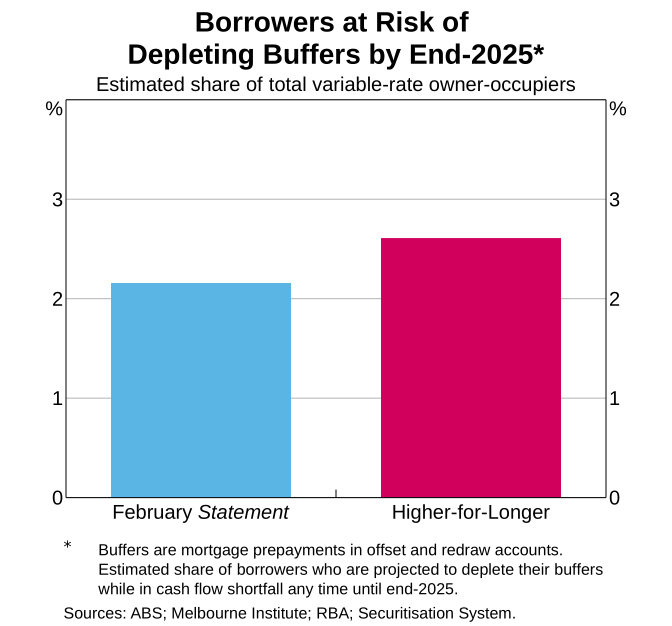
Despite greater budget pressures under the Higher-for-Longer scenario, we estimate
that less than 3 per cent of variable-rate owner-occupier borrowers would be at risk of
depleting their liquid savings buffers by the end of 2025. This is around ½ a percentage
point more than under the February Statement scenario (Graph 4.1.2). In addition, the
estimated shares under either scenario are unlikely to translate fully into increases in mortgage
defaults: many of these borrowers could still make other – often difficult – adjustments.
These could include increasing their hours of work, temporarily reducing some expenses or – as a
last resort – selling their property. These adjustments may not be available for some borrowers,
including those with lower incomes and greater leverage. However, this does not affect our current
overall assessment that financial stability risks from housing lending remain contained (see Chapter 2:
Resilience of Australian Households and Businesses).
Graph 4.1.2
Most listed companies are expected to remain well placed to continue servicing their debts under both
scenarios.
Methodology
We assess the resilience of indebted listed companies by evaluating
their ability to service their debts under the different scenarios. To do so, we use
business-level data covering non-financial listed companies – which tend to be
larger businesses – to estimate the (debt-weighted) share of businesses with
earnings less than double their interest expenses. This is equivalent
to an interest coverage ratio (ICR) less than 2, which is indicative of weaker
debt-servicing capacity and, historically, has been associated with an increased risk of
insolvency.
In contrast to the exercise conducted for mortgagors, we do not allow for
full pass-through of changes in interest rates to businesses interest expenses. The
rate of pass-through is determined by how quickly businesses debt and hedges
mature and thus need to be refinanced at potentially higher interest rates. Businesses
can take actions to reduce pass-through – by, for example, reducing the duration of
new debt issuance (as interest rates on fixed-rate debt usually increase with maturity)
or deleveraging. We apply a pass-through rate of 40 per cent after around two
years, based on historical experience. For simplicity, we apply the
same interest rate increase to all businesses and hold earnings constant.
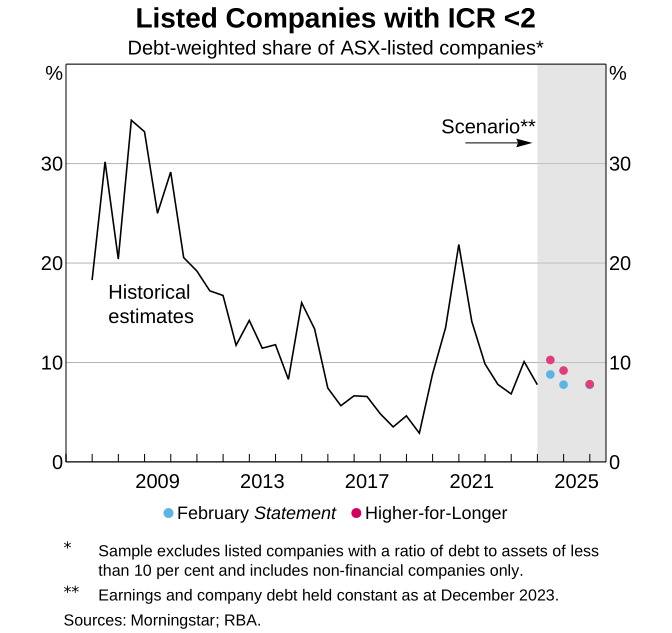
Across both scenarios, the share of companies more at risk of debt-servicing challenges is little
changed over the next couple of years (Graph 4.1.3). The share of listed companies
projected to have an ICR less than 2 is only moderately higher under the Higher-for-Longer
scenario than under the February Statement scenario and, under both scenarios, it remains well
below its peak during the global financial crisis (GFC). While our analysis assumes firms earnings
(the other component of a firms ICR) to be constant under both scenarios, the findings are little
changed when allowing for some decline in earnings.
Graph 4.1.3
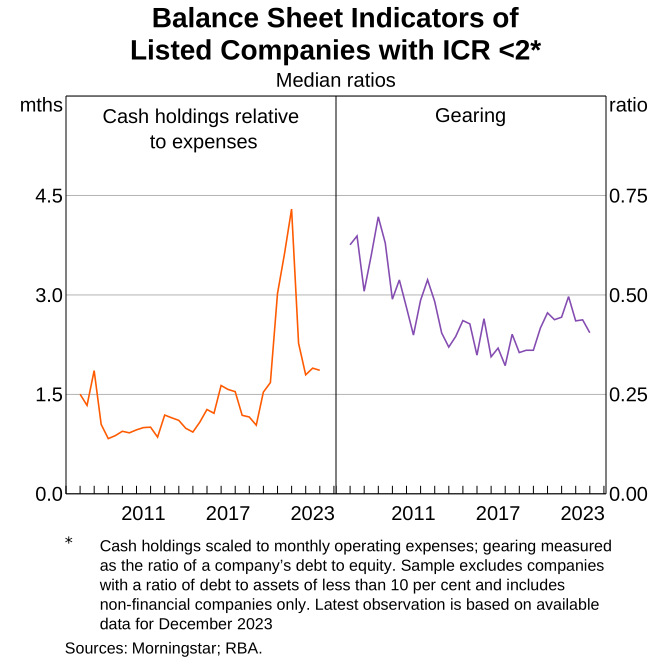
Additionally, strong balance sheets limit the risk that these firms will experience severe
financial stress in either of these scenarios. Cash buffers (relative to expenses) are
double the pre-pandemic level, and indebtedness has been relatively stable among those firms currently or
projected to have an ICR less than 2 under both scenarios. Cash buffers have declined from pandemic
peaks but are still well above pre-pandemic levels (Graph 4.1.4, left panel). The
decline was driven by strong growth in expenses; cash holdings in dollar terms have remained at pandemic
peaks for most firms. Information from the Banks liaison program suggests cost pressures have eased
for some companies and many are stepping up their focus on cost-cutting measures. Gearing – which
measures debt over equity – has declined since the GFC (Graph 4.1.4, right panel).
Furthermore, firms with a projected ICR less than 2 in our scenarios typically have lower gearing
than other listed companies with higher ICRs. Consistent with relatively low indebtedness, half of those
firms projected to have an ICR less than 2 can fully pay off their short-term debt with their liquid
assets.
Graph 4.1.4
We do not have timely balance sheet data to allow for a similar analysis of indebted smaller
businesses, but banks small exposures to these businesses limits risks to the financial
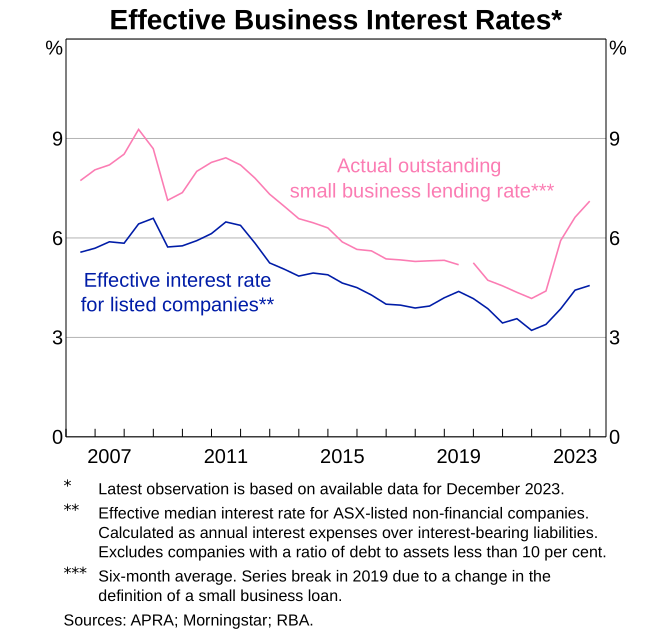
system. Small businesses are more vulnerable to an increase in interest rates than larger
ones as they have higher earnings volatility and lower cash buffers. Effective interest rates have
already risen considerably among small businesses. Since 2022, the outstanding small business lending
rate has increased by nearly 300 basis points, more than double the increase for listed companies
and close to two-thirds of the increase in the cash rate (Graph 4.1.5). As a result, these
businesses have already been facing higher interest expenses. Consistent with this, liaison with banks
suggests there is relatively more stress among smaller businesses, although loan arrears remain low.
Smaller businesses have also accounted for the bulk of the increase in business insolvencies since 2022.
Loans to small businesses account for only around 6 per cent of bank loans, and, as a result,
risks to the financial system from this lending activity remain low. Some businesses, particularly
smaller ones, also obtain credit from non-banks, whose share of business credit has continued to
increase. However, risks to the financial system from this lending activity remain low as non-banks
share of lending remains small and banks have limited exposures to non-bank lenders (see Chapter 3:
Resilience of the Australian Financial System).
Graph 4.1.5